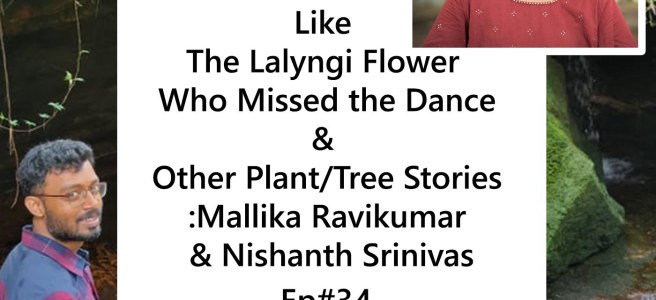
How the Teak Tree Tilted the Course of History in India and Other Stories.

With Mallika Ravikumar and Nishanth Srinivas

Episode #34 Heart of Conservation podcast. Show Notes (Edited)

or listen here.
Mallika Ravikumar
Nishanth Srinivas

0:03

Lalitha Krishnan: Hey there. I am Lalitha Krishna and you are listening to episode #34 of Heart of Conservation. Today I am speaking to two plant and tree lovers, basically tree experts. I find it so fascinating to listen to folks who are passionate and knowledgeable about the things that they love. Some of the fauna we are going to discuss are everyday plants and trees we pass by or sit under or love for their fruits and flowers, but truly we barely notice or know much about them. I promise you some extraordinary insights, botanical facts, myths, history, personal stories and more, on this episode.

0:47

My guest Mallika Ravikumar is a lawyer-turned-writer. She writes about history, culture and nature and has authored over six books mostly for children including one called ‘Tracing Roots’.  She also has her own ‘YouTube’ channel called ‘Tree Talk with Mallika Ravikumar’. You’re very likely to have watched her on Instagram but you can check out more about her work on her website https://mallikaravikumar.com/

1:12

I have also been following ‘Trees of Shillong’ on Instagram which belongs to Nishanth Srinivas, my other guest.  Nishant has a Master’s degree in Biotechnology from Bangalore University and worked as a Junior Research Fellow at the Department of Molecular Reproduction, Development and Genetics at the Indian Institute of Science.  Having changed course, he is now based out of Shillong, and is working with an NGO called Conservation Initiatives. He specializes in satellite mapping and is interested in human–elephant interactions and landscape ecology. I believe Nishanth loves, doodling, graphic design, and writing and staring at tree canopies. I have a feeling that is true of both of my guests.

1:47

Mallika, and Nishanth thank you both for joining me on Heart of Conservation. I am really looking forward to your stories.

Mallika Ravikumar: Thank you, Lalitha for having me.

Nishanth Srinivas: Thank you so much for having us Lalitha.

2:02

Lalitha Krishnan: My pleasure really. To start with, why don’t you briefly tell me about the fascination for trees? Mallika, why don’t you go first?

2:12

Mallika Ravikumar: I grew up in Mumbai which as you know is a city with a lot of people, with a lot of concrete. Trees are not something you think about or associate with Mumbai. I grew up like any city person, knowing very little about trees and then I happened to shift into a place where I was surrounded by trees. I was very curious; I felt very bad that I didn’t know… I couldn’t recognize most of the trees around me. I didn’t know their names. It made me feel like something was off because I knew from what I had learnt in science and textbooks that we get our oxygen from trees. We get our food from trees. Trees are such an important part of regulating our environments so the role of trees in textbooks I was aware of, but I was not able to identify more than a handful of trees which made me feel very awkward. That started the process of making me want to learn, and enroll for field botany lessons during weekends at BNHS. I went for some field trips with botanists and ornithologists, to learn about birds and flowers and things. And, that took me down the rabbit hole and that learning process is still on. So, that’s how it all began.

Lalitha Krishnan: The learning process for all of us will keep going on I hope.  What about you Nishanth?

3:31

Nishanth Srinivas: My story is not much different from what Mallika’s story is. I am also from the city; I am from Bangalore. Just like she mentioned, trees give us oxygen. I remember when I was so concerned about the environment, reading about all of this. The thing is during summer holidays, the best most outdoorsy thing that I would get to do is go to my grandparent’s place. They had a very big garden and they were every possible fruit tree there. This started my love for gardening. It started with gardening and I took a different route. I studied biotechnology and I happened to work in the Indian Institute of Science. And there, there were more trees and they have a 400-plus acre filled with trees. And, all my free time would be spent observing trees, canopies… Eventually, somewhere, that fueled my change to a different profession and now, I’m in conservation and I actually started observing trees beyond what is there in the city. And, that’s how Trees of Shillong was born and here we are. Right.

Lalitha Krishnan: It’s amazing how the ‘outdoors’ draws us out of our shelters.  One of my podcast guests, Suniti Bhushan, introduced me to the concept, not his concept of ‘Nature Deficiency Syndrome’. Still, I would like to hear from you; why do you think tree stories are important? Nishanth, do you want to go first?

Nishanth Srinivas: Tree stories or stories in general related to myths or folk stories I believe are very important. Coming from a conservation point of view, whenever we approach a place or a region to understand what are people’s beliefs and how they connect with their culture, it usually starts with understanding or trying to make sense of their surroundings. And most of this is usually in the form of folk stories. There might be biases as conservationists so I try to bring in this idea of conservation a lot. And even in my stories when I write about Shillong, I usually end it with two lines about conservation which is very much the need of the hour. So, the thing is these stories need that. As a researcher and conservationist, they give me an understanding of the local context and how people relate to it and some sense of the relation of how they understand and make sense of the nature around them.

As a researcher and conservationist, they give me an understanding of the local context and how people relate to it and some sense of the relation of how they understand and make sense of the nature around them.

-Nishanth Srnivas

Lalitha Krishnan: So true. Mallika?

6:21

Mallika Ravikumar: Yes, very similar to what Nishanth said. In a country where we are such an ancient culture-we have such a plethora of stories and folk tales, myths, and legends about trees from various backgrounds: Hinduism, Buddhism, Islam… In every tradition, some people consider trees sacred. There is an association with them. I think, going into the psychology of it, people’s actions are not based on reason alone. Although we would like to believe we are rational, reasonable people, intelligence plays a very important role in how we behave but reason is only one of the faculties we use to make decisions. The other huge factor is emotion. Many things we do in our life–the decision to marry somebody, the decision to follow a certain career—it is based on hope and dreams and are also mixed with emotion. It’s not ‘reason’ alone that guides us. So, pummeling people with facts alone—you know, “trees give us oxygen, trees regulate the environment” — all this appeals to a certain side of us but all these legends, myths, folktales, and rituals and traditions; appeal to the emotional side of us. Which is also a very important part of human decision-making and psychology.

So, I think they have a very important role. Sometimes, I think emotions play a larger role when I connect with a tree or plant or pet dog emotionally, I feel much more to protect them and save them than if I connected with them academically or you know, intellectually. So, I think they play an important role in the way people behave in general.

8:05

Lalitha Krishnan: OK. And from a male point of view, Nishanth, do you also feel the emotional connection?

8:13

Nishanth Srinivas: Yes, very much so. The whole point of why we are very interested in learning and trying to talk about myths… is generally when we have a conservation or do a presentation, it’s to have that emotional connection. When we speak of myths and folk stories, they also reveal a lot about the culture and they trying to make sense so yes, the emotional aspect makes a very good point. It’s important.

8:33

Lalitha Krishnan: Thank you. This question is for both of you. So, how many trees are you going to share with us today?  Mallika if you would like to start, you can tell us some interesting facts that you like and then a myth.

8:57

Mallika Ravikumar: Sure, how many trees? There is no answer to that. It can go on endlessly but I would be happy to start with a tree that I talk about a lot which is the teak tree which is an Indian tree. It’s called ‘Saagaun’ in Hindi, and Thekku maram’ in the south. In fact, the word ‘Teak’ itself comes from the word Thekku maram’ which is in Malayalam, and before that in Tamil. It is a tree that changed world history. We have this human-centric way of looking at history and saying, “This king changed history, this general, Alexander the Great, Akbar the Great, Chandra Gupta Maurya; they did this…and they changed history…” But really, so many of these trees if they could speak, would tell you that they are the ones who changed history and changed the course of time. So, teak is one of those trees you know.

But really, so many of these trees if they could speak, would tell you that they are the ones who changed history and changed the course of time. So, teak is one of those trees you know.

-Mallika Ravikumar

9:45

There is this period in history in the 16th and 17th centuries that was called the period of Teak Rush, which was a time when the French and the British were engaged in several battles before and during Napolean’s time when the British were very wary of the rise of Napolean because he was a big threat. And, they had completely decimated the oak trees of England to build ships. And we all know the British were able to control a large part of the world because they had a great navy. And what was the basis of their navy? Their ships. And what were their ships made of? Wood. But their oak forests were completely decimated because of the ships they had built in conquering various places and they were on the lookout for wood to build their ships. That is when this period of Teak Rush comes in when both the French and the British are on the lookout for wood for building ships. Because all these battles that used to happen were naval battles. And by chance, it is the British who discovered the teak forests of southern India and then they brought in forest laws to control all our forests. The conservation laws that we have today didn’t start as a measure of protecting the forest as much as wanting to control the resources from the forest.

And what is the main resource they wanted to control? Teak. They had scouts going out to look out for these teak forests. They massacred these forests, they had teak plantations, they converted large forest areas into monoculture teak plantations and it is the teak that they got that helped them get this hegemony and control larger parts of the world. So, it titled the scale of history. We are having this conversation in English today because of teak otherwise we might have been talking in French. Who knows? But it’s teak that changed the tide that was the bedrock of the British empire. So, that’s just one of the many stories that changed our past and continue to shape our present.

11:37

Lalitha Krishnan: That’s amazing. Frankly, I did not know of this. I have only heard of the Gold Rush, not the Teak Rush. Nishanth, what plant, or tree are you bringing home to our listeners?

11:41

Nishanth Srinivas: Well, I thought of four plants but one tree which is very common to our listeners which we all know; it is very common is the coconut. I have always been intrigued; there was a coconut tree near my home in Bangalore, in my neighbour’s house and it stood tall. In 2018 we had very terrible rains; very cyclonic. There were a couple of trees which fell but this one tree did not fall. You do not hear of many instances of coconut trees falling and if you follow the weather channels you will always see that when they talk about coasts or rain in the weather reports, you will always see some palm trees flaying around but it’s not usually uprooting away. I always used to think about why and it is very interesting how coconut trees have adapted to live in a coastal region where geographically, it is quite flat. We know that when the winds come in, they pick up rain, and the first thing they will encounter is the coast. So, how these trees have adapted is quite interesting.

13:00

First of all, the shape of a coconut tree is a tube-like any other palm tree. And if you observe the bottom of the tree, it is a little wider at the bottom than the top. Very marginally. And, the top region of the tree, the crown as we call it is quite flexible. That is one. We have all seen Bahubali (the movie) where he uses the palm tree to make it so flexible that it is wind-borne and things like that. Though, palm trees are not that flexible but the top region is. So, it sways when there is a lot of wind movement. That is one.

13:39

When we talk about the inside structure of the coconut tree… it is a monocot. Monocot trees do not grow by girth every year and it’s made up of spongy tissue inside. It is so much like a concrete mould and is reinforced by lignin fibres. These fibres run longitudinally along the length of the coconut trees so they are fill which is inside the concrete. It provides structural stability to the tree. That is one.

14:11

The other is the roots. We have all seen the roots. These roots are fibrous. They go in every direction and they hold the tree in a place like any other (root system).

14:25

Last but not the least is the frond. So, the coconut tree is almost feather-like; it is pinnate. So, it has a central big stem called the Rachis. So, most of the very tall palm trees have feather-like leaves. So, these are some of the very interesting adaptions that I came across when I was trying to understand how the coconut tree stands cyclones.

14:51

Lalitha Krishnan: Wow. You explained that well. I also believe every part of the coconut tree can be used. Am I right?

15:00

Nishanth Srinivas: That’s true. That’s one of the reasons why it is called ‘Kalpavriksha’ I guess. Mallika would have many more stories about it. But interestingly, since coconut trees are there in the tropical regions all around, there are multiple stories of ‘how’ or ‘what’ when it comes to the folk stories. Each culture or region has its own take on it. It is quite interesting.

15:25

Lalitha Krishnan: O.K. Would you like to share that?

15:30

Nishanth Srinivas: I will quickly share two of them. One of them is from Hindu mythology itself. When Ganesh was very small, he wanted to play with the third eye of Shiva. And then, I guess, one of the demons if I am not mistaken a small model/idol with three eyes and gives it to Ganesh. By mistake, this small idol falls from Ganesh’s hands and falls on earth. They say that’s how coconut came into existence or how mankind found the coconut.

16:04

That is one of the stories. There is one more very interesting story—again similar to this—the three eyes. When you de-husk a coconut, why does it have three eyes? This story is from the Polynesian culture- Hawaii, Melanesia, New Zealand and all of those places.  They say, in an ancient island there used to be a chieftain’s daughter. Her name was Sina. She used to always visit the sea and she sort of became friends with an eel. This eel over time developed feelings for Sina. And it became very violent as time moved on; wanting more of her time and affection. But then, she goes back to her village and complains about this eel which is sort of always stalking her. And then, one of her relatives goes and kills the eel. Before dying, the eel’s head speaks. It tells Sina to bury the head in the sand and that it will be reborn as a tree whose fruit Sina can drink. The three holes are where the coconut shell is the lightest. So, every time, you break it open and drink, it’s like the eel kissing Sina. That’s what the story says. These are different stories and they talk about (lost in translation).

17:30

Lalitha Krishnan: Lovely stories. Mallika, would you like to share another one?

17:33

Mallika Ravikumar: Sure, I can talk about a plant which is not a tree but a lot of people think it is a tree which is the Banana. You know, in usual parlance, we say banana tree or kela ka jaad or vāḻai maram in Tamil. Botanically, it is not a tree and the reason is- for a plant to be considered a tree, the key feature is the wooden trunk. And the banana, if you notice closely, does not have a wooden trunk so it is not botanically a tree, although we all call it a tree.

Botanically, it is not a tree and the reason is- for a plant to be considered a tree, the key feature is the wooden trunk. And the banana, if you notice closely, does not have a wooden trunk so it is not botanically a tree, although we all call it a tree.

-Mallika Ravikumar

18:03

There’s this interesting story from the Gadabas tribe of Odisha which I like very much. So, the story goes that there were five sisters. They were the mango, the tamarind, the fig, the jamun and the banana. As they were growing older, their father was getting worried that they weren’t getting married and he wanted to find husbands for each of them. So, he asked them what kind of husbands they wanted and they all told him. And, he looked for such partners for them but the banana said, “I want children but I don’t want a husband.” This is a very modern, feminist sort of story so I like it for many reasons. She said, “I want children but I am very clear I don’t want a husband.” So, the father grew worried. “How is this going to work?” But the other girls got married and they had children and it is said that all the mango and fig, tamarind and jamun trees that we have are descendants of those children. But then what about the banana? She said, “I don’t want to marry but I want children.”

19:00

The thing is as per the story the banana had children without a husband. The beautiful thing about this story is that bananas reproduce parthenogenetically which is asexual reproduction. In botanical terms, if one were to study that there are two forms of reproduction: one is sexual, and one is asexual; the way the banana reproduces by bypassing the fertilization of the ovule by the pollen is sexual reproduction. And it is fascinating to see that this ancient folktale has captured that in such a simple way. Those daughters wanting to marry and one daughter saying, “I want children but I don’t want a husband.” And to see that very astute scientific observation finds reflection in this folktale. So, I find it very fascinating for many reasons including the fact that it’s a sort of modern, feminist sort of take on life. But, yeah, this is a fascinating story about the banana that I shared on my YouTube channel where I share these sorts of stories that I find.

20:02

Lalitha Krishnan: Fascinating. I agree with you. How on earth did they figure it out then? Nishanth, it’s your turn. Another tree, another plant?

20:10

Nishanth Srinivas: One more tree that is quite common in Bangalore gardens is Nyctanthes arbor-tristis. It’s called parijata. It’s also called night jasmine though it does not belong to the Jasmine family. Again, according to legend, what happens is this tree also comes from the churning of the milky ocean. The demons and the gods churn up the mountain. And then, from the ocean arises this tree and Indraloka who plants it in his garden. Once, Narada,–who is usually a mischief-monger—takes some of the flowers from Indira’s garden and gives them to Krishna. And, Krishna goes and gives it to Rukmini, his wife. Having known this Narada being Narada, he goes and tells Krishna’s other wife, Satyabhama, that Rukmini got these heavenly flowers and Satyabhama becomes quite jealous. So then, she asks for the whole tree and so Krishna goes and steals the tree. En route, when he is coming with the tree, he is confronted by Indra and a battle ensues. Eventually what happens is Indra curses the tree such that it never produces fruit. Interestingly, this parijata does not produce fruit. It belongs to the Oleaceae family. It produces a heart-shaped capsule. Oleaceae is the olive family- the olive fruit. So, this does not produce that. It just produces the capsule. And, this is a little bit of humour: he (Indra) says that the owners where this plant is will never get the flowers. What I have observed is that in Bangalore morning time, around 6:00 or 7:00 o’clock, you see all these people coming to pick these flowers and usually the flower never falls in the garden where it is planted but usually falls on the roadside. ( lost in translation )These are some of the things that I find nice. Also, it brings the thought –as we discussed- we don’t know what came first. This or that but it is people trying to make sense of what they observe in nature and putting it into some sort of context.

22:55

Lalitha Krishnan: Very interesting. I can relate to this. I never get any of the fruits or flowers that I plant. They all go mostly to the monkeys. But I don’t feel cursed. I feel privileged. I think it’s the tax one pays for having wildlife around. Mallika, what next?

22:17

 Mallika Ravikumar: The story that Nishanth related…I had a parijat growing in my house and it was exactly like that. The plant was on one side of the fence and the flowers were falling on the building on the other side of the fence. That story also has another element. You know when he brings back the tree, Rukmani is very upset and says, “Why did you give Satyabhama the tree?” So, Krishna being very smart, plants it in a way that Satyabhama is happy to have the tree but the flowers come to Rukmani’s side of the garden because he knew that then both his wives were happy. These folk stories have several narratives or variations. So, that’s also very interesting that someone has heard one part and you hear another part. This is a version of the story that I had heard but yes, it’s a beautiful tree and flowers and a lovely story also.

These folk stories have several narratives or variations. So, that’s also very interesting that someone has heard one part and you hear another part.

– Mallika Ravikumar

24:12

Another tree with lovely flowers that I can think of is the silk cotton tree- the semal. This story comes from the Mahabharat. This story is narrated by Bhishma when he is on his bed of arrows; when he is about to die all the others come around him, asking for advice and ask various questions. He narrates this story when he is asked about the qualities of a good king. How must a king behave when a neighbouring king is stronger than him?  What is the diplomacy and relations one must have? So, he narrates this story of the silk cotton tree.

Nishanth mentioned Narada so this story struck me. Narad Muni, as he said was a troublemaker. He is walking along a forest and he comes upon this beautiful silk cotton tree and he is absolutely stunned. He says, “You know, you are so gorgeous and your flowers are so beautiful, how is it that you are still standing like this? “The wind is blowing so hard over here; all the trees are bent; all the leaves have fallen because Vayu has blown with such force but you seem to be unaffected by Vayu’s force. How is it possible? So, the silk cotton replies saying, “You know Vayu may be strong for the others but I am stronger than Vayu and what do you think? I can’t bear the brunt of the breeze?” So, he boasts about how strong he is and Narada is sure that if the wind really wants to blow something down, nobody can stand in its way so he being a troublemaker, goes back to Vayu and says, “ You know there is this proud silk cotton tree in the forest who thinks it is stronger than you and I find it laughable.”

Vayu of course says, “That’s ridiculous. I spared the silk cotton tree because when Brahma created the world, he rested under this tree and therefore, I have respect for this tree and therefore I don’t blow on it. But, if the silk cotton tree is going to interpret this as my weakness, let me show him how strong I am.

26:04

He says, “I’ll show him how strong I am tomorrow. But that night, the silk cotton thinks and reflects and looks at all the trees around and thinks, “If all these trees are bent and turned over, and leaves have fallen and they are all facing Vayu’s impact, surely it can’t be that I am so strong that I am stronger than Vayu.” So that night, the silk cotton tree decides that before Vayu comes, let me myself, drop my leaves and flowers so that when Vayu comes tomorrow, he cannot inflict any damage on me. So, the next day, when Vayu comes blowing fiercely down the mountainside, the silk cotton has nothing left. No leaves or flowers. Nothing is left on the branches. He says, “I am glad that you learnt the lesson to be humble. Now shorn out of your beauty, you have realized that you don’t need to show off many times. People are being gracious and nice to you and it’s not all about how strong you are.” So Bhisma is narrating this story to say that you have to accept that someone is stronger than you and not be futile and say, “I can take on anyone.” If your neighbouring king is stronger than you, then accept and be humble and bow before him. That was the context of the story.

27:17

But I use this story when I take children out for tree walks to tell them about leaves falling. And, why some trees are deciduous and some trees are evergreen and have you noticed leaves falling? So, if you just start off with deciduous and evergreen, kids sort of get put off. But if you start with a story, it becomes a point of generating curiosity and then they start noticing which trees around them are dropping leaves. Some kids have come back to me and said, “Aunty, we remembered this story from the Mahabharat when you told us when we saw this tree outside our school which was dropping leaves. So the important thing is also to connect kids with trees around them because it’s a way to generate curiosity.

27:56

Lalitha Krishnan: wonderful. I am feeling like a kid listening to your stories. Nishanth, why don’t you tell us more? What’s your next tree or plant of choice?

28:08

Nishanth Srinivas: The next is a plant, a type of ginger and this takes forward what Mallika said. Some of these stories and myths also serve a purpose to teach kids or the younger generation something. There is some moral behind it. This story is about a type of rock ginger. Rock gingers have very showy flowers and they are quite common in the Himalayan region. It’s called butterfly-ginger, butterfly rock ginger- it’s got different names but they have very showy flowers and they are quite common in and around the Himalayan region. This particular plant, its scientific name is Hedychium gardenarium.

Since I work in Meghalaya, this is one story which came to me from one of the museums that I visited here. So, they have this plant and they have this story along with it. so, in Khasi, this plant is called Ka tiew lalyngi. ‘Lalyngi’ which I understand must be the name and ‘tiew’ is flower. There is a saying, “Wat long tiew lalyngi pepshad” which roughly translates to: “Do not be late like the Lalyngi flower who missed the dance.”

29: 31

So, the story goes that there was a great feast. There was a huge tree called the lei tree. I am sure I am pronouncing these things wrong but if someone knows the correct pronunciation, please get back to me. This large tree was blocking out the sunlight and that itself is a different story. Eventually what happens is that people cut it down and there is sunlight again in the land and there is a celebration that happens. So, to celebrate, all the creatures that is animals, people, birds, and insects were invited to a great dance in the region of Meghalaya. So, what happens is there’s also this girl who is invited. Her name is Lalyngi. She’s a very beautiful young girl and she happens to come.  But the thing is she wants to look the best. What she does is she takes a lot of time to get ready. In that process of getting reading, she loses track of time. So, by the time, she reaches the dance arena, she finds the event is already over and she is quite upset by it. Because nobody is there to see her after all the effort she took. She is so upset she jumps off the cliff and dies. Where she dies, a flower is born and that flower is the Hedychium gardenarium.

The thing is, this flower is so much part of the culture. If you have seen the Khasi dress, they wear these Paila beads which are mostly in shades of golden yellow and red. And, this flower has stamens which are of the same hue of red. And the petals are yellow. In some sense, they feel it is part of their folk story. Most of these stories are oral; part of the oral tradition they have here in Meghalaya. Stories that are passed on through generations; something which they feel is one of their own which tells something about their culture. And, interprets some sort of moral lesson to children to prioritize and give importance to things when they are doing something.

Stories that are passed on through generations; something which they feel is one of their own which tells something about their culture. And, interprets some sort of moral lesson to children to prioritize and give importance to things when they are doing something.

-Niahanth Srinivas

32:12

Lalitha Krishnan: Wow. That’s a sad but beautiful story but also such an exotic flower.

32:21

Nishanth Srinivas: It is. Google it and see.

32:28

Lalitha Krishnan: Mallika, would you like to share another story or plant if you like?

32:33

Mallika Ravikumar: Another commonly seen tree in India is the Neem. This is not a story that comes from myths or folk legends. It’s a historical, current affairs kind of story. Where, as we all know, the neem has been traditional medicine in India for centuries. From ancient times to now, we have all experienced how if you had chickenpox, were told to have a bath in neem-leaf water or brush yourself with neem branches to heal.

33:10

Generally, if there’s a neem tree around you, one considers mosquitoes won’t come into your house. Neem is just part of growing up in India. You keep hearing the healing properties of neem. Some decades ago, in the US this company was granted a patent for the use of the neem in their pesticides or herbicides for controlling pests in plants. And, they also applied for a patent in the European patent office and fortunately, this was highlighted and India opposed that.  The Indian Council of Scientific Research opposed that and this is Traditional Knowledge. A patent as we all know is a special right given to you if you have invested in researching something and you have come up with something very novel, and it is original and it’s of use to people. Those are the considerations for a patent. But here is someone asking for a patent for something that was commonly known. Haldi is another one. Basmati, as we know, we also got a patent some time back. So many Indian plants, some of them medicinal whose healing properties have been common knowledge—even illiterate, uneducated—everybody in India knows about the healing properties of these plants. You don’t need to be a doctor or anything.

34:17

And, you get a patent for that where you are claiming that you have something original and useful and novel was something that India opposed and that patent was finally revoked after a lot of appeals and several processes. What it highlighted was something called Biopiracy. Piracy we know that if you film a movie in a theatre and you release it and make money out of it, is called a pirated copy of the movie or a book. Because it is making money out of somebody else’s creativity without giving them their due.

34:50

But, this idea of bio-piracy became a taking point after this Indian Neem incident of biopiracy and India then woke up to the fact—even till now, several of the patent applications made by pharmaceutical companies in the West are based on traditional knowledge of ancient cultures including India. And then fortunately this was taken to serious levels. There was this body called the Indian Traditional Knowledge Systems and a database was formed where if someone in the US applies for a patent for, let’s say haldi, obviously they might know this is traditional knowledge in India… But the Patent Office can then search in this database where you have all these plants that have been recorded as traditional healing plants in unani, ayurveda, siddha etc. and it will show up in the search at the patent office. At least in the future, private enterprises will not given rights– exclusive rights—for traditional healing plants of common knowledge in India. It all began with the neem biopiracy case that triggered all this. That’s not a legend or a myth but an interesting story, especially something to be aware of this is a huge amount of traditional knowledge that we are sitting on and some people are using it for private gain. We should be aware of it.

36:14

Lalitha Krishnan: Very true. And biopiracy is a new one for me. And I doubt they are trying to get patents for anything innocently.

36:28

Mallika Ravikumar: Absolutely. There was a very interesting article that I read. In Covid times, a lot of plants were getting stolen out of our botanical gardens. Orchids. Nishanth is in the north-east. He will know better. Orchids are disappearing in the northeast. Some of them are threatened species because there is this craze for owning these exotic plants and keeping them in your gardens and your house. The West has always had this craze but even today it is there. We talk about the tiger and the elephants and big mammals, birds etc. when they are threatened but a large number of species on the IUCN list are actually plants. Many of them are Indian plants. We somehow don’t highlight them because they are not as dramatic as the tiger and elephant and so on. But they are also part of threatened species.

We talk about the tiger and the elephants and big mammals, birds etc. when they are threatened but a large number of species on the IUCN list are actually plants.

-Mallika Ravikumar

37:14

Lalitha Krishnan: Butterflies too…from the northeast. Thanks for sharing that, Mallika. Nishanth, would you share some more?

37:21

Nishanth Srinivas: Yes. Mallika has given me segways into different things… She mentions the US and how plants are collected and taken to different places. One very common plant which was reversed from the New World to the Old World is scientifically known as Euphorbia pulcherrima. It’scommonly known as the Christmas flower. It’s these red bracts; it’s almost like bougainvillaea. It usually flowers during Christmas time. I’m sure both of you are familiar with seeing this plant. It’s very common. Especially in the western ghats, it’s grown as a hedge around coffee plantations etc. Here in Shillong, it’s quite a common garden plant.

38:14

Though this plant is a showy ornamental plant, it’s got a very nice and interesting story. And, it highlights something which I shall share at the end. It’s also commonly known as the poinsettia. The thing is even the names: Why poinsettia? Why Christmas flowers? It has a nice big story to it. This plant is native to the dry forests of Mexico, basically central and northern South America.

38:50

During the Aztec civilization time, this was also a plant of high cultural importance.  In Aztec, it was known as cuetlaxochitl which translates to ‘a mortal flower that perishes and withers but is all pure. Apparently, in Aztec legend when it was formed it was white. And, because of the war between two different tribes, the flowers become red.

39: 26

So, the Aztecs would plant this around their habitations or wherever they had their cities and stuff. But we know a little bit about their history and how the Europeans started coming and colonizing the West. So, what happens is, that when the people/missionaries came into the region in the 17th century, they noticed these plants. They sort of took this aspect of how important this plant was and made it part of the Christian culture. How they did this is quite interesting.

40:10

There is one interesting story. In Spanish, this flower is called Flor de Nochebuena which translates to “flower of the Christmas eve.’ The story is all about a girl named Pepita. I am sure you’ll be aware that during Christmas time, they make a manger which is a model of the birth of Jesus/ nativity scene. This girl comes from a very modest background. The story goes that all the people go to the church to offer something to baby Jesus. Everybody is trying to get the best thing to give as an offering. Being of a modest background, she tries her hand at many things. She tries to knit a shawl but she can’t untangle the wool. She then tries to make small boots for baby Jesus but she doesn’t even have the strength to push the needle through the leather.

41:29

She gets quite upset and a stranger comes up to her and tells the young Pepita, “Even if you offer anything with a lot of devotion, it will be accepted.” So, she goes around and gathers a bunch of leaves and twigs and she offers them at the church.  What happens is, magically over time, these greens she has picked, turn red.  This also goes back to the plant as I was saying. They are not flowers but like bougainvillea, they are red bracts. The flowers themselves are quite small. The story weaves the aspect of those and also them coming into flower during winter time around Christmas. That is what I found interesting; it gives a reference point. Some of these myths and stories may stay but this is how some aspects get introduced and become one of their own. So, that was what this story represents to me.

42:45

The word ‘poinsettia’ is also quite interesting. Mallika mentioned how people collect plants. There was a person called Joel Roberts Poinsett who was very much into collecting plants. He was from the US and was working as an ambassador to Mexico sometime in the early 19Th century. When he was there he collected these plants and sent them to the botanical gardens. In honour of him having introduced this to the western plant per se, it got the name, poinsettia. In political terminology, there is a term called poinsettismo which represents a kind of diplomacy which the US follows. Which is very intrusive. It represents how the US is or functions with other countries which they trade with.  This tells us also how words are derived, how there are stories are attached to them and what the roots of the stories are. This is an example of a plant being behind one such name.

44:09

Lalitha Krishnan: Thank you.

44:19

Mallika Ravikumar: I was about to say, I learnt a new word. Poinsettismo. I am going to look it up and read more about it.

44: 27

Lalitha Krishnan: The association is still there. I remember 2 Christmases ago; I gifted a poinsettia to someone.

44:36

Nishanth Srinivas: It all came from one small town in Mexico and got sent to the Philadelphia Botanical Society and from there, if I am not mistaken, just one company had world domination. And, they sent this poinsettia to different parts of the world. So, all of them probably have one or two mother plants if I am not mistaken. That’s how it is.

45:09

Lalitha Krishnan: Thank you so much. My last question to you both—and I feel almost guilty asking you this question—because both of you have already introduced so many new concepts and words but I am going to ask anyway cos this is how I always end my podcast.

Could you share something about trees or plants that is new to us or significant to you in some way?   It could even be about your relationship with plants.      

43:35

Mallika Ravikumar: Before that, can I add to something that Nishanth said which reminded me of something else?

45:40

Lalitha Krishnan: Of course:

45: 42

Mallika Ravikumar: Nishanth said how beautifully the idea was told to the girl: “You offer something with devotion and that is the most important thing”. There is a mirror story of that even here. That is one of the stories that I thought I could narrate but we don’t have time. This is the popular story of Shabri and the ber—the Indian jujube—where you have, shabri picking ber fruits from the tree and offering them to Ram. It comes from the Odhiya Ramayan. It’s not in Valmiki’s Ramayan. And, that became a very important story in the Bhakti movement to cut across barriers of caste and varna… In the Odhiya Ramayan, he accepts this jhutey ber as they say. She has tasted the ber, tasted the fruit to see if they are sweet and gives it to Ram. Laxman says, “I cannot eat this but Ram says, “Anything offered to me with love and devotion is acceptable and nobody is small or lesser or greater and I will take anything that is given to me with love and devotion. That is exactly the mirror story of what he mentioned. So, in every country, or culture, I guess you have such stories and it is really beautiful to study these parallels. Even in the Bhagvat Geeta, you have a slok/verse which is exactly that. “Patram pushpam phalam toyam, yo me bhaktya prayaschati” (You offer me fruit, you offer me flowers, you give me anything. As long as you give it with devotion, I will take it.)

It’s beautiful though and very often those offerings are plants and fruits and flowers which is a form of expressing devotion to whichever divine power that you worship.

47:16

Lalitha Krishnan: I am getting goosebumps. Between you guys, you can start an Oral History of Plants podcast. There are too many stories to go on one episode.

47:30

Nishanth Srinivas: There are a lot more.

47:31

Lalitha Krishnan: I think it will be amazing to have an encyclopedia of stories. So, coming back to my question…

47:45

Nishanth Srinivas: One word which comes to mind and which is central to… the reason why I am here also is ‘Green blindness’. People do not see green things. What captures our imagination is things which move—animals, birds, insects. They come to mind very fast but when we talk about plants, a common person may speak of plants in respect of their utility. In respect to food, or in respect to being ornament like a flower. But plants are much more. They are the reason why we are here. Somewhere when it comes to the topic of conservation, as Mallika initially spoke of the British way of forest management, it’s mostly utilitarian purpose. They wanted something which they wanted to extract and that is something which is continuing even today. Even with many forest departments, there have been many instances of people razing down natural forests, razing down places of high diversity and putting down monocultures of teak and mahogany and things like that. There are many examples like that that keep happening. With different forest laws and policies and amendments; time is progressing least in the Indian context, what is happening is not going for the good. In some ways, it is going for the bad because we are also an aspiring nation. We want to develop and be a superpower. We always see this happening in the spectrum of life but the conservation of our natural resources, our trees, what is natural per se, is much more important. Usually, the first thing that gets chopped or which gets the axe is always the tree. When there is any development even in our cities, when there is road broadening or widening, or setting up an economic zone or trying to expand business, anything that relates to land, it is usually the plants and trees which suffer first. Because they can’t move. They will be lost if they are removed from a region.

Usually, the first thing that gets chopped or which gets the axe is always the tree. When there is any development even in our cities, when there is road broadening or widening, or setting up an economic zone or trying to expand business, anything that relates to land, it is usually the plants and trees which suffer first. Because they can’t move. They will be lost if they are removed from a region.

-Nishanth Srinivas

50:40

Green Blindness is also one of the reasons why I started writing about plants though I do not come from a background of botany. So, that is something that I believe people should keep in mind and be more cognizant of what is green around them and living.

50:55

Lalitha Krishnan: So true. And where can we read your writings?

50:59

Nishanth Srinivas: I’m on Instagram @treesofshillong Otherwise, very much like you, write for magazines like #RoundGlassSustain I saw you had an article about how ants carry flowers so… different things. I also write to the Meghalayan. I have been writing about plants: myths and trees that are very common in Shillong gardens.

51:36

Lalitha Krishnan: Do share these links for my blog. Okay, Mallika; what would you like to share?

51:43

Mallika Ravikumar: Okay. While there are many ideas and words, something I noticed before I started learning about trees, I noticed that when I used to walk, I used to like looking up at the canopies of the trees from below and the reflection and the play of light. I discovered much later, that there is a word in Japanese, for this phenomenon and it is called Komorebi. I was so happy to discover that there was a word for this. Because, sometimes you observe or have certain experiences and you don’t have a word to explain what it is you are experiencing. But I was delighted to know that there was a word for this light filtering through the canopy of trees and the way you see it from below is called Komorebi in Japanese. So that’s a very wonderful idea and concept.

52:31

And going from that, another associated term called ‘crown shyness’.  What is fascinating is—again when I tell children or tell adults about it—if you’re walking below trees—say on the road and there are trees on both sides of the road, if you look up, you will notice the canopy of the trees are meeting up but just about. They touch each other but there is a slight gap between them. Not all trees do this but it is observed in many places and this is called ‘crown shyness’ where the crowns of the trees just stay within touching distance of each other. The reason of course is because they both want sunlight and if one covers the other one, the other one is not going to get sunlight. So, the tree is not going to grow under the shade of the other. There is a reason of course for it but we call it “crown shyness’ and it is very easy to observe when you’re out for a walk. Just look up. There are two beautiful things you can see. Light -whether daylight or moonlight –whatever it is, it’s filtering through these trees and it’s a beautiful Japanese word called Komorebi and this concept of crown shyness which you notice. It almost looks like the trees are having a conversation but they don’t want to be touching each other they are just about touching. That’s a beautiful thing to see and anybody can observe that when they are walking under trees.

53:46

Lalitha Krishnan: It’s like they are being good neighbours, right? Not getting into each other’s space that much.

53:53

Mallika Ravikumar: Live and let live…

53:55

Lalitha Krishnan:  Exactly. And the Japanese word? Is it the same for forest bathing?

54:00

 Mallika Ravikumar: No, Shinrin-yoku I think. Forest bathing is where you soak in the sounds smells and sights of a forest, and you spend time there. That is also a very beautiful Japanese idea as well. But this is Komorebi which is light filtering in through the canopy, through the leaves. The leaves are moving in the breeze, so the light is playing and dancing around. That idea is called Komorebi.  It is also very beautiful to have a word for it.

54:25

Lalitha Krishnan: It paints such a pretty picture. That’s fantastic. Thank you both so much. It was wonderful

54:35

Mallika Ravikumar: it was wonderful being here and chatting and connecting with Nishanth and you; both of you.

54:37

Nishanth Srinivas: Yes, same here. It was very nice to hear about new things and learn and put forth…

Disclaimer: Views, thoughts, and opinions expressed in the podcast and show notes belong solely to the guest/guests featured in the episode, and not necessarily to the host of this podcast/blog or the guest’s employer, organization, committee or other group or individual
When was the last time you visited a zoo? Is it time to rethink zoos?

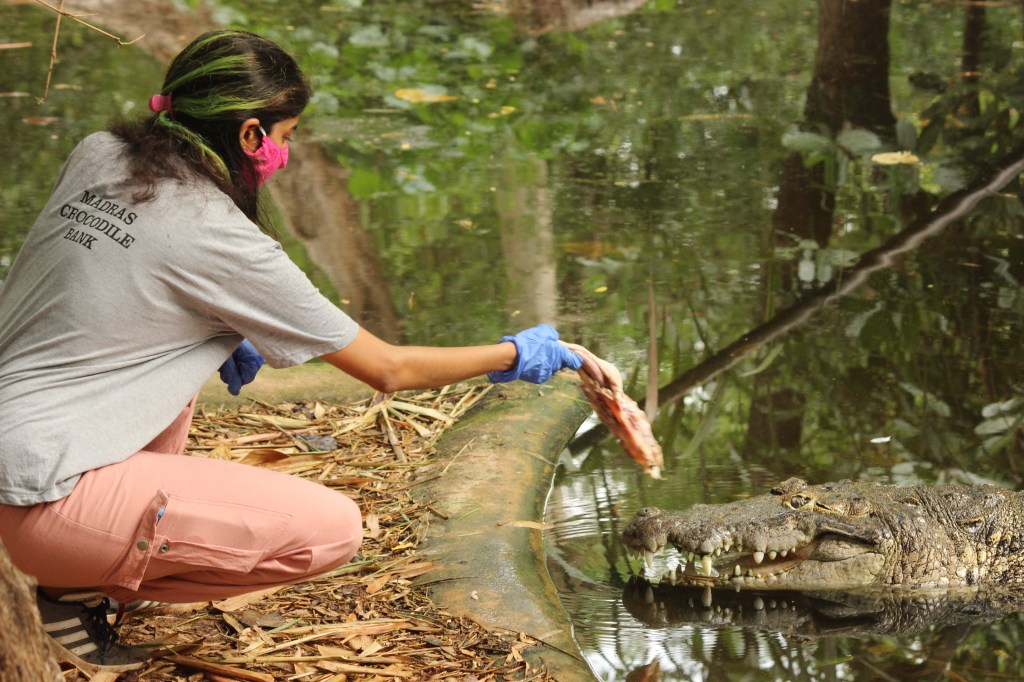
A conversation with the Assistant Curator of the Madras Crocodile Bank Trust (MCBT)

Heart of Conservation podcast Ep#23 Show Notes (Edited)

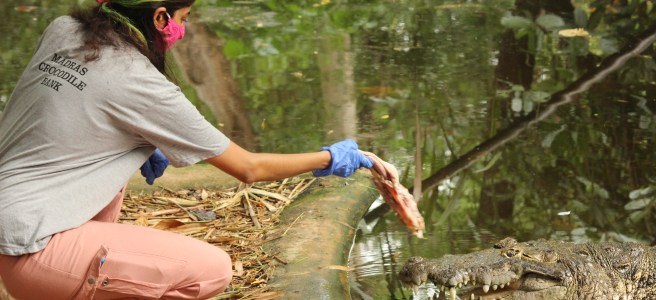
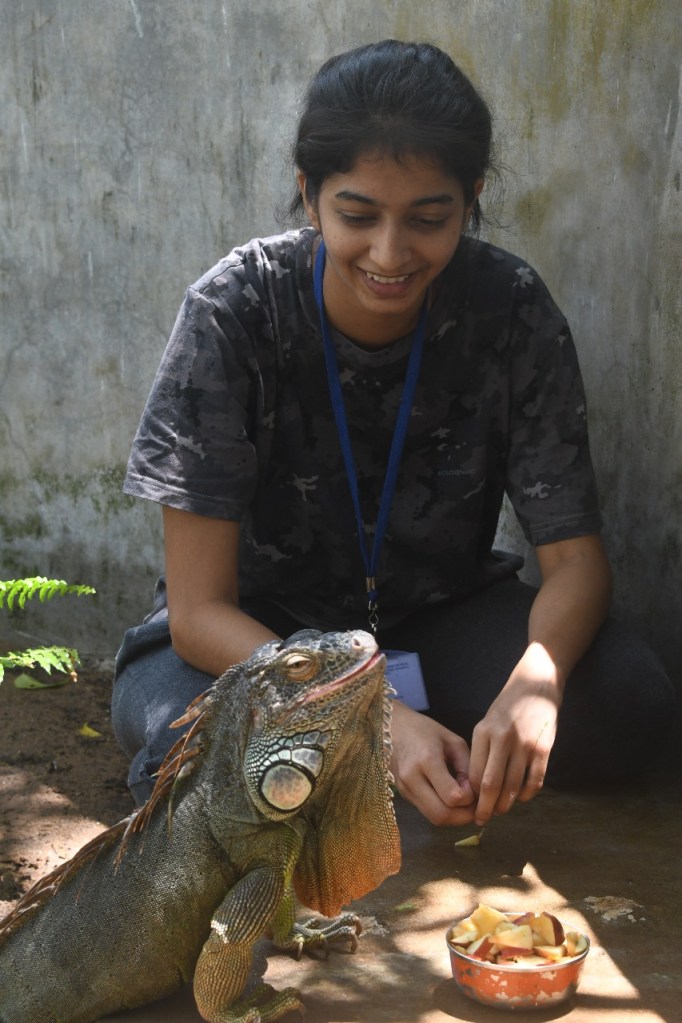
Scroll for show notes. Cover photo courtesy @zoologistambika All photos courtesy: Ambika Yelahanka


I am speaking to Ambika Yelahanka whose has a very enviable job involving lots of animals. Ambika’s has a Masters in Zoo Conservation and a specialization in feline behaviour and reptilian husbandry. She’s the Assistant curator at Madras Crocodile Bank Trust in Chennai. Find out what a day at the Madras Crocodile Bank Trust as Assistant Curator looks like. Ambika explains why enrichment is as important for reptiles as it is for carnivores and other animals. She also tells us why zoos play an important role in conservations and explains in detail about captive breeding. She also regales us with her experiences in the game parks of Africa and has interesting info about volunteering at the MCBT (Chennai) and sound advice for future zoologists.

Some useful link – MCBT website – https://madrascrocodilebank.org/

For MCBT volunteer program info: education@madrascrocodilebank.org

Adoption of animals – https://madrascrocodilebank.org/web/adopt_a_reptile

Photo courtesy Ambika Yelanhanka at MCBT https://earthymatters.blog/

SHOW NOTES (EDITED)

Lalitha Krishnan: Hi there, Thanks for listening in to ep #23 of Heart of Conservation. This is season three and I’m Lalitha Krishnan bringing you more stories from the wild that keep us connected with the natural world.  I am speaking to Ambika Yelahanka whose has a very enviable job involving lots of animals.  Ambika has a Masters in Zoo Conservation and  specialization in feline behaviour and reptilian husbandry. She the Assistant curator at Madras Crocodile Bank Trust in Chennai. Without wasting more time let’s listen to her amazing story.

Lalitha Krishnan: Ambika, thank you so much for joining me on Heart of Conservation. It’s really nice of you.

Ambika Yelankha: Thank you for having me.

Lalitha Krishnan:  So, Ambika tell us why zoo conservation? What inspired you?

Ambika Yelankha: Basically, my inspiration came from my family. My family is not directly involved with conservation but I haven’t ever been alone in the house in a way because my mom and dad have rescued over 200 cats and about  100 dogs. So, from the time I can remember, there have been at least about10 animals in the house along with the humans. So when I selected zoology it was not a big shock to my parents because they knew it was going to be something similar to what I’ve grown up around. That’s why I got into zoo conservation as well. I did do internships in field research and captivity and I fell in love with doing captive work.  Field research is great but I didn’t think that was for me so I did my Masters in Zoo Conservation got into zoos and working here.

Lalitha Krishnan: Such a lovely childhood!

Ambika Yelankha: Yes.

Lalitha Krishnan: What is a typical day at the Madras Crocodile Bank Trust [MCBT] look like as the assistant curator?

Ambika Yelankha: As the Assistant Curator, my day usually starts off with a general check-up round so I go around and take a look at all the animals with the help of keepers. So, keepers will report to me or the curator depending on if there is anything to report or if everything is normal. Since these animals are nocturnal- most of the reptiles that we have here are nocturnal- there is a lot of activity at the night and we tend to miss out on most of it because we are not active at night. So, we do a general check-up in the morning to see if everybody is okay. If there’s any leftover food, any faeces that need to be removed from enclosures… Kind of decide what enclosures need to be cleaned for that day. That’s basically my morning. It takes about an hour to go around and check up on all the animals especially the babies to see they’re okay. After that, we tend to get into food preparation. So, with the help of keepers, we will prepare food for the herbivores that we have. For carnivores it’s pretty much basic food…so the meat comes frozen. All we have to do is thaw it and serve the food. Whereas for the herbivores it needs a little bit of preparation, a little bit of chopping for appropriately sized animals. After the food has been distributed, I do have some paperwork so I get some two hours of paperwork done. Then, if any medical treatments are required, I also assist the veterinarian with any medicals treatments that are required to be done that day. So currently we have an animal recovering from surgery so we have him on an alert watch so we check up on him every hour. If we have any special needs animals as such that will take up part of the day as well.

Lalitha Krishnan: So, you have a full day really. There’s a saying (actually a quote) that if you pet a dog, you have a full-time job or something like that but you have a zoo full of animals and keepers. When you speak of keepers and their wards, how many are you talking about?

Ambika Yelankha: We have about 50 people working as a team here. And all of them are separated into different designations. We have the Curatorial team, the Education team, the Veterinarian team and then Management. Our combined total is 50 but people are divided into four sections mostly.

Lalitha Krishnan: OK. I saw a post where you were proving engaging activity for a reptile. It almost looked like play but of course, it was sort of an enrichment activity. How important is this for captive animals?

Ambika Yelankha: As many people know and it’s one of the reasons why zoos get a lot of negative comments is because you tend to have wild animals that tend to have usually a lot of mental stimulation as well as physical stimulation in the wild. And, when you house them in smaller enclosures -especially in zoos- you need to sort of providing that sort of mental stimulation especially. Otherwise, like all humans, if you’re not active then you tend to deteriorate in your mental health. So that is something that is not been studied a lot in reptiles but is very common for mammals. Zoos actually provide enrichment ideas, especially for cats. You have your ‘carcass feeding’ or a big ball to play with… There’s a lot of enrichment for mammals but people tend to usually ignore reptiles when it comes to this because they are generally seen as lazy but they seem lazy because they need to conserve their energy. They don’t have that much energy as mammals do expend. That does not mean that they do not require mental stimulation and physical stimulation, especially in captivity. So a saltwater crocodiles that can swim from one continent to another continent needs exercise especially when it’s in captivity. Otherwise weight gain becomes a problem. To stop animals from displaying stereotypical behaviour, to stop the decline in mental health, enrichment is provided.

I am now training with an alligator, ‘Ally’. She is the only alligator bred in India, in captivity. So, I do enrichment activities with her and some of our juvenile gharials and also with our commodore dragons. So, depending on the species, the enrichment activities will change. Most of them will include a positive reinforcing stimulus such as food. So, any behaviour I want them to display will be rewarded with food. But if they display negative behaviour there will not be a punishment as such. She is open to display any sort of behaviour she wants but if she wants food, she will kind of do what I ask her to do.

When I’m talking about enrichment in captivity, especially in zoos, the enrichment is trying to get them to how they would naturally. So that is what separates this from circuses because a circus will make them do human-like tricks, jumping through the hoops and things like that. That is not what we are aiming to do. We just want her to swim really fast. Or jump up to get her food which are things that these animals do in the wild. And we just want her to display those same wild behaviour just in captivity. So there is not unnatural behaviour that will be encouraged.

Lalitha Krishnan:  I like the way you differentiated what they do in a circus. You know it is exactly this photograph you had put up on Instagram that made your work so interesting to me. I’m so glad (I saw it). You’ve explained enrichment in much detail. So, one of the most important questions for you and for people who have negative views about zoos, is why are places like the MCBT and zoos important for conservation?

Ambika Yelankha: As manypeople already know MCBT as such has contributed to reptile conservation the most in India. Rom and Zia Whitaker started this facility because the crocodilian population especially the marsh crocodile and the gharial had declined so much, they were about to be critically endangered. Therefore, they started this breeding facility where most of the mugger crocodiles that were bred here were reintroduced in the wild. And that is how we still have a large population of mugger crocodiles in India right now. So, zoos as such, especially those focused on conservation breeding-especially for critically endangered animals- is very essential because one of the most popular stories are currently with critically endangered species is with the right rhino. Where the only last male passed away and the species has been declared functionally extinct. But there are two females in captivity which people are hoping to breed and bring back the species. So, for animals that have been hunted to that extent, bringing them back would only be from a captive place as such. So, zoos play a very important role in conservation breeding. Apart from that, zoos play a very important role in conservation education. I think, pretty much everybody saw wild animals for the first time in a zoo. As a kid, the parents would have taken them to a zoo and that’s where they see a wild animal and you get to learn about an animal that you didn’t even think existed in this world. I think it sort of builds a sort of curiosity.

We have a great education programme at MCBT as well as explaining why reptiles are important. Why you shouldn’t have an irrational fear of them.  Irrational fear of snakes is generational. It’s passed on by grandparents, parents and things like that.  So, if they visit the zoo and we help kind of eradicate that fear, maybe that person will not kill a snake if it enters his house next time. So, we’re hoping that education plays a big role in kind of eliminating fears especially of reptiles and kind of builds that curiosity…okay, maybe they want to join conservation. Because more people in conservation, the better.

Lalitha Krishnan: I think education and awareness makes a big difference. Tell me if I’m wrong but is it more likely that a younger child or a younger person is more likely to be influenced by you than say, an adult who has lived his life in fear?

Ambika Yelankha: Definitely.

Lalitha Krishnan: The last I visited a zoo was in Nanital aeons ago and to tell you the truth I had never seen healthier animals in any other zoo. They also had the opportunity for the public to sponsor animals which was pretty unique back in the day. I believe the MCBT also does that.  But are people as receptive to sponsoring reptiles?

Ambika Yelankha: I think, with MCBT especially there are a lot of sponsors and a lot of people adopting the animals. Because the curiosity for snakes and crocodiles has exponentially grown over the years. And the outreach programmes done by MCBT has really made a big impact. My coworkers travel around the country and visit schools and hospitals to try to bring these species to light. And, they talk about why conserving them and why respecting their boundaries is also very important. So, I think these outreach programmes have played a very big role as well as social media. We have a big following on social media and a big following for our founders as well since they have done great conservation work for the country. They have a, I would say a fan following, very loyal people. So, the adoption scheme is going quite good especially the sponsorships. There are a lot of people who want to adopt crocodiles.

Lalitha Krishnan:  So, are these people from India or abroad mostly?

Ambika Yelankha: Most of our adopters are Indian. We do have a couple of people from abroad. We have a lot of parents adopting for their children’s birthdays. Birthday gifts…

Lalitha Krishnan:  How nice. Very cool. They’re changing the whole mindset.

Lalitha Krishnan:  So, when you’re speaking of outreach and schools, what kind of schools do you go to? Are they private or govt? Or do you cover the whole spectrum?

Ambika Yelankha: I think the entire spectrum is covered. We started with govt. schools especially around Chennai because we are situated in Chennai. It was first initiated in all the govt. schools in and around Chennai and the radius slowly expanded from there. Now we have sister organisations that have taken up/are doing it in different states as well. So we have a bunch of organisations that collaborate with us and do it in the state that they’re present in as in Andhra Pradesh and Karnataka. It started with govt. schools but we started advertising it more on our social media and that got the attention of public schools and private schools as well. We’re now in collaboration with companies that will sponsor our travels and things like that and are going to schools all around the country right now, including the North East especially. Now we’re concentrating on schools and hospitals in the northeast and are hoping that it’ll be fruitful.

Lalitha Krishnan:  So, if some school were to approach you directly you would make a presentation to them too?

Ambika Yelankha: Yes, definitely. Before the pandemic, we used to go to the schools. Any school that calls us, we will happily go and give them a presentation. So for multiple classes, I think my colleagues went every day for two weeks to give talks in multiple classrooms. Snakes, especially are a big fascination. King Cobra always brings out a lot of screams from the children.

Lalitha Krishnan:  But, I bet it’s better than sitting behind a desk and looking at a textbook. That’s cool. So many renowned animal centres around the world like MCBT have breeding programmes that are bringing wildlife back from the brink of extinction like the Arabian Oryx, the California condor or the Amur Leopard. I know MCBT also has great success when it comes to captive breeding. Could you elaborate on that?

Ambika Yelankha: Yes, MCBT started with the goal of captive breeding and reintroduction. That was the main reason why the entire park was built in the first place. The first main species that was concentrated on was the Indian population of crocodiles. India has three species of crocodiles which is the marsh crocodile, the gharial and the saltwater crocodile. So, the main aim was to bring all three back to sustainable population because the Wild Life Act was published, crocodiles were almost hunted to extinction for their meat and their hide. So, after the Wild Life Act was published, hunting them was banned. It was still a big struggle because the population was so fragmented that without the captive breeding programme it would very difficult to bring them back to a sustainable population. Rom and Zai Whitaker started this park where animals and eggs that were collected in the wild- to ensure a 100% hatch rate- collected eggs from the wild and also a couple of animals from the wild. All this with permission from the forest dept., with permission from the state govt. and the central govt. and they were bred here, especially the marsh crocodiles. Once they reached a size and an age where the crocodiles could fend for themselves, they were reintroduced into pre-selected sights. So researchers from MCBT went to these wild sites and you know, did the research and saw what would be the best sites for reintroduction throughout India. These particular sites were selected and marsh crocodiles were transported from here to those sites and reintroduced. Now we have a thriving population of marsh crocodiles in India.

Lalitha Krishnan:  It’s a huge project. Getting so many permissions to start with and to ensure that these marsh crocodiles adapt and survive in so many different parts of India is quite amazing.

Ambika Yelankha: Because the work doesn’t stop after you reintroduce the animals. You have to constantly monitor the reintroduced animals to see how they are doing. Because once you have reintroduced them and they are not doing great and reducing again then your site was not great then you have to change sites again. It’s a lot of work that continues after your animals have left the facility as well.

Lalitha Krishnan:  Right. So, you’re still looking after them for a long time. Being a zoologist can have its perks apart from the obvious one of working with animals. You seem to have travelled/worked in many countries. Tell us about your experiences. I‘m sure the young people who are listening and want to be zoologists will be even more inspired.

Ambika Yelankha: Yes, I ‘ve had the privilege of working in a couple of places around the world. That was mostly during my Master’s degree. During my Bachelor’s degree, most of my internships and volunteering were within India. I did my Master in Zoo Conservation from Manchester Metropolitan University. Through the university…they provided a lot of opportunities, especially since I was doing Zoo Conservation… they had a collaboration with Chester Zoo which is in the UK. I got to do a six-month internship with Chester zoo. So, basically, while most college students go to their classrooms, my classroom was the zoo. So for six months, I had to take my class in the zoo. I had a lot of hands on experience. I got to do my Masters thesis as well at the zoo with some incredible researchers, incredible scientists. People who have been involved with zoos for over 40 years. I got to learn a lot of things.

Along with that, we did have the opportunity to go do a field project as well for which we were taken to Tanzania in Africa. We went to over eight national parks kind of doing research projects.  I selected the grassland density of butterflies. I got to walk around the savannah with armed guards because hyenas were lurking right behind the bushes where I had to collect data. It was an experience that I shall never forget.

Lalitha Krishnan: I can imagine. I’m sure you have some particularly memorable moments which are part of these experiences at the zoo and the savannah.

Ambika Yelankha: When we were in Tanzania we were camping…so, the campgrounds are in the middle of the savannah. So, basically, you’re living inside the protected area. They warn you saying, the animals have become quite comfortable with visitors and do not shy away from entering campsites even if there are people there. So we were always told to be on the lookout. When we were in the Serengeti and we were camping out in the night, a bunch of us girls went to use the washroom and we opened the door and there were three hyenas right inside the washroom. We screamed and the hyenas kind of -I don’t know what the sound was-but I would say, they sort of screamed. They ran in one direction and we ran in another direction. It was almost comical.

Lalitha Krishnan: But scary at the same time. For both animals and humans. Lovely. So, you know, do you take volunteers and what sort of work can someone who wants to volunteer expect to do?

Ambika Yelankha: MCBT has a great volunteering programme as well as internship programmes.  Currently, due to the pandemic, we are not taking any volunteers at moment but we will soon be opening programmes for people. And, anybody from any background can apply for this. It doesn’t have to necessarily have to be a zoology background. You can be from any background if you want to come and work with animals just for a week. That’s also OK. You get to be part of all of our four sections other than the management section. If you’re interested in the curatorial aspect you get to follow our keepers around, kind of observe what they do. And they’ll teach you the ropes of taking care of the animals. If you are more of a people person, then you can always tail our education officers who’ll teach you how zoo education works. How it is talking about animals. There are a lot of myths and false beliefs about animals and how you need to tackle those things. So you can do that. We also have some veterinary students that want to come and volunteer. They get to work with our doctor here and learn how reptile medication works.

Lalitha Krishnan: OK. You said you can be from any background. What about an age limit? Do you have an age limit?

Ambika Yelankha: As long as you’re 18 and above, there’s no upper limit for the age.

Lalitha Krishnan: You might just find me at your doorstep one of these days. So, I usually ask my guests to share a word or a term or concept something significant for them. Would you like to share something?

Ambika Yelankha: I may have just about have a few words (of advice) for people who want to get into conservation and study wildlife. I would say if you have the opportunity and you have the financial aid, please go ahead and spend that to further your education. Otherwise please look into getting internships and volunteering programmes rather than taking out loans. Don’t get into debt to try and get into this field. Because this field will not help you pay your debt back.

Lalitha Krishnan: That’s if you study abroad right? Can’t you study here in India?

Ambika Yelankha: Yes, you can study it here. It’s quite cheap as well. There’s the Wildlife Institute of India, there’s NCBS and ….. There’s ATREE and a lot of other institutions that offer you programmes to further your education while they get you internships and volunteering opportunities. If that is the case, yes.

Lalitha Krishnan: That’s good advice. Thank you so much.  OK Bye.

Check out the useful links provided above by Ambika Yelanka. I hope you enjoyed Episode 23, stay tuned. I’m Lalitha Krishna and you’re listening to Heart of Conservation. You can read all show notes right here on my blog Earthy Matters. If you know someone whose story should be shared do write to me at earthymatters013@gmail.com. Heart of Conservation podcast is available on several platforms so do check it out. Till then stay safe and keep listening.

Birdsong by hillside resident, the collared owlet.

Disclaimer: Views, thoughts, and opinions expressed in the podcast and show notes belong solely to the guest featured in the episode, and not necessarily to the host of this podcast/blog or the guest’s employer, organization, committee or other group or individual
Bhavna Menon: Saving the Wilderness Through Community Participation

Heart of Conservation Podcast Ep#14 Show Notes (Edited)

Introduction:

Lalitha Krishnan:You’re listening to Heart of Conservation Podcast, Season II, Episode #14. I am your host Lalitha Krishna keeping you informed and connected with the natural world by bringing you stories from the wild.

My guest today is Bhavna Menon. She is the programme manager at the Last Wilderness Foundation, an NGO that works in and around three Tiger reserves in Madhya Pradesh. I am doubly grateful to Bhavna because we had to rerecord this podcast because of technical issues.

Thank you Bhavna, for coming on Heart of Conservation podcast for the second time. To begin with, we were talking about how Last Wilderness Foundation has been working in Madhya Pradesh since 2009 and you’ve been engaged with the forest department, urban and the rural l communities over there. So briefly, could you tell me how it all started? What was the goal when you started?

Bhavna MenonSure. Last wilderness Foundation was started in 2009 like you rightly mentioned by an individual called Nikhil Nagle. So, when he met the Field Director of the Bhadhavgad Tiger reserve in 2010, Mr. C K Patil, Mr. Patil asked Nikhil to first send a team to understand the on-ground challenges faced by the villagers in the buffer villages surrounding a tiger reserve. And when we did the survey, of about 33 villages which were in the buffer zone of the tiger reserve, we found man-animal conflict to be the main reason and problem behind working out proper conservation strategy. So what we decided to do was to start a healthy dialogue with the villagers which couldn’t be done by just meeting them. There had to be something more fruitful coming out of it…something more personal coming out of it. So what we did is we took the kiddos of the villages—there are about a 100 odd villages in the buffer zone of the Bandhavgarh Tiger Reserve now—So, over seven years, we took the kiddos inside the park for a safari because it would probably not make sense for us to tell them, save the tiger…save the forest…without them having to experience the forest or an animal.

Lalitha Krishnan: Right.

Bhavna Menon: We took them on a safari; spent the whole day with them…had lunch with them, we did presentations; we asked them what their idea of forests and forest conservation was and at the end of the end we would try to tell them, “Yes, now that we have experienced the forest together, what can we do to protect the forests?” So many a time kids would come up with solutions. “Plant trees.” “Yes, we should not set fires in the forest”. “Yes, we can perhaps, think about reporting illegal incidents”, which was a win-win situation for us. And via the kiddos, even the adults were getting impacted in a manner because the kids would rush back home and say, “Oh my God, we saw a tiger today and it was harmless. It didn’t do anything to us.” “It was huge and big; it had long claws and big teeth but it only used that to hunt its natural prey.” It walked right past us when it saw us and it was that beautiful thing they saw. Once, a tiger was walking past the Gypsy (jeep) and this kid kept backing into me and finally without realizing she sat on my lap. And she said, “How big it is. How beautiful it is.” She kept whispering that as if she was in bliss. The way the mindset of the community members changed via the kids, via the inclusion of the community members in conservation, we saw a dramatic change.

Another impact that we saw because of the Village Kids Awareness Programme is that it extended to the adults. Once we had gone to this village in the buffer zone called Badwar which was anyway, a sensitive village and there we quite a few incidents of man-animal, man-tiger conflict in that area. So we decided to do the Village kids Awareness Programme in that area. And the day we arrived, we learned of an elderly gentleman succumbing to his injuries because of an encounter with a tiger in the forest when he had gone to… Basically, he was a herder. He had taken the cattle to the forests and he encountered a tiger and a kill and the tiger had attacked him etc. and he passed away. To meet the family members, we visited them, we just sat quietly—no one spoke a word—and we decided, out of respect to the community members, that we could not run the pogramme in the village because it would be very insensitive to work in that village at that point of time and tell them to protect the tiger. But, the most amazing part was, the next morning, this gentleman walks up to our canter…to our car and says, “Why aren’t you guys doing the programme? I want you to do the programme and I want you to take my kids in the first batch of the programme. I want them to learn about the forest and respect the forest and understand why it’s important to protect it.” From then on, we realized that we had opened the channel. Thanks to the forest department and the community this channel was open wherein we can reach out to the main stakeholders of conservation and tell them that we can work together as a team where we could learn from each other and protect the wilderness.

Lalitha Krishnan: Wow. Let’s talk about the forest department. I know you said the channels were open but in what way did you interact with them or engage with them?

Bhavna Menon: So,we started working with the forest department by conducting workshops. So although the frontline staff is very beautifully equipped to protect the forest, we wanted to equip them with certain topics slightly more thanks to the experts in the field. Like birding, a little more information about the biodiversity… Then slowly, we moved on to how they could—because we had worked with communities—we gave them a little bit of information on how they could deal with members of the community in times of conflict when we were not there. Our idea was to bridge the gap between the forest department and the community members via these workshops so that even if we are not there, they are not dependent on an external force like an NGO coming there and working. And they could do that themselves. They were their people. So they could have that connect between themselves.

Lalitha Krishnan: Do you think that this connection is now well established and they don’t need outside help so much now?

Bhavna Menon: Well, it’s an ongoing process I would say. It needs constant follow up. You need constant dialogue because they are people after all. People need to communicate. I don’t think it will be a one-time thing. Of course, there’s a huge adhesive that’s come into place but still, we need to do a lot of work. A lot of work still needs to go in.

Lalitha Krishnan: Can we start talking about the communities? Tell me about the Pardis and what initiatives you are taking with them in particular?

Bhavna Menon: Sure. We came in contact with the Pardhis in 2009 when the tigers in Panna (tiger reserve) had disappeared. There were no tigers in Panna. The Field Director, Mr. R. S. Murthy, invited us to Panna to meet with the Pardis to see the forest. And the first thing we heard from everyone is how notorious the Pardhis are. How they are a criminal tribe. How they are hunters and that Panna had suffered a lot because of Pardis. But despite all these preconceived notions I had held about them, as soon as I went to visit the hostels that house the Pardi kids—which in fact, was started by the former Field Director, before Mr. R. S. Murthy, Mr. G. Krishnamoorthy…Mr. Gola Krishnamoorthy, it was his visionary plan to work with the communities at some point and start two hostels for the boys and girls. So the minute I opened the gate of the girls’ hostel, I saw this number of kids rushing towards me who have no idea who I am but they clung to just any part of my body. I found kids hanging from my arms, legs feet…. All they said was, “hello”, “welcome,” “please come and sit”, “have chai”. And I was wondering, am I in the right place? 

But the warmth, the genuine love they showed someone who didn’t even know them was brilliant and that was when I and the Director, Mr. Venkatesh, we decided we needed to do something to secure the future of these kids. So what we did, continuously, from 2009 to 2015 we kept visiting them to understand more about the community, kept an ongoing dialogue with them and in 2015 we ran a vocational training programme which was a two-month training programme with both the boys and girls. Wherein the children themselves choose what vocations they would like to pursue. The girls did stitching and the boys did an electricians’ programme. Local teachers were employed to teach them the same and we really bonded. All of us over two months really bonded. We had volunteers coming in who had also interacted with the kids and the success was that because of these hostels and because of these continuous dialogues, we now have five Pardi students who are pursuing their graduations –higher studies and they are the first line of Pardhis graduates from the Pardi community.

Lalitha Krishnan: That’s impressive. It’s something, to be proud of for sure. For them and the younger kids. Very inspiring.

Bhavna Menon: Lalitha, another great success story that has come out of working with the Pardhis is a girl called Reesna, Pardhi from the Pardhi community who has been absorbed by Taj Safaris after an initiative I am going to tell you about so basically when we were working with the kids and the adults saw the success of the programme, the adults in the community started demanding that we work with them as well. They kept saying, “why aren’t you working with us?” So we said, “OK, what would you like to do?” They said, “We like the forest, we like to walk in the forest. We can tell you all about birds and animals and, trees and medicinal herbs.” So I said, “Great”. So then we met with Taj safaris, we met with a gentleman whose extremely pro community. He’s called Mr. Nagendra Singh Hada who is the Area Director of Taj Safaris and because of his excellent team of naturalists, and our volunteers, we trained twelve Pardhi guides for three periods of training and because of that we started something called ‘Walk with Pardhis’.

Lalitha Krishnan: Right. I have read about that.

Bhavna Menon: It’s a walk in the territorial area. Guests can go for a walk and there are beautiful gorges you can encounter on your walk there. The animals they (the Pardhis) mimic, the birds they mimic…if you shut your eyes you won’t be able to tell the difference if it’s animal or if it’s a Pardhi guide imitating the animal. It’s super incredible. And because of this, there is a particular girl called Reesna Pardhi who was also trained as part of the Pardhi initiative. The guests loved her so much and Taj saw so much potential in her that she is now working at the Taj Kahna Property, Banjaar Tola. If someone is visiting Kanha, they can most certainly visit Reesna also. She is a lovely, confident young woman now and yes, that’s what we are trying to do with the Pardhis. 

Lalitha Krishnan: So nice to hear. Moving on, the other tribal communities you worked with, the Baiga community and the Gonds. So tell me about the jewellery workshops and the community in general.

Bhavna Menon: The Baiga community-the Baigas we met with-live in the buffer zone of Kanha tiger reserve another beautiful park and there we work with an extremely visionary forest officer called Mr. Surendra Khare who is like this champion for women empowerment In Kahna. I would like to say something before the Baiga community workshop about something they have done in Kahna Lalitha if I may?

Lalitha Krishnan: Of course. Please do.

Bhavna Menon: First time, there was a visually impaired camp that we ran in Kanha with the vision of Mr. Khare. There was this little girl called Tulsa. She is visually –impaired, she called up Mr. Khare Sir once and shed asked. “Why aren’t you showing me the jungle?” He was very puzzled and taken aback and emotional all at once and he said, “yah, actually…why not”? There should be no difference between kiddos wherever they are. We’ve done about three visually impaired camps in Kanha. We run the hearing impaired camp based on sign language. We run the visually impaired camps based on a sensory nature trail, as well as sounds.

Lalitha Krishnan: How many kids came on that (visually impaired camps)?

Bhavna Menon: So the first batch had 23 kids then there was a batch of 40 kids. So different groups had come from NAD(?) Bombay. So one had come from the Netraheen Kanya Vidyalaya, Jabalpur and one was from Justice Tankha Memorial School, Jabalpur and that was a hearing impaired camp. So a different number of people have come to each camp.

Lalitha Krishnan: That’s quite the initiative. Unfortunately in our society, challenged people are left on the side or not included.

Bhavna Menon: Yah, and the experience Lalitha…I learned so much from there. I mean, I thought we’ll go and tell them…in fact, there was a time when a tiger was walking by our canter. The kids could only hear it. These were the visually-impaired kids. They could only hear it walking in the grass. They could hear rustling. And they said, “Oh my God, I saw a tiger”. And the happiness was just contagious. Everybody was crying by the end of that camp.

Lalitha Krishnan: I can just imagine. Just visualizing it in my head I’m thinking, what a joy to hear something like that.

Bhavna Menon: They were just bouncing around camp and they’re happy and they’re singing and they’re not…I’ve never seen them feel sorry for themselves. And this was because of Mr. Khare. Had it not been for that Officer, none of this would have happened. This again is an extract of what the forest department is doing. After doing these camps we realized there was a lot of more work to be done in Kanha and Mr. Khare encouraged us since we had already worked with communities and we had had a dialogue with the people. He encouraged us to work with the Baiga community who live in the buffer zone of the Kanha Tiger Reserve. They are very dependent on the forest produce as a source of livelihood. Women usually visit the forests and collect a leaf called Mahul. It’s a creeper with a very big leaf. They make little plates and bowls of those which are then sold in the market for Rs. 30/- 40/-. So you have to collect a whole lot of them to make plates for which they used to spend the whole time in the forest which encourages encounters with wild animals and encourages the chance of a conflict. So Mr. Khare said, “why don’t you work with these ladies concerning livelihood. We spent three-four months discussing and visiting the ladies and we finally chanced upon an elderly lady in the village who was wearing very beautiful silver coin jewellery. We said, “Okay, where did you find this from?” She said, “No we made it.”

“Wow, with what machinery?”

“No, we make everything by hand. Nothing is machine-made. Nothing is bought except the raw material.”

We said, “Okay, that’s brilliant, Can you make this for us?”

A group of 10 women started laughing and saying. “Who do you think is going to wear this in the city? No one’s going to wear it. It’s a village thing, it’s a tribal thing”. They sometimes feel shy that people will make fun of them. In fact, they have amazing tattoos on their body. Baigas are famous for tattoos on their body. But unfortunately, the younger generation is refraining from doing it because everybody will tease them in school and colleges saying, “Oh, this one’s is a Baiga”. So that also hit us and we said, “No you should be proud of this.” So we started giving them ideas: “You can make bracelets, necklaces.” So we started giving them the raw material. We have a branding partner called “Natureworks India’ which helps us sell the jewellery and the response has been beautiful. We are working with some 40 odd ladies now across four villages. Reduction in the forest has happened drastically because ladies can now sit at home instead of being in the forest. They can sit at home and make jewellery, It’s a whole day’s work. They get paid on the spot…as soon as they make the jewellery. The beautiful part is men used to mock them. “Why are you making this jewellery? Who’s going to buy it?” They’ve seen their wives being successful in business. When their wives are ill or pregnant, the men sit and make the jewellery.

Lalitha Krishnan: Really? That’s a change. That I’d love to see.

Bhavna Menon: Youshould see the men running around carrying necklaces instead of the women.

Lalitha Krishnan: That’s good news. I have seen them (the jewellery) on social media and they look fabulous And colourful.

Bhavna Menon: Yes. Veryhappy.

Lalitha Krishnan: There’s some mention of the Gond tribe or community you work with.

Bhavna Menon: Yes,that’s in Basically, what I’m trying to do also Lalitha, is to include guests and tourists to visit community members. What hit me once was when I was on a safari, a very happy guest said, “Oh we saw five tigers today”. 

I said, “Lovely. If you have time, why don’t you visit a village?

“What? They have villages here? I thought there were only forests and resorts.”

“No, no. There are lots of villages and lots of amazing people you can meet if you can step outside the confines of your resort.”

“Wow. What are the activities you offer?”

Then and there, Vidya and I decided to pen down a list of activities guests can do while they are visiting the tiger reserves. I am happy to say those tour operators especially, who are helping us with this do encourage guests to do these activities. We have village walks, we do lunch, breakfast, dinner with villagers if you choose that an option. We have jewellery making workshops wherein you can go to the village, sit with the Baiga people and make jewellery. And then we have the tribal dance. People while eating their dinner or while they are having chai, can sit and watch the dance. More often than not, guests are dancing themselves. It’s a contagious dance. They get up and start dancing themselves.

Lalitha Krishnan: That’s great and is homestay a possibility or not…because they are living on the fringe?

Bhavna Menon: Homestay is a possibility. It requires a little bit of work as we need to speak to the community members. Because community members need to be comfortable with strangers staying in their houses as they are in remote areas. So the idea is to get them on board. A lot of them in Panna and Bandhavgarh are on board with this idea. We’ve been in talks with them. They want to be trained in regards to hospitality so we will be exploring this and maybe in the next few years when you come to Central India, we can put you up in a homestay.

Lalitha Krishnan: Yes, I look forward to that. So what other outreach programmes or initiatives have you’ll be taking in these areas.

Bhavna Menon: So we run the nature education programme in these areas in association with the forest department, with the help of brilliant volunteers in Kanha. The nature education programme is very very similar to the Village Kids Awareness Programme of Bandhavgarh that we had started in 2012. Where kids from the buffer zone are taken inside the forests and we tell them about the interconnect of denizens of the forest. Apart from that a very important programme that we run from the conservation point of view is the Forest Fire Prevention Programme in Pannah. That again, Mr. K S Bhadoriya who is the current Field Director of Panna…he’s been extremely supportive and he’s been practically part of each and every session that we do with villagers. He travels for one hour and comes down every time and sits with the villagers. So the idea is to understand/ first talk to the villagers about their challenges and then tell the villagers. “Now that the tigers have a magnificent comeback in Panna, we need to protect them.” The biggest problem in Panna is fire. It is an extremely dry landscape. So we need to talk to the people with special emphasis on how to prevent forest fires in the landscapes. Whether via reporting fires to the fires department or patrolling teams and helping the forest department in helping different regions for fire and other illegal activities. We are encouraging community members to do so via our sessions.

Bhavna Menon: 

Lalitha Krishnan: Ok. And these fires you are talking about. Do they happen in April…the dry seasons?

Bhavna Menon: It happens in the summer months andacres and acres of forest get burnt becausethe landscape is so dry and it is completely grassland. So, one spark can actually ignite the whole forest. It’ happened in Panna before but I’m very happy to report that since we started working in 2019 there hasn’t been a case of forest fires last year. We’ve done two sessions with the villagers in 2019 and 2020 and covered almost 37 villages and 1200 villagers. There hasn’t been a case of forest fires. We are hoping to God, fingers crossed that there won’t be any forest fires this summer.

Lalitha Krishnan: Fingers crossed and congratulations to you and your team for making it possible.

Bhavna Menon: Thank you

Lalitha Krishnan: 1200 people is a big number. You were talking about volunteers. I wanted to know if anyone wanted to volunteer in any of these camps or places that you work in how long would they have to stay and what sort of work would you expect them to do? What are the options for anyone who is interested or goes to your website or connects with you? This is just to give them a feel for what it will be like.

Bhavna Menon: Ideally we call upon volunteers when there is a project in place. Suppose there’s a Nature Education Camp in place like the Visually –impaired Camp. We had volunteers for that also. Then, mostly conservation outreach programmes, even the forest fire prevention programme we had volunteers coming in and helping us. When we were training the Pardhis, at that time also we had volunteers who were staying on for two-three weeks and helping us see the project through. That’s how volunteering works. But suppose people want to write to us irrespective of an ongoing project, so we may shortlist them later, they can write to us on an email Id that we’ve provided on the website. It’s called conservarationatthelastwilderness.org. All the details of our project and the email id is mentioned on our website.

Lalitha Krishnan:  That’s good to know. You mentioned Bhavna that you’ve been working for nine years or around nine years. First I want to know how you started working for this organization and for you’ve been personally affected. You did say a bit of that but you can expand.

Bhavna Menon: I’ve always been interested in wildlife and conservation, forest and people. I’m very interested in meeting people but I was never a science buff. I was always an English Literature buff. I did Psychology for three years. And it was when I moved to pursue my post-graduation in journalism from Xaviers in Mumbai, this came after my college ended. This came as a college placement. Our founder Director Mr. Nikhil Nagle was looking for media students to help him put together a comprehensive website on wildlife and communities, and conservation efforts in different areas because he said, “there isn’t a good enough website as of now, which gives all this information.” So when he hired us, he hired some students from Sophia’s, some from Xaviers. We were a biggish team then. Now we are an extremely big team of two people. We started working then. We travelled to tiger reserves and collected the information. Every time we would come back and tell Nikhil about the different efforts being taken, he thought to himself and then he said it out loud to us: “You know, why don’t we give back to the forest as well?” Because, the tiger, he claims has given him so much in life—such happiness—he wanted to give back to the tigers as well. So that’s how we started work. We all build the NGO together and that’s how we started conservation.

Lalitha Krishnan: And do you want to tell me what the experience has been like for you?

Bhavna Menon: I think when I started out in this field I came from a lot of privilege. I carried with me a whole bag of preconceived notions but the day I walked out from the field, all of that just vanished into thin air. I realised that I knew nothing. I unlearnt and learned a lot of things thanks to the community members and they grounded me. I felt grounded when I realized the challenges people faced n villages and how they live. I always say this to people, even though it sounds real clichéd, that the real India is in the villages. The cities are beautiful yes but India exists in the villages. In the past nine years, I have changed a lot and I have learned to accept people for who they are. I’ve not been judgemental of people and I come with a very broad mind thanks to conservation.

Lalitha Krishnan: Excellent

Bhavna Menon: But the only thing I want to say is none of this would have been possible, like I said before, without our field coordinators. We have had some brilliant field coordinators like Indrabanji who handles Panna and Pushpenderji who handles Bandhavgarh. Disksha, she used to work in Kanha. Now we have Mr. Ram Kishore who works with us and volunteers. It sounds great that we are doing a brilliant job but it’s a huge team that’s behind this…

Lalitha Krishnan: I’m sure. So, how many people actually work in your office?

Bhavna Menon: Just me and Vidhya. Vidhya is my Director and I am the Programmes Manager for the organisation.

Lalitha Krishnan: OK. Hats off to you guys.

Bhavna Menon: All of two women team

Lalitha Krishnan: That’s amazing. I want to know how FWF is funded and whether you require funding and how does it work if somebody is interested in funding you?

Bhavna Menon: Yes. As an NGO we are definitely looking for funding because a: we definitely want these projects to be sustainable in the long term. We wouldn’t want them to stop because we don’t have funds. Secondly, we are slowly expanding. We are working with more and more community members for which again, we need funds. So if anybody wants to contribute or wants to donate either their time or financially support us, they can again, write to us at conservation@thelastwilderness.org or they can directly contact me. I am available on social media and mail.

Lalitha Krishnan: One last question. I always ask my guests to share a word that is significant to them or to conservation. So what is yours?

Bhavna Menon: Right. Mine would be inclusion and acceptance. Actually two words maybe, almost meaning the same thing. It’s a word I choose or associate with conservation very deeply because had I not accepted the people/community members around tiger reserves for whom they are…because Last Wilderness believes you should not change people. You should work with them to understand them and then find a solution together. So acceptance and inclusion are extremely important. They have accepted me for who I am so and so have I…which has helped me work for the past nine years 

in conservation and enjoy every bit of it.

Lalitha Krishnan: I was going to say, it works both ways for the people involved. That’s lovely. Such a pleasure talking to you! Thank you so much.

I hope you enjoyed this episode of Heart of Conservation Podcast. You can listen to it on Google podcast, Spotify, Apple podcast and many other platforms. If you know somebody who is doing interesting work and whose story should be shared, do write to me at earthymatters013@gmail.com. And keep listening. Bye for now.

 Introdcution:

Lalitha Krishnan:You’re listening to Heart of Conservation Podcast, Season II, Episode #14. I am your host Lalitha Krishna keeping you informed and connected with the natural world by bringing you stories from the wild.

My guest today is Bhavna Menon. She is the programme manager at the Last Wilderness Foundation, an NGO that works in and around three Tiger reserves in Madhya Pradesh. I am doubly grateful to Bhavna because we had to rerecord this podcast because of technical issues.

Thank you Bhavna, for coming on Heart of Conservation podcast for the second time. To begin with, we were talking about how Last Wilderness Foundation has been working in Madhya Pradesh since 2009 and you’ve been engaged with the forest department, urban and the rural l communities over there. So briefly, could you tell me how it all started? What was the goal when you started?

Bhavna Menon: Sure. Last wilderness Foundation was started in 2009 like you rightly mentioned by an individual called Nikhil Nagle. So, when he met the Field Director of the Bhadhavgad Tiger reserve in 2010, Mr. C K Patil, Mr. Patil asked Nikhil to first send a team to understand the on-ground challenges faced by the villagers in the buffer villages surrounding a tiger reserve. And when we did the survey, of about 33 villages which were in the buffer zone of the tiger reserve, we found man-animal conflict to be the main reason and problem behind working out proper conservation strategy. So what we decided to do was to start a healthy dialogue with the villagers which couldn’t be done by just meeting them. There had to be something more fruitful coming out of it…something more personal coming out of it. So what we did is we took the kiddos of the villages—there are about a 100 odd villages in the buffer zone of the Bhadavgad Tiger Reserve now—So, over seven years, we took the kiddos inside the park for a safari because it would probably not make sense for us to tell them, save the tiger…save the forest…without them having to experience the forest or an animal.

Lalitha Krishnan: Right.

Bhavna Menon: We took them on a safari; spent the whole day with them…had lunch with them, we did presentations; we asked them what their idea of forests and forest conservation was and at the end of the end we would try to tell them, “Yes, now that we have experienced the forest together, what can we do to protect the forests?” So many a time kids would come up with solutions. “Plant trees.” “Yes, we should not set fires in the forest”. “Yes, we can perhaps, think about reporting illegal incidents”, which was a win-win situation for us. And via the kiddos, even the adults were getting impacted in a manner because the kids would rush back home and say, “Oh my God, we saw a tiger today and it was harmless. It didn’t do anything to us.” “It was huge and big; it had long claws and big teeth but it only used that to hunt its natural prey.” It walked right past us when it saw us and it was that beautiful thing they saw. Once, a tiger was walking past the Gypsy (jeep) and this kid kept backing into me and finally without realizing she sat on my lap. And she said, “How big it is. How beautiful it is.” She kept whispering that as if she was in bliss. The way the mindset of the community members changed via the kids, via the inclusion of the community members in conservation, we saw a dramatic change.

Another impact that we saw because of the Village Kids Awareness Programme is that it extended to the adults. Once we had gone to this village in the buffer zone called Badwar which was anyway, a sensitive village and there we quite a few incidents of man-animal, man-tiger conflict in that area. So we decided to do the Village kids Awareness Programme in that area. And the day we arrived, we learned of an elderly gentleman succumbing to his injuries because of an encounter with a tiger in the forest when he had gone to… Basically, he was a herder. He had taken the cattle to the forests and he encountered a tiger and a kill and the tiger had attacked him etc. and he passed away. To meet the family members, we visited them, we just sat quietly—no one spoke a word—and we decided, out of respect to the community members, that we could not run the pogramme in the village because it would be very insensitive to work in that village at that point of time and tell them to protect the tiger. But, the most amazing part was, the next morning, this gentleman walks up to our canter…to our car and says, “Why aren’t you guys doing the programme? I want you to do the programme and I want you to take my kids in the first batch of the programme. I want them to learn about the forest and respect the forest and understand why it’s important to protect it.” From then on, we realized that we had opened the channel. Thanks to the forest department and the community this channel was open wherein we can reach out to the main stakeholders of conservation and tell them that we can work together as a team where we could learn from each other and protect the wilderness.

Lalitha Krishnan: Wow. Let’s talk about the forest department. I know you said the channels were open but in what way did you interact with them or engage with them?

Bhavna Menon: So,we started working with the forest department by conducting workshops. So although the frontline staff is very beautifully equipped to protect the forest, we wanted to equip them with certain topics slightly more thanks to the experts in the field. Like birding, a little more information about the biodiversity… Then slowly, we moved on to how they could—because we had worked with communities—we gave them a little bit of information on how they could deal with members of the community in times of conflict when we were not there. Our idea was to bridge the gap between the forest department and the community members via these workshops so that even if we are not there, they are not dependent on an external force like an NGO coming there and working. And they could do that themselves. They were their people. So they could have that connect between themselves.

Lalitha Krishnan: Do you think that this connection is now well established and they don’t need outside help so much now?

Bhavna Menon: Well, it’s an ongoing process I would say. It needs constant follow up. You need constant dialogue because they are people after all. People need to communicate. I don’t think it will be a one-time thing. Of course, there’s a huge adhesive that’s come into place but still, we need to do a lot of work. A lot of work still needs to go in.

Lalitha Krishnan: Can we start talking about the communities? Tell me about the Pardis and what initiatives you are taking with them in particular?

Bhavna Menon: Sure. We came in contact with the Pardis in 2009 when the tigers in Panna (tiger reserve) had disappeared. There were no tigers in Panna. The Field Director, Mr. R. S. Murthy, invited us to Panna to meet with the Pardis to see the forest. And the first thing we heard from everyone is how notorious the Pardhis are. How they are a criminal tribe. How they are hunters and that Panna had suffered a lot because of Pardis. But despite all these preconceived notions I had held about them, as soon as I went to visit the hostels that house the Pardi kids—which in fact, was started by the former Field Director, before Mr. R. S. Murthy, Mr. G Krishnamurthy…Mr. Gola Krishnamurthy, it was his visionary plan to work with the communities at some point and start two hostels for the boys and girls. So the minute I opened the gate of the girls’ hostel, I saw this number of kids rushing towards me who have no idea who I am but they clung to just any part of my body. I found kids hanging from my arms, legs feet…. All they said was, “hello”, “welcome,” “please come and sit”, “have chai”. And I was wondering, am I in the right place? 

But the warmth, the genuine love they showed someone who didn’t even know them was brilliant and that was when I and the Director, Mr. Venkatesh, we decided we needed to do something to secure the future of these kids. So what we did, continuously, from 2009 to 2015 we kept visiting them to understand more about the community, kept an ongoing dialogue with them and in 2015 we ran a vocational training programme which was a two-month training programme with both the boys and girls. Wherein the children themselves choose what vocations they would like to pursue. The girls did stitching and the boys did an electricians’ programme. Local teachers were employed to teach them the same and we really bonded. All of us over two months really bonded. We had volunteers coming in who had also interacted with the kids and the success was that because of these hostels and because of these continuous dialogues, we now have five Pardi students who are pursuing their graduations –higher studies and they are the first line of Pardhis graduates from the Pardi community.

Lalitha Krishnan: That’s impressive. It’s something, to be proud of for sure. For them and the younger kids. Very inspiring.

Bhavna Menon: Lalitha, another great success story that has come out of working with the Pardis is a girl called Risna Pardhi from the Pardi community who has been absorbed by Taj Safaris after an initiative I am going to tell you about so basically when we were working with the kids and the adults saw the success of the programme, the adults in the community started demanding that we work with them as well. They kept saying, “why aren’t you working with us?” So we said, “OK, what would you like to do?” They said, “We like the forest, we like to walk in the forest. We can tell you all about birds and animals and, trees and medicinal herbs.” So I said, “Great”. So then we met with Taj safaris, we met with a gentleman whose extremely pro community. He’s called Mr. Nagendra Singh Hada who is the Area Director of Taj Safaris and because of his excellent team of naturalists, and our volunteers, we trained twelve Pardi guides for three periods of training and because of that we started something called ‘Walk with Pardis’.

Lalitha Krishnan: Right. I have read about that.

Bhavna Menon: It’s a walk in the territorial area. Guests can go for a walk and there are beautiful gorges you can encounter on your walk there. The animals they (the Pardis) mimic, the birds they mimic…if you shut your eyes you won’t be able to tell the difference if it’s animal or if it’s a Pardi guide imitating the animal. It’s super incredible. And because of this, there is a particular girl called Reesna Pardi who was also trained as part of the Pardi initiative. The guests loved her so much and Taj saw so much potential in her that she is now working at the Taj Kahna Property, Bunchar tola. If someone is visiting Kahna, they can most certainly visit Reesna also. She is a lovely, confident young woman now and yes, that’s what we are trying to do with the Pardis. 

Lalitha Krishnan: So nice to hear. Moving on, the other tribal communities you worked with, the Baiga community and the Gonds. So tell me about the jewellery workshops and the community in general.

Bhavna Menon: The Baiga community-the Baigas we met with-live 

in the buffer zone of Kahna tiger reserve another beautiful park and there we work with an extremely visionary forest officer called Mr. Surendra Kahrey who is like this champion for women empowerment In Kahna. I would like to say something before the Baiga community workshop about something they have done in Kahna Lalitha if I may…

Lalitha Krishnan: Of course. Please do.

Bhavna Menon: First time, there was a visually impaired camp that we ran in Kanha with the vision of Mr. Karhe. There was this little girl called Tulsa. She is visually –impaired, she called up Mr. Karhe Sir once and shed asked. “why aren’t you showing me the jungle?” He was very puzzled and taken aback and emotional all at once and he said, ”yah, actually…why not”? There should be no difference between kiddos wherever they are. We’ve done about three visually impaired camps n Kanha. We run the hearing impaired camp based on sign language. We run the visually impaired camps based on a sensory nature trail, as well as sounds.

Lalitha Krishnan: How many kids came on that (visually impaired camps)?

Bhavna Menon: So the first batch had 23 kids then there was a batch of 40 kids. So different groups had come from NAD Bombay. So one had come from the Netrya vidyala, Jabalpur and one was from Justice Tanka Memorial School, Jabalpur and that was a hearing impaired camp. So a different number of people have come to each camp.

Lalitha Krishnan: That’s quite the initiative. Unfortunately in our society, challenged people are left on the side or not included.

Bhavna Menon: Yah, and the experience Lalitha…I learned so much from there. I mean, I thought we’ll go and tell them…in fact, there was a time when a tiger was walking by our canter. The kids could only hear it. These were the visually-impaired kids. They could only hear it walking in the grass. They could hear rustling. And they said, “Oh my God, I saw a tiger”. And the happiness was just contagious. Everybody was crying by the end of that camp.

Lalitha Krishnan: I can just imagine. Just visualizing it in my head I’m thinking, what a joy to hear something like that.

Bhavna Menon: They were just bouncing around camp and they’re happy and they’re singing and they’re not…I’ve never seen them feel sorry for themselves. And this was because of Mr. Kahre. Had it not been for that Officer, none of this would have happened. This again is an extract of what the forest department is doing. After doing these camps we realized there was a lot of more work to be done in Kanha and Mr. Karhe encouraged us since we had already worked with communities and we had had a dialogue with the people. He encouraged us to work with the Baiga community who live in the buffer zone of the Kanha Tiger Reserve. They are very dependent on the forest produce as a source of livelihood. Women usually visit the forests and collect a leaf called Mahul. It’s a creeper with a very big leaf. They make little plates and bowls of those which are then sold in the market for Rs. 30/- 40/-. So you have to collect a whole lot of them to make plates for which they used to spend the whole time in the forest which encourages encounters with wild animals and encourages the chance of a conflict. So Mr. Karhe said, “why don’t you work with these ladies concerning livelihood. We spent three-four months discussing and visiting the ladies and we finally chanced upon an elderly lady in the village who was wearing very beautiful silver coin jewellery. We said, “Okay, where did you find this from?” She said, “No we made it.”

“Wow, with what machinery?”

“No, we make everything by hand. Nothing is machine-made. Nothing is bought except the raw material.”

We said, “Okay, that’s brilliant, Can you make this for us?”

A group of 10 women started laughing and saying. “Who do you think is going to wear this in the city? No one’s going to wear it. It’s a village thing, it’s a tribal thing”. They sometimes feel shy that people will make fun of them. In fact, they have amazing tattoos on their body. Baigas are famous for tattoos on their body. But unfortunately, the younger generation is refraining from doing it because everybody will tease them in school and colleges saying,” Arey this one’s is a Baiga”. So that also hit us and we said, “No you should be proud of this.” So we started giving them ideas: “You can make bracelets, necklaces.” So we started giving them the raw material. We have a branding partner called “Natureworks India’ which helps us sell the jewellery and the response has been beautiful. We are working with some 40 odd ladies now across four villages. Reduction in the forest has happened drastically because ladies can now sit at home instead of being in the forest. They can sit at home and make jewellery, It’s a whole day’s work. They get paid on the spot…as soon as they make the jewellery. The beautiful part is men used to mock them. “Why are you making this jewellery? Who’s going to buy it?” They’ve seen their wives being successful in business. When their wives are ill or pregnant, the men sit and make the jewellery.

Lalitha Krishnan: Really? That’s a change. That I’d love to see.

Bhavna Menon: Youshould see the men running around carrying necklaces instead of the women.

Lalitha Krishnan: That’s good news. I have seen them (the jewellery) on social media and they look fabulous And colourful.

Bhavna Menon: Yes. Veryhappy.

Lalitha Krishnan: There’s some mention of the Gond tribe or community you work with.

Bhavna Menon: Yes,that’s in Bandhavgarh. Basically, what I’m trying to do also Lalitha, is to include guests and tourists to visit community members. What hit me once was when I was on a safari, a very happy guest said, “Oh we saw five tigers today”. 

I said, “Lovely. If you have time, why don’t you visit a village?

“What? They have villages here? I thought there were only forests and resorts.”

“No, no. There are lots of villages and lots of amazing people you can meet if you can step outside the confines of your resort.”

“Wow. What are the activities you offer?”

Then and there, Vidya and I decided to pen down a list of activities guests can do while they are visiting the tiger reserves. I am happy to say those tour operators especially, who are helping us with this do encourage guests to do these activities. We have village walks, we do lunch, breakfast, dinner with villagers if you choose that an option. We have jewellery making workshops wherein you can go to the village, sit with the Baiga people and make jewellery. And then we have the tribal dance. People while eating their dinner or while they are having chai, can sit and watch the dance. More often than not, guests are dancing themselves. It’s a contagious dance. They get up and start dancing themselves.

Lalitha Krishnan: That’s great and is homestay a possibility or not…because they are living on the fringe?

Bhavna Menon: Homestay is a possibility. It requires a little bit of work as we need to speak to the community members. Because community members need to be comfortable with strangers staying in their houses as they are in remote areas. So the idea is to get them on board. A lot of them in Pannah and Bhandhavgad are on board with this idea. We’ve been in talks with them. They want to be trained in regards to hospitality so we will be exploring this and maybe in the next few years when you come to Central India, we can put you up in a homestay.

Lalitha Krishnan: Yes, I look forward to that. So what other outreach programmes or initiatives have you’ll be taking in these areas.

Bhavna Menon: So we run the nature education programme in these areas in association with the forest department, with the help of brilliant volunteers in Kahna. The nature education programme is very very similar to the Village Kids Awareness Programme of Bhandhavgad that we had started in 2012. Where kids from the buffer zone are taken inside the forests and we tell them about the interconnect of denizens of the forest. Apart from that a very important programme that we run from the conservation point of view is the Forest Fire Prevention Programme in Pannah. That again, Mr. K. S Badhoria who is the current Field Director of Pannah…he’s been extremely supportive and he’s been practically part of each and every session that we do with villagers. He travels for one hour and comes down every time and sits with the villagers. So the idea is to understand/ first talk to the villagers about their challenges and then tell the villagers. “Now that the tigers have a magnificent comeback in Pannah, we need to protect them.” The biggest problem in Pannah is fire. It is an extremely dry landscape. So we need to talk to the people with special emphasis on how to prevent forest fires in the landscapes. Whether via reporting fires to the fires department or patrolling teams and helping the forest department in helping different regions for fire and other illegal activities. We are encouraging community members to do so via our sessions.

Bhavna Menon: 

Lalitha Krishnan: Ok. And these fires you are talking about. Do they happen in April…the dry seasons?

Bhavna Menon: It happens in the summer months andacres and acres of forest get burnt becausethe landscape is so dry and it is completely grassland. So, one spark can actually ignite the whole forest. It’ happened in Pannah before but I’m very happy to report that since we started working in 2019 there hasn’t been a case of forest fires last year. We‘ve done two sessions with the villagers in 2019 and 2020 and covered almost 37 villages and 1200 villagers. There hasn’t been a case of forest fires. We are hoping to God, fingers crossed that there won’t be any forest fires this summer.

Lalitha Krishnan: Fingers crossed and congratulations to you and your team for making it possible.

Bhavna Menon: Thank you

Lalitha Krishnan: 1200 people is a big number. You were talking about volunteers. I wanted to know if anyone wanted to volunteer in any of these camps or places that you work in how long would they have to stay and what sort of work would you expect them to do? What are the options for anyone who is interested or goes to your website or connects with you? This is just to give them a feel for what it will be like.

Bhavna Menon: Ideally we call upon volunteers when there is a project in place. Suppose there’s a Nature Education Camp in place like the Visually –impaired Camp. We had volunteers for that also. Then, mostly conservation outreach programmes, even the forest fire prevention programme we had volunteers coming in and helping us. When we were training the Pardhis, at that time also we had volunteers who were staying on for two-three weeks and helping us see the project through. That’s how volunteering works. But suppose people want to write to us irrespective of an ongoing project, so we may shortlist them later, they can write to us on an email Id that we’ve provided on the website. It’s called conservarationatthelastwilderness.org. All the details of our project and the email id is mentioned on our website.

Lalitha Krishnan:  That’s good to know.You mentioned Bhavna that you’ve been working for nine years or around nine years. First I want to know how you started working for this organization and for you’ve been personally affected. You did say a bit of that but you can expand.

Bhavna Menon: I’ve always been interested in wildlife and conservation, forest and people. I’m very interested in meeting people but I was never a science buff. I was always an English Literature buff. I did Psychology for three years. And it was when I moved to pursue my post-graduation in journalism from Xaviers in Mumbai, this came after my college ended. This came as a college placement. Our founder Director Mr. Nikhil Nagle was looking for media students to help him put together a comprehensive website on wildlife and communities, and conservation efforts in different areas because he said, “there isn’t a good enough website as of now, which gives all this information.” So when he hired us, he hired some students from Sophia’s, some from Xaviers. We were a biggish team then. Now we are an extremely big team of two people. We started working then. We travelled to tiger reserves and collected the information. Every time we would come back and tell Nikhil about the different efforts being taken, he thought to himself and then he said it out loud to us: “You know, why don’t we give back to the forest as well?” Because, the tiger, he claims has given him so much in life—such happiness—he wanted to give back to the tigers as well. So that’s how we started work. We all build the NGO together and that’s how we started conservation.

Lalitha Krishnan: And do you want to tell me what the experience has been like for you?

Bhavna Menon: I think when I started out in this field I came from a lot of privilege. I carried with me a whole bag of preconceived notions but the day I walked out from the field, all of that just vanished into thin air. I realised that I knew nothing. I unlearnt and learned a lot of things thanks to the community members and they grounded me. I felt grounded when I realized the challenges people faced n villages and how they live. I always say this to people, even though it sounds real clichéd, that the real India is in the villages. The cities are beautiful yes but India exists in the villages. In the past nine years, I have changed a lot and I have learned to accept people for who they are. I’ve not been judgemental of people and I come with a very broad mind thanks to conservation.

Lalitha Krishnan: Excellent

Bhavna Menon: But the only thing I want to say is none of this would have been possible, like I said before, without our field coordinators. We have had some brilliant field coordinators like Indrabanji who handles Panna and Pushpendrji who handles Bandhavgarh. Disksha, she used to work in Kanha. Now we have Mr. Ram Kishore who works with us and volunteers. It sounds great that we are doing a brilliant job but it’s a huge team that’s behind this…

Lalitha Krishnan: I’m sure. So, how many people actually work in your office?

Bhavna Menon: Just me and Vidhya. Vidhya is my Director and I am the Programmes Manager for the organisation.

Lalitha Krishnan: OK. Hats off to you guys.

Bhavna Menon: All of two women team

Lalitha Krishnan: That’s amazing. I want to know how FWF is funded and whether you require funding and how does it work if somebody is interested in funding you?

Bhavna Menon: Yes. As an NGO we are definitely looking for funding because a: we definitely want these projects to be sustainable in the long term. We wouldn’t want them to stop because we don’t have funds. Secondly, we are slowly expanding. We are working with more and more community members for which again, we need funds. So if anybody wants to contribute or wants to donate either their time or financially support us, they can again, write to us at conservation@thelastwilderness.org or they can directly contact me. I am available on social media and mail.

Lalitha Krishnan: One last question. I always ask my guests to share a word that is significant to them or to conservation. So what is yours?

Bhavna Menon: Right. Mine would be inclusion and acceptance. Actually two words maybe, almost meaning the same thing. It’s a word I choose or associate with conservation very deeply because had I not accepted the people/community members around tiger reserves for whom they are…because Last Wilderness believes you should not change people. You should work with them to understand them and then find a solution together. So acceptance and inclusion are extremely important. They have accepted me for who I am so and so have I…which has helped me work for the past nine years in conservation and enjoy every bit of it.

Lalitha Krishnan: I was going to say, it works both ways for the people involved. That’s lovely. Such a pleasure talking to you! Thank you so much.

I hope you enjoyed this episode of Heart of Conservation Podcast. You can listen to it on Google podcast, Spotify, Apple podcast and many other platforms. If you know somebody who is doing interesting work and whose story should be shared, do write to me at earthymatters013@gmail.com. And keep listening. Bye for now.

Photo Courtesy Bhavna Menon

Birdsong by hillside residents


Disclaimer: Views, thoughts, and opinions expressed in the podcast and show notes belong solely to the guests featured in the episode, and not necessarily to the host of this podcast/blog or the guest’s employer, organisation, committee or other group or individual.

Earthy Matters: 46th in Feedspot List of Top 75 Wildlife Blogs on the Web. Pretty Stoked.

Top 75 Wildlife Blogs, Websites And Newsletters To Follow in 2019 Last Updated Sep 19, 2019, via Feedspot

‘Heart of Conservation Podcast’ also on the Feedspot list of wildlife -podcasts.

Top 75 Wildlife Blogs

46. Earthy Matters

Earthy Matters

About Blog I live in the foothills of the Himalaya and welcome you to a glimpse of my world. The landscape is never the same on any two days and I’d like to share its uniqueness: all the quirks & surprises the mountains dole out. Bird & animal behavior, flowers & bugs, sky & earth, people & their stories. You’ll find them all here. Come. Grab your favourite cuppa and join me as I document wildlife through writing, podcasting and photography.
Frequency about 1 post per month.
Blog earthymatters.blog

18. Heart of Conservation

Heart of Conservation

About Podcast I want to reconnect my fellow Indians to nature through storytelling and to share everything I learn by entertaining, creating awareness, and bringing back the ‘awe’ of our natural world seamlessly.
Frequency about 1 post per month.
Podcast soundcloud.com/heart_of_cons..
Facebook fans n/a. Twitter followers n/a.View Latest Episodes ▸

Dr. Sejal Wohra: Intrepid Woman Leader Ep#5

#HeartofConservationPodcast #storiesfromthewild

Ep#5 Show notes (edited)

Lalitha Krishnan: You’re listening to Heart of Conservation podcast Episode #5. I’m your host Lalitha Krishnan bringing you stories from the wild. Stay tuned for exciting interviews and inspiring stories that keep you connected to our natural world.

Lalitha Krishnan: A 20 min walk from my home is a natural forest that forms a wildlife corridor between the Shivaliks and the middle Himalaya. Over the years, I have seen this stretch of land being converted into the incredible Jabarkhet Nature Reserve. This is the only privately owned and managed wildlife sanctuary in Uttarakhand. It came about thanks to the vision and effort of one woman. She practically commuted every weekend from Delhi or whenever she could get away from her demanding job to make this happen.

I am so pleased to introduce you to the woman who truly needs no introduction. She’s Dr. Sejal Wohra, Programme Director at Worldwide Fund for Nature- India. She has been working for over 25 years of the field of environmental conservation and spearheads a team of over 300 professionals tackling the whole gamut of conservation concerns. Welcome to Heart of Conservation podcast Dr. Sejal Worah. Thank you so much for joining me today.

Dr. Sejal Wohra: Thank you

Lalitha Krishnan: My first question to you is, as a woman leader who’s in a very influential and enviable position at WWF India, what has your journey been like through all the years?

Dr. Sejal Wohra: It’s hard to really explain the journey because some things were things I was determined to do and some things just happened in life. I grew up in and around Mussoorie so we’ve always grown up in nature. Ever since I was little, I kind of had this affinity for nature and as I grew up, I knew I wanted to do something. Something that would keep me close to nature and ecology. So I went to school like we all do, I went through university like we all do. Then after I finished my bachelors in Mumbai I kind of looked around for something that would, you know, help me learn more about nature.

At that time in India, there was no university that offered anything in conservation. There was no Wildlife Institute of India. There was no NCBS. It was also a time in the 80s when—I mean nothing has changed today—when people were looking to the US as a future study option. So I said, OK, let me look around. And lo and behold, I was amazed to find that there were so many universities in the US that offered degrees in wildlife conservation. I did my Masters in wildlife conservation. But, I realized, after I finished my Masters that while I enjoyed the courses and the learning in the US I really wanted to do something on the ground. I really wanted to do applied conservation…and I didn’t think I wanted to do it in the US. So I was thinking, what should I do. Should I do a Ph.D.? Should I go back to India? My worry about coming back to India at that time was not that I was a woman in this field but that I wouldn’t get a job. I just thought, who is going to give anybody a job with a degree in wildlife biology, wildlife conservation in those days? Funnily enough, the day I was graduating there was somebody from India who came to give a talk. …in the US, at my university. It turned out that he was the CEO of WWF India at that time.

Lalitha Krishnan: Oh my goodness.

Dr. Sejal Wohra: Bizarre. Anyway, he gave his talk and at the end of the talk—he looked at me because I was obviously Indian…I was the only Indian in that class–he asked me, “So, what do you want to do next?” I said, “Well I would love to come back to India but no one is going to give me a job?” He said, “Why don’t you come meet me, we’ll give you a job.” So, I said, “OK”. I packed my bags and landed up in Mumbai.

A week later, I was at the door of WWF India saying, “Here I am, you promised me a job.” Yeah, that was my first job.” My first job really was doing nature education at WWF India in Mumbai. It was great fun. We used to run these nature camps. There were these iconic nature camps that WWF ran in those days. And I think a whole generation of conservationists in India, you know of my generation have come through those nature camps. It is kind of something that has died out.

Lalitha Krishnan: You think?

Dr. Sejal Wohra: Well, it’s happening but in a very different way than what we used to do. But, yes, that was my grounding in conservation. When I came, I was thrown right into the deep end. We used to spend weeks and weeks and weeks in the forests with small kids teaching them about nature. What more do you want?

Lalitha Krishnan: Yeah.

Dr. Sejal Wohra: Anyway, I did that for a while then I kind of started getting itchy feet. Again, I wanted to do again, something that would ground me and take me back to conservation. We used to travel a lot in those days with friends; we used to hike and trek in the Sahaydris. There was one place, that caught my imagination. This was a place in south Gujarat called the Dangs which was a tribal district, which was very unique in those days. And I thought it would be fun to spend a few years just studying the ecology of this place. So I managed to get a grant and I went off to…study ecology in the Dhans and that was challenging.

Let me tell you. That was the first time that I felt that—you know you had asked me what it is to be a woman in this field?

Lalitha Krishnan: Right, Yes.

Dr. Sejal Wohra: That was the first time I felt a little bit alone and I felt this is not what I am meant to do in India. Which is live completely alone in the forests with tribals… you know? Spending hours in the forests, driving a jeep at four in the morning, through remote areas, all by myself… People would come and you know, and visit me once in a while, and many of them would remark on this and say, “What are earth is a woman like you doing here sitting here in the middle of the night in a remote forest guest house surrounded by maps and dead insects.” “What’s going on?”

Lalitha Krishnan: In low light?

Dr. Sejal Wohra: In low light, No light. The good thing about it was my family never questioned me. That was the great part. That, despite my doing something very unconventional in those days, I had the full support of my parents and my family which is what helped. Because without that I don’t think, I could have survived those years.

Again it was serendipity. I was sitting in the forest rest house one fine day and a group of university professors from Pune University walked in. And they said, “What are you doing?” And, I told them what I was doing. And they said, “This is amazing work and you have amazing data. Why don’t you register for a Ph.D.?” So I said OK, why not?” So that’s how my Ph.D. started.

Lalitha Krishnan: Oh…Ok

Dr. Sejal Wohra: I registered with the University of Pune. I finished my Ph.D. and then again, I was at a loose end. Believe me, it was not an easy sector to find a job in.

Lalitha Krishnan: Still isn’t, is it?

Dr. Sejal Wohra: Still isn’t. So there I was, with a Ph.D. in environmental sciences and was wondering how what do I do? Funnily enough–so what happened then?– there was an international conference on parks and protected areas. This was happening in Venezuela, of all the places. Someone suggested to me, “Why not go to this conference because your work is really interesting?” “And you should present a paper.” So somehow I managed to get a grant and went off for this conference and presented my paper. A gentleman walked up to me after the presentation and said, “That was very interesting. Would you like to work with us?”

Lalitha Krishnan: Oh wow

Dr. Sejal Wohra: I was like, “Who’s this? Who are you?” “Work where?” He said, “I’m the programme head of WWF in the UK and I would like you to come work with us in the UK and head our Asia team.” I said, “ No, no I don’t want to do that…

Lalitha Krishnan: This is just from your speech…your presentation?

Dr. Sejal Wohra: Yah. Just from my presentation. I said, “No way, I am a field person, I do not want to sit in an office. I definitely do not want to go to the UK. I want to go back and sit in another forest you know? This is what we think in that stage in life because we are so passionate about what we do we think we want to do it forever. Be close to nature. Be close to wildlife. Anyway, a lot of my friends convinced me and said, “You should try this for a couple of years.” “You’ve done enough.” “Why don’t you give it a shot?” “What’s the harm?”

So, I said, “What’s the harm?” I packed my bags and went off to the UK. I spent a couple of years there—about three years in the UK. It was an interesting job but I was just aching to get back.

Lalitha Krishnan: Really?

Dr. Sejal Wohra: I just could not handle…it was fun…but I just thought, one more miserable winter in the UK and I’m just going to die. So then, I wrote my own proposal. By that time, I realized that I was very interested in capacity building, training, and teaching. So I wrote up a proposal, I got a grant and then and I moved to Bangkok.

Then, I spent five years in Thailand but it was more of a regional hub and at that time I was working in 15 different countries. It was amazing.. so everything from Pakistan to Fiji.

Lalitha Krishnan: Sounds like a dream.

Dr. Sejal Wohra: It was. It was really interesting and really, really fun. I saw so much conservation. I got so much experience in learning what goes on in different countries. But then, once again I realized that I had had enough after five years and I always knew that I wanted to come back to India. It was never in my mind that I would stay away from India forever. I had been away by then for more than 10 years. I felt like if I don’t go back now I am going to be out of touch. I don’t know what’s going on in my own country. So, I packed my bags. I came back to India and landed up in Mussoorie, which was home. I worked out of Mussoorie for several years. I was doing consultancy for the UN; I was travelling, I was working in India…  After three or four years of doing that I again started getting a little bit of, you know, this feeling, that I’m doing great stuff, I’m doing well as a professional, I’ve got a good career but am I making a difference. I’m doing lots of little things, I am advising a lot of people on how they should do things but what difference am I making to India, to a place or to a people? Again, the WWF India job just happened. It was something that people have been telling me for a long time, saying, “You’re in India, you know WWF, why don’t you go and work for WWF India? I said, “No way I’m going to be a manager, I hate management, I have never been trained in management. I’m a conservationist. What do I know about people management?” But all that was in vain. I got into the job and I have been there for over 10 years. We have a great team. I am proud to say I built up a fantastic team and a great programme. Today I feel pretty satisfied that I have made a difference not just in the people I have trained…anywhere in the world, it’s amazing. I go to so many places in the world and people come up to me and say, “That training I did with you changed my life”.

Lalitha Krishnan: Really? Wow.

Dr. Sejal Wohra: Or “changed my career or changed the course of my thinking”. And that is an amazing feeling. Also in WWF, I think we have gone on a long journey. Things have changed a lot. Finally, my little project in Mussoorie, Jaberkhet, it’s been one of the most satisfying projects in my life.

Lalitha Krishnan: We will definitely talk about that a little later.

Dr. Sejal Wohra: So that’s my journey. It’s been fantastic and I’ve never really felt hampered being a woman in this journey. Except when I came back to India and didn’t have grey hair. Because people would not take you seriously. But now that I have grey hair and I look kind of experienced.

Lalitha Krishnan: Haha, you are experienced

Dr. SejalWohra: The woman factor doesn’t come in the way and people take me more seriously.

Lalitha Krishnan: That’s pretty incredible. You were talking about your journey in the last 25 years. What has changed since you started and what is the state of conservation in India?

Dr. SejalWohra: Let me talk about the good and not so good. On the good side, what has changed is just the sheer number of people in this sector. As I told you when I started, I didn’t know where I would go, what I would do. There were so few people who were in this sector and most of us were wondering what would be our future. My parents, my relatives would get a lot of pressure;. “What is your daughter doing?” “How is she ever going to get a job?” “Just get her married off.” Because this is a crazy field to be in.

But today, it’s amazing. The number of universities offering this course in conservation and wildlife biology…the number of young people opting for this and the amount of cross-fertilization that is going on… It’s no longer a sector in conservation and wildlife biology… it cuts across everything. It cuts across law, communications, policy… The sector has exploded in a very positive way. There are lots and lots of people and lots of momentum. Lots of good research going on…lots of activism, going on. That part to me is the good part in terms of what’s changed dramatically.

I think the challenge is that we are not winning too many battles. That sometimes gets frustrating. In the last 10 years I’ve started feeling a lit bit –what should I say, depressed is not the right word—a little bit less optimistic than I used to. This is a sector in which you have to feel super optimistic. You have to keep telling yourself that every little victory is a battle won. And that whatever you save, whatever you delay, wherever you can get a small win, you have to celebrate it. Now we are finding that even the small wins are getting harder and harder to get. All the news that you see today is negative—it’s depressing…it’s how much we are losing. Certainly, on some fronts, we are doing well but overall the picture is not looking great for India.

The challenges are just starting. For a country that’s on an economic precipice, where things are going to boom, one just wonders how we are going to balance the conservation requirements and ecology with the development that we need. I am not saying that we don’t need that development.

Lalitha Krishnan: Is it because we are not highlighting the positive? Is it because media tends to just highlight the negative? Do you think that’s (one of) the reasons?

Dr. Sejal Wohra: It’s a bit of both. Yes, media, of course, like sensational stuff. And usually, sensational stuff is negative. Very often and I can tell you this. When we’ve tried to put out positive stories, and we’ve tried to put out positive stories, and we put out a lot because nobody wants to hear gloom and doom all the time we are often told by the editors of the newspaper said, “this is too boring”. “It’s too bland.” But, the minute there is a negative story we get approached by a hundred of them saying, “Give us a sound bite, tell us what’s going on?” And the other problem is nobody wants to hear the story. Everybody wants a sound bite. And sound bites are often negative. Or they don’t tell you the story. When you try to connect the dots, they cut out all the stuff. So really we do not understand the full picture… we do not understand the complexity of what’s going on. We are just working on sound bites and single sentences and twitter and stuff like that.

Lalitha Krishnan: Right, and we tend to believe what we hear or see (on social media).

Dr. Sejal Wohra: That is a challenge I think. Trying to tell the story in a smart way. This is what we keep telling ourselves. We challenge ourselves to say in this era of short attention span – where everyone has a short attention span – how do you grab the attention but also sustain it? We need to get smarter too. We need to get smarter at how we communicate. I think we conservationist haven’t learned the art of communicating with today’s generation. Unless we do that, we are going to lose their interest.

Lalitha Krishnan: I would have thought today’s generation is more aware than our generation.

Dr. Sejal Wohra: They are more aware but they also want short-term solutions

Lalitha Krishnan: True.

Dr. Sejal Wohra: It’s like …we do this ‘Earth Hour’ thing, every year. You’ve heard about it? It’s a single action.

Lalitha Krishnan: Yes.

Dr. Sejal Wohra: You switch off your lights and you feel good about it. Stop using straws and you will feel good about it. Give up this and you will feel good about it. Which is all good and they’re very quick to pick those up. Those are snappy messages that you can send out on social media and stuff. But really, it’s about a lifestyle change.

Lalitha Krishnan: And that’s hard for them.

Dr. Sejal Wohra: Yeah, that’s hard And the danger is by giving people these short fixes you make them feel that they have done their bit. And that’s enough.

Lalitha Krishnan: OK

Dr. Sejal Wohra: So, there is a good and a bad side to it as well. The good side is that people are doing something. The bad side is they think it that is enough. Unless we tell the whole story.

Lalitha Krishnan: OK. You worked in over 20 countries in south-east Asia, thePacific and East Africa.  Can you tell us your most unforgettable experience? It could positive or tell us positive and negative? Do you remember (them)?

Dr. Sejal Wohra: Let me start with the negative. I am not sure if it was negative but it was shocking. If you’re in the conservation field and in your sort of formative years, one of the places that make an unforgettable impression on your mind that you read about and you dream about is obviously rain forests. Rainforests are the thing. And, Borneo is another place we all dream about. We have this picture of Borneo in our heads. I got a chance– of course as part of my travels in South East Asia– to go to Borneo. I was excited beyond belief. I was so thrilled to be going to Borneo. I had this image in my head. I had read all the books, seen all the movies. There I was, landing in Sabah. We were driving, actually, to a very remote village where we were working with the community there. So, I was excited. This was the place on the border of Sabah and Kalimantan as deep in Borneo as you can get. And, we drove for something like seven hours on makeshift roads mostly. And it was probably one of the most depressing drives of my life.

Lalitha Krishnan: Why?

Dr. Sejal Wohra: Because the only thing you saw was logging trucks. The only thing you’re so was logged over forests. Or burnt forests. Or forests, that has been converted to palm oil. And literally, I must’ve counted thousands and thousands of trucks with these enormous rainforest trees…

Lalitha Krishnan: Oh nooo. Your dream must have just shattered.

Dr. Sejal Wohra: I just thought… Frankly, I don’t think I have recovered from that. And I never wanted to go again. I’ve been since to other parts of Borneo–they are amazing and remarkable –it just made me realize that there is no stopping the amount of resources that humans need.

Lalitha Krishnan: How long back was this?

Dr. SejalWohra: About 20 years ago.

Lalitha Krishnan: And, they’re still at it?

Dr. Sejal Wohra: Yeah, still at it. And it’s relentless. I think that was my wake up moment to the reality is that going on. Of course, I realize that there are so many issues. We work on logging, all kinds of issues related to logging but at that time, I was just starting. And it was an eye-opener.

In terms of something exciting and really positive… I sort of shifted my career a little bit in terms of pure conservation to working with people and communities and looking at the interface between social issues and conservation. That was very interesting for me… something I was deeply interested in.

So as part of that, we were working in Thailand with the fishing community. The problem here was there was a small fishing community, which was heavily threatened by trawlers. So the trawlers were coming in and scooping up all the fish and destroying the entire ecosystem small fishermen were just being left out in the cold. And we wanted to work with them to devise strategies on how we could help them conserve their resources and you know, deal with the trawler menace.

It was amazing. We were sitting with these fishermen… they would go out fishing all day and come back dog tired at the end of the day. Then we would start a discussion with them. Literally, we would sit through the night— they were Muslim fisherman, in southern Thailand —they would go, say their prayers, come back and we sit and sit and sit, talk, drink coffee and talk, drink coffee and talk all the way into morning until they had to go for prayer again. Literally, we would spend night after night sitting down and devising strategies and thinking about how we could solve the problem. And to me, just this incredible connect this community had with their issues, their resources… and how eager they were, how committed they were to solve their problem made me realize that the solution to conservation problems doesn’t lie with governments, doesn’t lie in policies, doesn’t lie with conservationists but it lies with the people.

Lalitha Krishnan: With the people.

Dr. Sejal Wohra: And again, that was an eye-opener for me. For me, it is just a career, a job but for these people, it’s their life. It was a mind-blowing experience for me to spend a week just talking through the night and coming up with a solution. I still think that was one of the most successful projects that I have been associated with.

Lalitha Krishnan: So that must have been hard because I’m sure none of them spoke English and you needed a translator. But over and above all of these issues, you still managed to solve the problems.

Dr. Sejal Wohra: Yeah. We had an amazing team in Thailand. Some people were very connected. I learned over those years –those five years in South East Asia to do a lot through translations. I did speak a smattering of Thai… and you realize when you work in different cultures how quickly you start picking up body language, how quickly you start picking up words, phrases, tones…

Lalitha Krishnan: It’s not really a barrier in the end.

Dr. Sejal Wohra: Yeah. Exactly. If you’re on the same side then actually you can communicate without languages.

Lalitha Krishnan: That’s amazing.

Lalitha Krishnan: Dr. Wohra, the Himalayas, I know, is a big part of who you are today. You grew up here as a child; you worked here as a young professional in the past and even now you continue to be passionate and immersed in projects in and around these hillsides. I was wondering if you had any apprehensions at all or concerns about the future of these beautiful mountains we are living on.

Dr. Sejal Wohra: The Himalayas are of course unique. You and I both know this and we live here because we love the place. I genuinely think that in India, we don’t realize the value of the Himalayas although; we pay a lot of lip service to the Himalayas. We talk about Himalayan ecosystems… there is a number of missions. The Ministry of Environment has a mission on the Himalayas. NITI Aayog has a sustainable Himalayas sort of mission as well. We have tourism things that focus on the Himalayas. We have adventure people who are focusing on the Himalayas. We have so much that in theory is dedicated to sustainable development or sustainable tourism. The word sustainable…

Lalitha Krishnan: The most commonly used word.

Dr. Sejal Wohra: Every time they talk about the Himalayas they say it’s going to be about sustainable development. But the actual development that you see in the Himalayas, particularly in Uttarakhand I should say, is anything but sustainable. I mean anyone can look around these mountains–not just Mussoorie, but anywhere you go– and see that and neither is the road building sustainable, neither is the infrastructure sustainable. And by sustainable I don’t just mean ecologically, I also mean from the human point of view. Neither is our river management sustainable. Neither is our tourism sustainable. Absolutely, to my mind, this is a disaster waiting to happen, you know? The sad part to me is that disasters are happening- both small and big; annually, yearly. But that does not seem to change the paradigm or the trajectory of development.

So what saddens me the most is actually when I look at the formation of Uttarakhand – and you and I were probably both here when it was formed from UP—the battle cry at that time for Uttarakhand was around ‘Jal, Jungle Zameen.’ It was all around resources. You know the ‘Chipko’ movement started here. This was a watershed movement in Indian environment activism. So this is the home of resources and resource management, and people’s activism. And today when you look at what’s going on; today when I actually look at people sitting in dharna to be allowed to cut hundreds of trees; to be allowed to build roads…I am not denying or saying we don’t need roads. But isn’t there some way to balance the kind of development we are doing? Shouldn’t we give some leeway to the future generations? Shouldn’t we think about what it is going to look like in 15 or 20 years if we trash every piece of these amazing mountains that we’ve got?

Today, I looked out of the window and saw another big part of the mountainside being gouged out… just literally being gouged out of the mountain to build another huge development. Just in front of my eyes on a steep slope.

Lalitha Krishnan: It’s already packed with this. There is hardly any ground left to build on.

Dr. Sejal Wohra: Every hill slope that I’m looking at is now just a series of buildings. Again, this is unsustainable. This not good for people, or for the environment. The challenge I think, which we face in the Himalayas is, on the one hand, we say we need to treat these mountains differently because they are different from the plains—that was the whole argument for getting different mountain states but the development that we are doing in the mountains is no different from the development we are doing in the plains. The greed that we are seeing in the people of the mountains to make as much money as quickly as possible is no different from what we have seen anywhere else. So I think this whole pride that separated us—and we felt, you know, we are from the mountains and we are different—to me is a tragedy. Frankly, it’s just a tragedy.

So if there is one thing that depresses me more than anything else it is the seeing the way the way Himalayas are being destroyed systematically in front of our eyes.

Lalitha Krishnan: And you’re talking about the whole Indian Himalayas? Or you feel its worse in Uttarakhand?

Dr. Sejal Wohra: I’m talking of the western Himalayas more. The eastern Indian Himalayas are still, of course in a better shape. We work in Arunachal. It’s still very different.

Lalitha Krishnan: It’s hard to get there.

Dr. Sejal Wohra: It’s probably the reason, right? Sikkim is interesting. Second is an interesting model. Because Sikkim always claimed they have a different development paradigm. They have a different form of tourism. But if you look at Sikkim today — look at Gangtok— it’s no different, right? Gangtok looks no different than Darjeeling or from Simla– Again, another urban disaster in the making. Some parts of cleaner, it may be better managed but at the end of the day, it looks like in an urban disaster in the making. Sikkim has just opened its first airport. We know what happens. I saw Ladakh change dramatically in the last 20 years once the flights started coming in and it is unrecognizable today.

So, with all the good intentions…Ladakh had probably the strongest tourism sector. It had a really good association of tour operators who were really trying to keep Ladakh special and separate. It’s gone.

Lalitha Krishnan: It’s gone. I hope it doesn’t happen to Spiti.

Dr. Sejal Wohra: Spiti, is on the way. Arunachal is on the way. Because there’s a big push to move tourism into Arunachal. They want to open up more areas in the Himalayas – they want to open more peaks for mountaineering, they want to open more areas for adventures sports. Trekking tourism, you know, it has taken off in such a big way but unmanaged.

Lalitha Krishnan: There’s hardly much to trek to, I remember we used to take two days to get to (specific) villages, Now the road reaches there. And also there are new rules about not camping on bhugyals  (meadows).

Dr. Sejal Wohra: Not camping on bhugyals is interesting. It’s a reaction to really, bad management, right?

Lalitha Krishnan: I know.

Sejal Wohra. I agree that bans are bad but they way they have treated our bhugyals…

Lalitha Krishnan: We need to give them a chance to revive.

Dr. Sejal Wohra: Nag Tibba is right next to Mussoorie. It’s a place where we used to hike when we were kids. It was pristine. I went to Nag Tibba recently and I was shocked. It is a garbage dump. It is a garbage dump. Why are we not able to manage tourism in this country? I do not understand.

Lalitha Krishnan: Yeah, but there are operators who take 50-100 people at one go and if you now go to some of the places I used to (trek) to or have been to, its full of dug out toilets pits…

Dr. Sejal Wohra: And toilet paper everywhere.

Lalitha Krishnan: There are no places to really camp. It’s ruined. And we used to go there to see the flowers in the monsoons.

Dr. Sejal Wohra:  So this is the problem. We have a regulatory regime but we are not able to regulate. So we swing from over exploitation to bans. And that is not the way to handle things.

Lalitha Krishnan: For sure.  Like we were discussing in our country, we live in close proximity to wildlife and we read about human-wildlife conflicts all the time. What are we doing to mitigate or intervene or even empower communities that live on the edge?

Dr. Sejal Wohra: This is again a very big challenge that we are going to have to resolve if we want conservation to have a future in India. We live in a crowded country which is both crowded with people and with wildlife. And if you were to ask me one positive thing, I said so many negative things, what amazes me and especially amazed me when I came back from Southeast Asia to India is that we have so much wildlife in our country.

Lalitha Krishnan: That is so true.

Dr. Sejal Wohra: In South East Asia it’s the typical empty forest syndrome. They have amazing forests, beautiful rainforest. Birdlife is pretty good, in some places but you don’t see mammals. You don’t see large mammals. You come to India and you see just about everything. I know my friends from Southeast Asia die to come to India. This friend of mine worked for years on elephants in Thailand and she saw maybe one herd.

Lalitha Krishnan: One wild herd.

Dr. Sejal Wohra: I have colleagues who have been working on tigers in Thailand for 15 years and have never seen a wild tiger except on camera (traps).

Lalitha Krishnan: Oh my goodness.

Dr. Sejal Wohra: So given all that, we are blessed. In many ways, we are blessed and there are many reasons for this. One of the many reasons for this is the famous tolerance of Indians that people talk about which we absolutely should not take for granted.

Lalitha Krishnan: Even animal tolerance no? They also are being tolerant.

Dr. Sejal Wohra: Exactly. People rubbish the word coexistence but I can tell you that even in this little forest of Jaberkhet, that we’ve got next door-it’s right in the middle of Mussoorie; there are all kinds of things going on there. There is a clear co-existence that you see. Because we know that there are large animals there who are watching us or behaving in a way or altering their behavior in a way that doesn’t come into conflict. So I think there is a lot to be said for tolerance, coexistence but as I said we can’t take it for granted. But there is a whole generation of Indians who are growing up with a disconnect. Even now, I have heard older generations of villagers – they have seen elephants rampaging through their fields, they see a leopard taking their life stock livestock and they will still be quite philosophical about it. They will say, “Well, it happens. We’ve lived through this”.

Lalitha Krishnan: Animals too, need to eat. That’s usually the response.

Dr. Sejal Wohra: It’s a kind of risk you take and manage in those kinds of areas. But the younger generation doesn’t want to. The want that leopard shot, they want that tiger killed, they wanted it captured. That’s going to increase and that’s how it is in most countries in the world. Where you’re not going to tolerate dangerous animals. When it comes to a choice between humans and animals it’s always going to be humans. So, we are reaching that stage. Unless we find smart, effective, efficient, rapid ways of dealing with conflict, this is something that is going to come back and bite us. Because people were just one those animals eliminated. We may save the species, maybe but individual animals will definitely suffer as a result of it.

So we’re working a lot on the conflict at multiple levels. Conflict needs to be addressed at three levels: one is immediate and short-term. People need to see an immediate response to conflict. Very often we do that through giving immediate relief or giving a small amount of compensation – immediately after the conflict or having a rapid response force that makes people feel the lives are valued, the crops are valued, their resources are valued. That’s the short-term response

But we need a median-term response as well which starts looking at: What are the physical barriers? What can we do in terms of cropping patterns? Can we grow alternative crops? Can we have you know, the right kind of barriers in the right kinds of places to actually _____create physical distance between humans and wildlife?

The long-term solution or long-term solution issue really is space. It’s all about space.

Lalitha Krishnan: Which is almost impossible, isn’t it?

Dr. Sejal Wohra: Which is impossible but not quite. One of the things we have been fighting a lot for is corridors, right? So you leave those corridors, you leave that space. Even agricultural fields, for example, are forming a buffer for a lot of wildlife. So, we need to understand the role that land use mosaics play in mitigating conflict and not have these hard barriers. We need softer measures to deal with how animals disperse. We need a better understanding of how they disperse and when animals and people come into conflict.

One of the things I hear a lot from a number of people is that numbers are increasing. There’s more conflict because there are more leopards. There is more conflict because there are more tigers. There is more conflict because there are more elephants. In pockets, there have been increases but part of the reason there are conflicts are that we are encroaching into their space. We are blocking corridors. We are blocking passages. So, we are coming much more in proximity to those animals. It is not necessarily that the animals that are coming and deliberately attacking us but we are increasingly in their space and there are behavioural issues. You know, another interesting factor we are seeing is leopard attacks. Villagers in Uttarakhand have lived with leopards all their lives. They know what to do and what not to do. They know that you don’t go walking out in the dark in the nallas with the dog. They know there are certain behaviours that you avoid. But with so many settlers coming in, labourers coming in, people coming in from the outside, who have absolutely no clue how to live with wildlife, they are doing things you would not normally do if you lived with wildlife. And a lot of the conflict is happening to these people. So, there’s a huge amount of education and awareness to be done as well because it’s like having a highway next to your house.

Lalitha Krishnan: Right.

Dr. Sejal Wohra: You had a two-lane road and that road has become a highway. You tell your children how to behave when there is a highway next to your house. Similarly, you also need to know how to behave when there I wildlife living next to you.

Lalitha Krishnan: True.

Dr. Sejal Wohra: Dangerous things are all around us. It’s not just wildlife, that is dangerous. Cars are dangerous. So, I think we got to put it in context and not overreact sometimes.

Also, the media plays a role in this, I am sorry to say. Sometimes the way these stories are portrayed. It’s always, “Killer on the lose”, or, “rampaging tiger”, or “marauding elephant”. So, it’s also how this is portrayed. There are so many things we can do.

Lalitha Krishnan: You’re right. We don’t know how to behave when we see wildlife. There were two leopard spottings in this area. One was right near the school gate.

Dr. Sejal Wohra: I heard that.

Lalitha Krishnan: There was this driver coming up and there was a leopard sitting on the edge. He has taken this video and his passengers are shouting and this tolerant leopard just sat there for 15 minutes and then turned around and walked away. So, we don’t even know what to do. It’s horrible.

Dr. Sejal Wohra: What I think is amazing is that how little conflict there is. Because, if you think about it, these leopards around Mussoorie are living with us all the time. They are all around us whether you like it or not.

Lalitha Krishnan: They’re seeing us even if we don’t see them.

Dr. Sejal Wohra: Exactly. So, the thing is if they were as blood-thirsty as they are portrayed to be, we would be having problems every day.

Lalitha Krishnan: Sure.

Dr. Sejal Wohra: The fact is they are avoiding us and we are only coming into conflict when it’s unavoidable. To me, the story is not about conflict, to me, the story is really about coexistence. That..look it’s amazing. That actually we are living with these wild animals with so little conflict.

Lalitha Krishnan: True. Closer home, all of us in Mussoorie feel so proud and privileged to live close to Jaberkhet Nature Reserve. Could you briefly tell us the before and after story…because I think everybody should know this. It’s been such a success and a wonderful thing.

Dr. Sejal Wohra: I don’t know if there’s a real before and after but I think I’ve told this story in different ways at different times. I’ll try and encapsulate it. We grew up in Mussoorie. We’ve been coming here since 1962 or 63. My sister was in Woodstock. As you probably know, Flag hill, as it was known…

Lalitha Krishnan: Yes

Dr. Sejal Wohra: …was a regular haunt of Woodstock students for hiking, picnics…

Lalitha Krishnan: Still is.

Dr. Sejal Wohra: Along with her, my sister, we used to go to Flag hill and hike and camp and really loved the place. But when you’re a child it’s a different context. And we always thought that this was the most amazing place on the planet. Then, of course, I grew up, I went away…I told you my history. Then, I came back to Mussoorie after 15 years or so and went back to Flag hill. It was like a, you know, a Flag Hill revisiting. I was actually quite shocked. Because it looks very different when you are an adult. Also, because by that time I was in conservation, an ecologist…so I was looking at it from the eyes of an ecologist. And I thought, “My God, this place is in a mess”. Not just because of the trash and physical manifestation but it was heavily degraded; it was badly overused. Also, at that time, I realized, the whole of Mussoorie had changed. And there was so much development as I told you. Every hillside was being eyed by developers for building, constructions, resorts etc.

I just thought, you know, “Here I am, I have spent the last twenty years of my life telling the rest of the world how to do conservation and I come back home and I see this situation.” You can’t just sit back, you can’t keep quiet.

Lalitha Krishnan: Yeah, you can’t.

Dr. Sejal Wohra: You can’t turn a blind eye to it and say “I’ll tell everybody else how to do things and I won’t try and sort out my own mess”. So then, I thought we must do something in Mussoorie or Mussoorie was just going to be another sad case of bad development. So, Flag hill or Jaberkhet as the area is known as, was something that I really felt strongly – that we could turn it around. We had no idea how to do it. I didn’t even know who owned it. I didn’t even know it was a private forest actually, at that time. I just thought, here’s a place. It’s one of those things you don’t question, right? You don’t ask those questions…in those days.

My sister then had a Woodstock reunion and I think it was the class of 72 or some such thing. Anyway, she went for this reunion. I think Steve was in that reunion. This guy called Vipul Jain turns up at that reunion and he’s a businessman from Bombay. My sister gets chatting with him and then he says, “I own Flag hill”. Then she says, “Oh my God, we’ve been looking for you for 30 years. Please talk to my sister”.

Lalitha Krishnan: What a breakthrough.

Dr. Sejal Wohra: I think my life has been a series of chance things. Nothing has been planned. Anyway, Vipul and I got talking, and he narrated to me, how his father had tried, in many ways to, do things in Jaberkhet. They tried to have an orchard, they had tried flower fields, and they tried growing vegetables but nothing had succeded. He had also planted trees. At that time, the forest was also being worked. They were actually cutting the trees and selling them as well. Earlier on, this entire forest was used for making charcoal for the brewery in Mussoorie. It’s not like the forest had not been used for a long time. Now they were just open access. They were not just being used but they were being misused. Anyway, he and I started talking and I kind of said, “Since you got this land and you are not using it, why don’t we do something we can actually leave for future generations? Something that you can be proud of… your father’s memory and I can use the skills that I’ve learned all these years and do something for Mussoorie. Credit to him, he agreed and put it in my hands. He said, “Ok fine”. In a way, “Show me what you can do”. And so we started the journey.

It was me, and Rajender. Rajender is the guy who brings milk from a village that is 10 k away. He walks 20 k every day. He and I started this little project to figure out what we could do.

Lalitha Krishnan: A two-person team?

Dr. Sejal Wohra: A two-person team…a lot of villagers against us. A lot of people basically not understanding what we were trying to do-thinking we were privatizing the place…and we were just going to make a lot of money out of it. So we had lots of meetings, lots of discussions with villagers. People would come and break my walls, they would break my fences…

Lalitha Krishnan: Really?

Dr. Sejal Wohra: Yeah, they would write nasty things about me… a whole history of…

Lalitha Krishnan: I didn’t know that part.

Dr. Sejal Wohra: The toughest part for me was managing the use by the people from Jaberkhet and Bhatta Ghat…mostly the cows being grazed.

Lalitha Krishnan: That’s hard.

Dr. Sejal Wohra: You know, it was a free for all forest. You could come and cut trees. You could come and do whatever you wanted. And suddenly here’s somebody saying, “Well, you can’t do that anymore as you want it. Now there are going to be certain rules.” I kept trying to explain to them, that, “This was going to good for you in the long run. That people will come. They will appreciate the place. Jobs will be created. There will be mann (status) for you. People will talk about this place. Right now you’re not on the map. It was a long journey.

For three years we struggled away, did the restoration, cleaned it up, somehow managed the cows, somehow managed to get the community on our side, creating jobs, employed the local people…did this, that and the other.

We then trained the local boys to become nature guides and that was quite a turning point for me.

Lalitha Krishnan: And for them, I think. Don’t you think so?

Dr. Sejal Wohra: Well, the funny thing was we had this training and I got 12 local boys from surrounding villages to come. We did this three-day training for them to say here’s an alternative career option rather than becoming a taxi driver or working in a restaurant or going off to Dubai which is what these kids aspire to do. This is a job that will give you name and fame and be satisfying. When I asked, “Who is going to come work for me?” No, none of them were interested. They all wanted to go work in hotels and stuff. Out of the 12, no one was interested except for this one young kid who was actually the quietest of the lot in the class. And, the one who t I thought had the least promise. He walked up to me and said, “I am willing to do the job.” And I turned around and said, “Nah, not really.”

I am so glad I took him on. Because I had no choice. He was the only one I had. Virender, is, of course, the find of the century. He has turned into this amazing naturalist and bird watcher. He has won a national award. He is like the star. Everybody who writes comments on Jaberkhet writes about Virender. The great thing is that he’s become like a rock star in town. Everybody wants to be him. So now all the young boys are coming to me. Their mothers are coming to me. Women, who are dead against me are now saying, “Can you give my son a job?” Now I have four of these young boys working for me.

Lalitha Krishnan: I was thinking, it must look to them like when you started off in conservation by saying, “What am I going to get out of this?” Now they see the difference and see that there’s a future here.

Dr. Sejal Wohra: Yes, Some of the boys here, like Vipul, he used to work in a restaurant here in Bhatta Ghat. He’s left that and become a nature guide. According to him, this is a much more satisfying job than slaving behind and making bun omelettes and Maggie noodles for tourists.

Lalitha Krishnan: Yes, I would think.

Dr. Sejal Wohra: If you ask me what’s been one of the most satisfying things, Jaberkhet, of course, has been a great story. We are now on the map. People come all the way from Bangalore, Pune, Mumbai…forget about Delhi and Mussoorie…people are coming from far away just to see the place and learn about the story.

The other nice thing and what I really wanted it to be is a model. And that’s starting to happen because people are coming to me from Hyderabad, from Sikkim…

Lalitha Krishnan: That’s so good.

Dr. Sejal Wohra: …saying, “I have a patch of forest. Can I do this with my forest? I say, “Yeah, please do it.” So people are seeing it as a model.

The third thing that I’m really keen on is, you know, Uttarakhand has a whole bunch of van panchayats which are community owned forests which are scattered all over the state. These forests are under great threat. Because, there are roads being built through them, they’re being cut down, they’re being decimated. And these van panchayats have a huge potential to become a network of nature reserves. Increasingly the van panchayat leaders are coming. Recently, we had 20 of these van panchayat leaders come to Jaberkhet to say, “How can we actually set up something like this in our villages?” So I think if this little experiment that we have set up in Mussoorie can become a model for the whole state, then I start seeing some hope for Uttarakhand.

Lalitha Krishnan: That’s amazing that they even know about it.

Dr. Sejal Wohra: There is hope for these small patches of forests. The other thing I would like to say about Jaberkhet is that— and I’m now speaking again as an ecologist, rather than anything else—initially I thought, “What’s a hundred acres?” Jaberkhet is a 100 acres but it’s surrounded by much more. It’s got Woodstock forests on one side, it’s got cantonment, it’s got the reserve forest, and other private forests…so it’s quite a large area. The vision and the hope that I have is that one fine day we will be able to connect all of these into one large defacto protected area.

Lalitha Krishnan: We’ll all cross our fingers for you.

Dr. Sejal Wohra: Let’s hope that happens. But even a small patch can make a difference. The story of Jaberkhet is the story of two or three things. One is that individuals can make a difference. You don’t need the state…you won’t need large amounts of money. I’ve invested some money but it’s not an unimaginable sum of money. It’s something I could afford and wanted to do so it’s not a lot. Success breeds success. And the other is that other private forest owners who are much more commercial-minded have been watching very carefully. And I am exaggerating the success a little bit…

Lalitha Krishnan: No you’re not. It’s such a healthy…

Dr. Sejal Wohra: For them, it’s not the health of the forest. It’s about how much money you are making.

Lalitha Krishnan: OK.

Dr. Sejal Wohra: They’re interested to know if it is a viable business model. The minute it becomes a viable business model conservation will start becoming something that they will do. Otherwise, they just see the forest as a liability. My fervent hope is that we start actually doing well as a business not because we want to make money that because I hope that it will encourage other forest private forest owners to say, “Hey, it’s a moneymaking model… It’s not just one crazy woman doing her hobby”.

Lalitha Krishnan: I see what you mean. But we are also proud of you and so privileged to have Jabberkhet next to us.

Dr. Sejal Wohra: Such a fantastic story and it’s been the support of everybody around. I should say that the initial hostility that I had has completely turned around. And we have so much support from everybody right from put stuff to people living around in the community to the taxi drivers, to the restaurant owners… everybody sees this, you know, just as we had hoped. That it would be something to be proud of rather than to be something to sneer at or say that this is a crazy idea. Yeah, let’s hope it goes from strength to strength. My dream is that it becomes sustainable and the locals can manage it themselves and I can step back and leave it to them.

Lalitha Krishnan: Really? Wow. That’s really ambitious but I’m sure it will happen.

Dr. Sejal Wohra: Let’s hope so.

Lalitha Krishnan: You must have so many stories Dr. Wohra. Do you think you will ever write a book?

Dr. Sejal Wohra: Oh gosh, this is something I’ve been thinking about for a while…

Lalitha Krishnan: Really?

Dr. Sejal Wohra: First of all, you need time to write a book. I need to stop this frantic pace of things that I am doing and the travel, and the work, and pause and take a deep breath. I shouldn’t say this but I’ve been kind of looking around and saying everybody is writing a book. So, why the hell am I not writing a book? I think people with less interesting lives with me are writing a book. Certainly, I can write a book.

Lalitha Krishnan: Yes, please do write a book.

Dr. Sejal Wohra: But it requires a certain temperament and at some point — I have never made notes–I have never actually kept notes of the journey or incidents or stuff like that.

Lalitha Krishnan: You’re a strange conservationist. I thought they always made notes.

Dr. Sejal Wohra: I have all those books but there are all technical. So they all notes about meetings and field visits and this and that but I haven’t captured the anecdotes. The stuff that makes a book interesting is the anecdotes.

Lalitha Krishnan: I guess with time you will remember.

Dr. Sejal Wohra: They’re all there in my head. Sooner or later I should put it down. My hope is that I will retire soon and maybe that’s a good project to take up.

Lalitha Krishnan: I look forward to that.

Dr. Sejal Wohra: If not a book at least something.

Lalitha Krishnan: Jottings… memories

Dr. Sejal Wohra: Good point. I should. Thanks for that idea.

Lalitha Krishnan: That’s great. I request all my guests to share a scientific term or word that they like or think is significant. What’s yours?

Dr. Sejal Wohra: It’s not necessarily a scientific term but I think the term of great importance in the conservational and environmental movement, which is ‘consumption’. To me, the future of this planet lies in us individually and collectively as human beings, to really question whether we need so much. I am as guilty as anybody else on that.

Lalitha Krishnan: We all are.

Dr. Sejal Wohra: When I look around and see just stuff— I think do we really need all this? If all of us humans lived with what we need this would be a very different planet. Unfortunately, the model of development that we have today is geared entirely towards consumption. It’s about getting people to consume more.

Lalitha Krishnan: True.

Dr. Sejal Wohra: Economies and countries thrive and build their economies on consumption rather than on sustainability. My dream is that we actually start questioning the whole concept of: “ Do we need to consume so much?” And we’ll have a different planet.

I’m going to make a plug here for some friends of mine who have started a very interesting venture. It’s called, ‘We share’. And the idea is to not buy stuff but to share stuff. They are going to set up a web platform where it will be a platform for sharing. So, it’s things that you buy but you only going to use once. Or you might just need now and then. And you can share it with others. So everybody starts buying less stuff and start sharing more stuff.

Lalitha Krishnan: That’s great but I guess it would work in a city rather than a place where you have to walk two miles just to meet your neighbour.

Dr. Sejal Wohra: Yeah, and that’s where the consumption happens.

Lalitha Krishnan: OK

Dr. Sejal Wohra: So even if people start thinking along the lines of, “I’ve bought this but I’m not going to use it for another year…

Lalitha Krishnan: Or it is lying in my cupboard for the past six months even.

Dr. Sejal Wohra: Exactly. We’ve started a little thing like that in our office as well Where we have a corner in the office where people leave stuff that they either don’t want or are willing to share. And people just keep exchanging things and this can be done by anybody… any community can do this.

Lalitha Krishnan: I know people do that with books but it’s the hardest to give away.

Dr. Sejal Wohra: I feel we should do this with everything. So, I think the more we change our mindset about things and stuff. I need this, I need this. We have to get away from that…the more we’ll change society.

Lalitha Krishnan: That’s a wonderful word – a wonderful concept. Thank you so much Dr. Wohra. I really enjoyed speaking to you. I think we have lots more to talk about. Hope you’ll join us again someday on another episode.

Dr. Sejal Wohra: Thanks. It was a pleasure. It’s always fun to talk to somebody who understands what you’re talking about so thanks for being a good listener.

Lalitha Krishnan: Thank you.

Lalitha Krishnan:. I hope you’re enjoying the conversations about conservation. Stay tuned for news, views, and updates from the world of conservation.

If you think of someone interesting whose story should be shared write to me with details at earthymatters013@gmail.com

Birdsong by hillside residents


Disclaimer: Views, thoughts, and opinions expressed in the podcast and show notes belong solely to the guest featured in the episode, and not necessarily to the host of this podcast/blog or the guest’s employer, organization, committee or other group or individual.