Why you should visit a nature reserve closer to home.


Invite an expert and take your family along.

We have a saying in India, “the home-bred chicken is as ordinary as your daily dal (lentil)”. If you have a nature reserve or green and wide open spaces in your backyard, you’re likely to take it for granted. You don’t visit it because you think it’s not going away. That’s how I felt about Jaberkhet Nature Reserve (earlier known as Flag Hill), which is only a twenty-minute walk from my home. I walk the forest trails often but not often enough. I visit the reserve to click photographs without quite observing or consciously listening.

Recently I joined an organized walk with expert environmentalists from two different fields: Chris Hails and Dr. Gopal S Rawat. Chris Hails who works at the Director level for WWI in Switzerland was recording bird sounds at the JNR while Dr. Gopal S Rawat, Dean, Faculty of Wildlife Sciences,  Wildlife Institute of India, Dehradun, was walking us through the local ecology of the area.

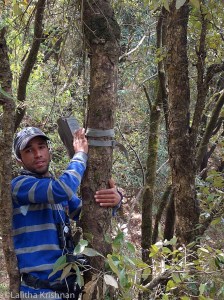
It was a rare opportunity and privilege to walk with these two very knowledgeable people besides being a great way to spend a morning.  I began to hear and learn new things every step of the way. The  JNR* has undergone an astounding transformation in a short span of time. Revived species of plants are visible everywhere. The forest is resounding with bird calls.  One sees a variety of scat. The reserve takes on a different look every season. Right now, the Rhododendron trees are adding vivid bursts of red to the hillside. JNR is also home to various animals and birds that we didn’t know existed in our vicinity but for camera-traps that have digitally captured them. Seeing is believing!

I came away with a deeper appreciation of the space I share with wildlife and more respect for conservationists like Hails and Rawat, and their fellow environmentalist Sejal Wohra, who runs the reserve with a lot of passion and sparse funding. Moreover, it made me realise that the onus of preserving wild spaces like this rests equally on people like me and you – the community. 

Nature reserves and green spaces are vulnerable and do disappear to make way for “developmental” projects for several reasons. When that happens, species disappear overnight. So please, if you haven’t already, do visit a nature reserve or forest/lake/natural open space close to you. Pack a picnic lunch. Learn about species you share the habitat with. You may well be surprised by who and what resides so close to you. Take your friends along. Donate. It’s easy. Volunteer. It’s a little harder but certainly doable. Contribute in any way you can. Start a club. Share on social media. Keep your backyard and enjoy it too.

*JNR is a part of an initiative set up as a private partnership between the owners of the land (the family of the Late Shri J P Jain) and Sejal Wohra (Programme Director WWF-India). Thanks to their joint efforts JNR is a perfect example of what can be achieved with the cooperation of locals and the know-how of professional environmentalists.
viru
The local villages are involved in the protection of the reserve. Tree lopping and cow grazing have altogether stopped. The local are receiving training and employment and have turned into protector of the forests

Follow me on Google Plus and Instagram


If you would like to get involved with JNR write to sejalwohra@gmail.com or visit http://www.Jaberkhetnature.com
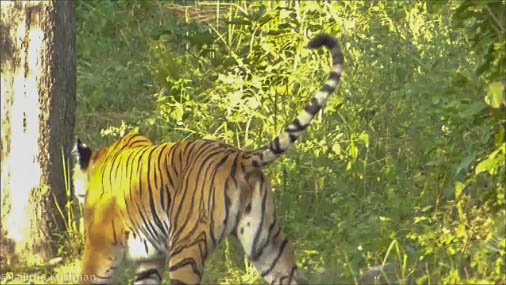


Tigress, Tigress Burning Bright

William Blake knew what he was talking about when he penned his poem, The Tiger. I saw this beautiful tigress scent her territory in Corbett, seemingly unperturbed by jeep loads of tourists capturing her every move. It was around 3-4pm , her coat looked like it was aflame in the dappled light. She confidently strolled ahead of us scenting every tree – letting us know we were trespassing.

Watch her on my You Tube channel:


The Tiger by William Blake.

TIGER, tiger, burning bright

In the forests of the night,

What immortal hand or eye

Could frame thy fearful symmetry?


In what distant deeps or skies

Burnt the fire of thine eyes?

On what wings dare he aspire?

What the hand dare seize the fire?


And what shoulder and what art

Could twist the sinews of thy heart?

And when thy heart began to beat,

What dread hand and what dread feet?


What the hammer? what the chain?

In what furnace was thy brain?

What the anvil? What dread grasp

Dare its deadly terrors clasp?


When the stars threw down their spears,

And water’d heaven with their tears,

Did He smile His work to see?

Did He who made the lamb make thee?


Tiger, tiger, burning bright

In the forests of the night,

What immortal hand or eye

Dare frame thy fearful symmetry?

Snapshot 3 (1-31-2016 6-35 PM)-3


When Street Dogs Attack Wildlife

Dogs on the hunt

nilgai

I was out with friends in the Little Rann of Kutch on 18th Jan 2016,  exploring the sanctuary for Asiatic wild asses and birds, when we came across this beautiful lone Nilgai (Indian Antelope) standing perfectly still. It was a great photo-op. As I zoomed in I noticed its eyes were focused at a point somewhere behind us.  Thinking it odd, we took our shots and moved on. Before we knew it the Nilgai turned around and started sprinting away with two dogs in hot pursuit.  Very soon a third dog joined the hunt. The chase continued for a quite a while. The antelope was tiring but the dogs looked like they would go on forever. As much as I love dogs,  I mentally rooted for the Nilgai.We didn’t quite expect to see wild dogs or a hunt. I did a second take when I realized these were strays. The sanctuary fringes a village. Never before have I seen strays attack wildlife.  There was nothing friendly or domestic about these dogs. They were plain wild. There was something wrong with the whole scenario. It wasn’t the same as watching a wild animal hunting another wild animal!

We kept our eyes on the animals till they disappeared from sight. What happened to the Nilgai? I’ll never know but I’m beginning to think something more needs to be done with managing strays. The incidents of humans being attacked by strays are multiplying. Now they seem to have found new hunting grounds.

Watch the chase here on YouTube: Street Dogs Chase Wild Nilgai

Grosbeak Alert From My Neck Of The Woods

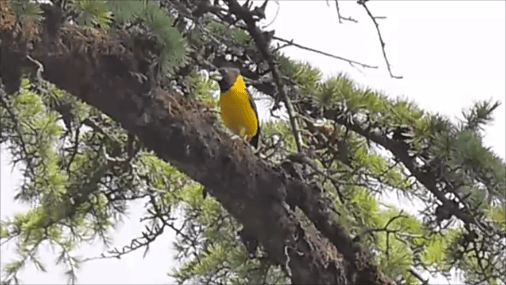
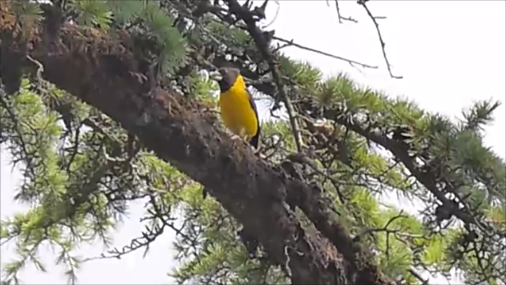
#Black-and-yellow grosbeak (Mycerobas icterioides)

Last month I was drawn to a new sound. Turned out to be a Black-and-yellow Grosbeak. I have seen them here in winter, in clusters on a bare tree. Their bright foilage and distinct bills made them hard to miss. Frankly, I think the word ‘gros’ is bit unflattering.

Here is my recording of the solitary (June) visitor who seems quite content with perching and pecking. Watch:http://youtu.be/A0D_BTcW6TQ

#Black-and-yellow grosbeak (Mycerobas icterioides)