Illegal Wildlife Trade in India with Dr Dipankar Ghose, Senior Director, Biodiversity Conservation, WWF India

Heart of Conservation podcast Ep #38 Show notes (Edited)

0:00:07: Hi, I’m Lalitha Krishnan, and you’re listening to Heart of Conservation. I bring you stories from the wild that keep us all connected to our natural world. Today, I have a very special guest, and we are going to be talking about the illegal wildlife trade. Illegal trade in vulnerable to critically endangered plants and animals is an organized crime network that has spread its tentacles across every continent.

0:00:31 Lalitha Krishnan: It takes a huge world network of very specialized partner organizations to bring down illegal wildlife trade. I’m speaking with Deepankar Ghose. Senior Director, Biodiversity Conservation, WWF India, to get the scope on illegal wildlife trade in India and abroad. He’s a conservator with three decades of experience under his belt, and I’m impatient to tap into his insights and hear of his battles on tackling the dark side of nature conservation.

0:01:00 Lalitha Krishnan: Deepankar, welcome to Heart of Conservation. I’m so happy to have you on board.

0:01:05 Dr Dipankar Ghose: Thank you, Lalitha. It’s an honour to be on this podcast.

0:01:12 Lalitha Krishnan:  So, you know, if one were to dig deep enough online, one could possibly see illegal wildlife trade routes for wildlife and exotic plants originating from our own country. With the demand growing, how serious a problem exactly is wildlife crime in India? And what numbers are we talking about?

0:01:36 Dr Dipankar Ghose: Well, first of all, let me congratulate you, or rather also thank you for bringing up a very important topic on wildlife trade. And today we are going to talking about the wildlife trade, more about the illegal wildlife trade. It is very big, unthinkably big globally. Now, when we come to India, wildlife trade in India is thriving because India is a source country. As long as countries, of course not India, but other countries continue to believe that rhino horn will cure cancer or a tiger bone vine will increase somebody’s strength our animals will continue to get poached. With a very high level of protection and dedication from the forest guards and tremendous support from the local community, poaching has been contained in many places, but it is still there. So we can’t say that poaching has stopped. What we need to also recognize is the fact that the culture of conservation in India, does not allow a tiger to be poached easily, right?

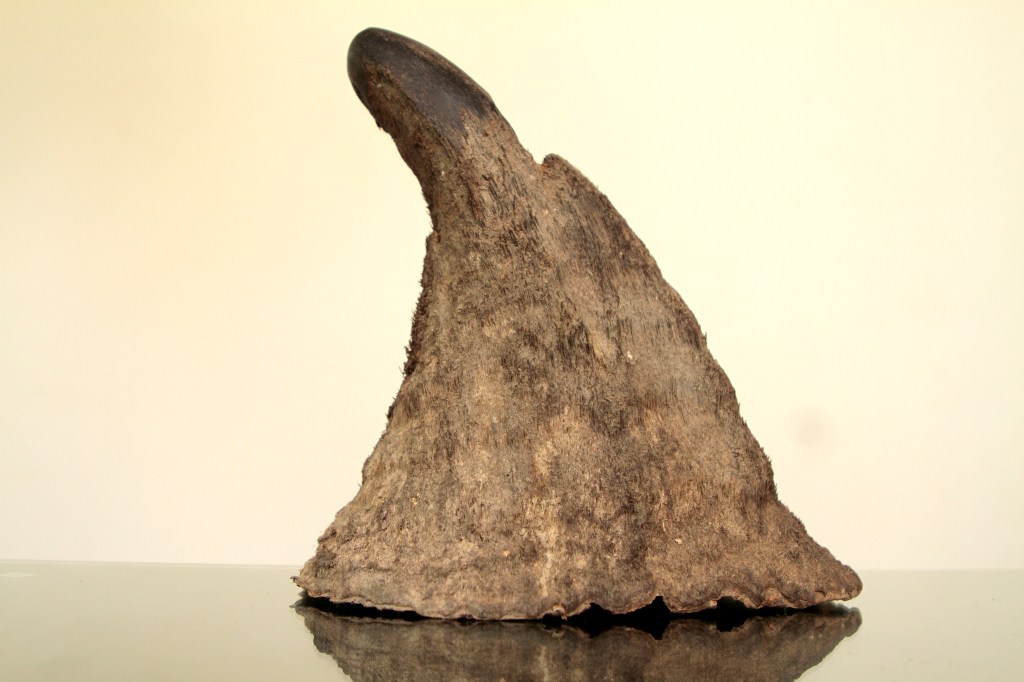
0:02:52 Dr Dipankar Ghose: So if, and we have actually seen it, that once a poacher in a village was identified, the person was kind of boycotted. So the local people support conservation, but it is the commercial nature of illegal wildlife trade. It is the very high demand and at times, pricing that allows the trade to thrive. Believe you me, rhino horn is nothing but a cluster of hair, which means it is keratin. Keratin does not cure cancer.
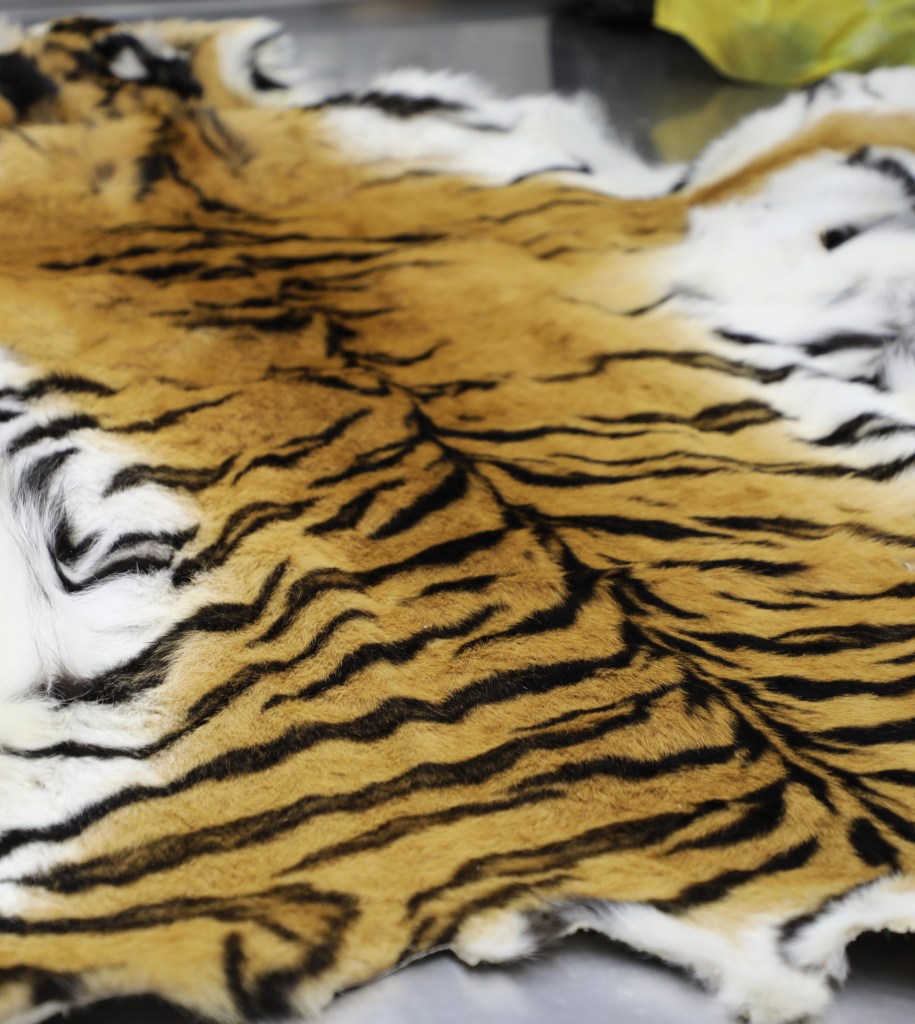
Tiger skin photo credit: Dr Saket Badola

0:03:25 Dr Dipankar Ghose: Same thing with tiger bone. It’s similar to any other carnivore bone. It will not add to the strength of a person. So while we are working in the country on strengthening protection and using modern tools to carve poaching, one also needs to work outside the country, which global organizations are doing to ensure that the demand is also reduced. So to answer your question, it is big, it is thriving, and India as a country acts as a source for some of these charismatic threatened animals. And we are talking about tiger body parts, rhino horns, elephant tusks, and sometimes even elephant bones and skins and blood bits.

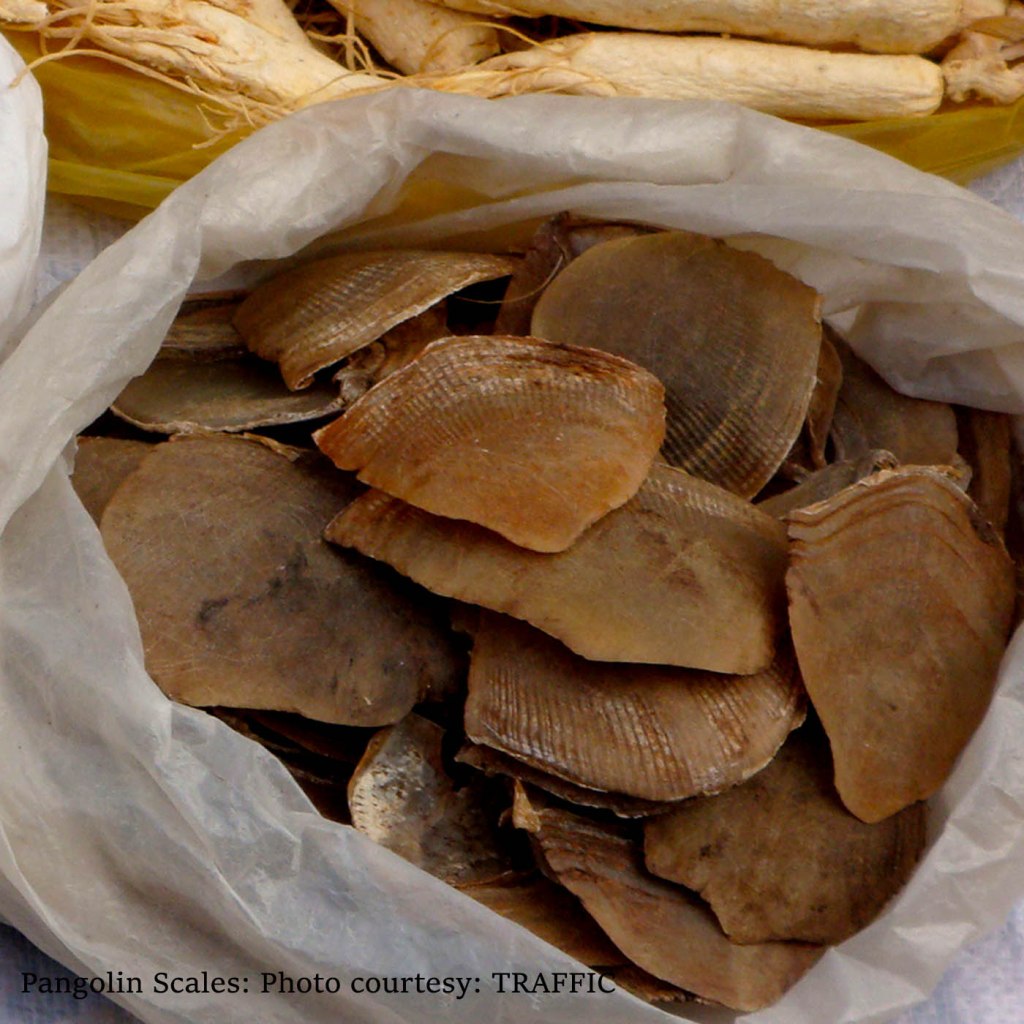
0:04:17 Dr Dipankar Ghose: We are also talking about marine species, freshwater turtles, pangolin scales, you name it. Most of the threatened species from India, animal species particularly, are in the illegal market.

0:04:33 Lalitha Krishnan: Right. It’s also like a catch 22 situation where we have so much and so much has been done to look after it. But at the same time, there’s a demand for all of this. So, you know, most of us have heard of tigers, rhinos being sold for medicine and skin, and the exotic pet trade of fish and birds. But most of us, I’m sure, in India, I’m not talking of the general public, who knows about the ‘conservation’ field… But, you know, a good number of us don’t even recognize the timid pangolin, which is part of this ongoing illegal network.

0:05:11 Lalitha Krishnan: And I read that 23.5 tons of pangolin were traded in 2021 alone. Of course, I don’t have the latest numbers, but why is it so?  Could we speak about why pangolins are the new tigers or the new most fashionable thing to trade?

0:05:29 Dr Dipankar Ghose: So pangolin scales are used in traditional oriental medicine, right? They’re never used in their fresh form, they’re used in their dried form. And there are papers published in reputed scientific journals which say that— there’s one particular paper I can send it to you—which says scales are burnt, roasted, ashed, cooked in oil, butter vinegar, boy’s urine, or roasted with oyster shells to cure a variety of ills.

0:06:00 Dr Dipankar Ghose: Among these are excessive nervousness and hysterical crying in children, women possessed by devils and ogres, malarial fever and deafness. So many pangolin skeleton requests for this purpose that yearly, the scales from some 5000 individuals were imported from a particular country. And these are all going into traditional Chinese medicine. The challenge again is the belief whether the scales have that kind of a property is not scientifically proven, but they are going to be used all the same as the rhino horn. It is keratin, which we know, does not cure cancer.

0:06:44 Dr Dipankar Ghose: Right. If it could be a cure, then probably we would have eaten up all our hair or bitten off all our nails just to prevent cancer from happening. But it doesn’t help in any way. So same thing with pangolin scales. And what we are also hearing is that pangolin scales, because the belief is they cure a lot of illnesses, they help women to lactate and stuff. People started using dry pangolin scales as a hair comb for combing their hair and brushing their hair.

0:07:20 Dr Dipankar Ghose: They make tiny combs out of those scales or use them as guitar plucks just to have a feel, just to touch a pangolin scale. So it’s deep in the belief that the challenge is that the users do not understand that a species is going to be exterminated from nature. Just because there is an unscientific belief in their mind, in oriental medicine, that’s the challenge.

0:07:51 Lalitha Krishnan: And this is such a small creature, it makes it even more vulnerable to ignorance you know?
0:07:58 Dr Dipankar Ghose: Absolutely. I tell you about 20 years back when many tiger skin seizures happened from India and Nepal, some of those seizures had also recorded the trade of otter skin. And then one found out, and I had been to Tibet and figured out this otter skin was used to make collars of coats of chuba. Why? Because otter skins have a very good waterproofing quality or character. So when it is snowing or it is raining, snow won’t settle on a coat which has got an otter skin collar. Now, my point is that in this time and age, when we have so much synthetic material use why kill a poor otter in the wild?

0:08:47 Dr Dipankar Ghose: And you’re not, not using farmed sablel hair, but you’re actually killing wild otters to use their skins on your coat.

0:08:56 Lalitha Krishnan: Makes my skin crawl. Is this still going on?

0:08:59 Dr Dipankar Ghose: Yes, we still hear otter skins getting seized. It’s like—at some point of time—in some parts of eastern India, Banded Krait, which is a very… it’s a poisonous snake, but a very docile snake. The Banded Krait was almost exterminated because there was high demand from the fashion industry to manufacture leather bags of Banded Krait skins. You know, yellow and very bright yellow and black stripes.

0:09:30 Dr Dipankar Ghose: That kind of exterminated the Banded Krait, which created another problem, because the Banded Krait, thrived on smaller snakes. They ate small snakes, and one of their food snakes was the Common Krait. So in Sundarbans, the hypothesis was that many people started encountering Common Krait. You see them inside your homes and fields, and you’re somebody getting into the farming room and stuff and getting bitten and bitten in odd places, odd times and dying.

0:10:04 Dr Dipankar Ghose: And one of the reasons scientists and naturalists who were working on this had said, “If bandit crates were there and there were a high number of Banded Kraits, they would have kept the population of Common Kraits.” I mean, that exactly is a typical maintenance of ecological balance. You know, one creature maintains the balance of another. But we took out the Banded Kraits, they were poached for fitting into the fashion industry.

0:10:33 Dr Dipankar Ghose: Demand for snake skin all gone, you know. So, I mean, we sometimes do not even think of… there is the whole illegality of it, but there is also the ecological aspect of it. And many a time one doesn’t see the ecological aspect. At some point in time, in the southern part of the country, the large tuskers were all poached, and most of the tuskers were poached. So the sex ratio was skewed and breeding success went down because the makhnas or the tuskers with smaller tasks were not selected by breeding-age females.

0:11:10 Dr Dipankar Ghose: Now that’s getting recovered in successful conservation initiatives, its population is recovering. So there is this whole ecological aspect which also needs to be looked at when we deal with illegal wildlife trade, right?

0:11:25 Lalitha Krishnan: And also communicated, I don’t think people realize what happens if you take all these species, especially keystone species off the picture. Wow, that’s interesting. Have you ever personally out of choice or otherwise been involved in particularly monitoring or witnessing wildlife training?

0:11:49 Dr Dipankar Ghose: Well, in my previous avatar, I was working with another organization and I was in charge of the enforcement unit: Wildlife Enforcement unit. So NGO’s and civilians… we are not authorized to take any enforcement action. So we worked very closely with government agencies, and enforcement agencies and monitored illegal wildlife trade and at some point in time also helped the government to bring an end to that trade. So this was around 2003, 2004 when I was working with another organization and we worked with the government of Uttar Pradesh to curb trade, or rather illegal trade in mongoose hair paintbrush.

0:12:35 Dr Dipankar Ghose: And initially what looked like a small industry of manufacturing paintbrushes, which is sold to the artists and students, we figured out that some of these brushes were actually getting into the fashion industry because that was one of the most preferred brushes, organic brushes for painting or face painting or colouring or masking. It was quite a long process. When we monitored this trade, often working with government agencies involved a lot of meticulous planning, careful planning and taking utmost care not to expose some of the people who were giving that information.

0:13:20 Dr Dipankar Ghose: And ultimately working with the government to curb the trade and bring the offenders to the book. So yes, I did that. But from WWF currently, we are not into any of these enforcement actions. If we get to know about any illegal trade, whether it’s through online monitoring or whether it’s based on information received by any of our field members, we immediately pass on the information to the nearest government authority, either the wildlife crime control bureau or the forest department.

0:13:56 Lalitha Krishnan: I mean, who would imagine part of your makeup is from a mongoose? To even think that, it’s just so sad. Could you explain what the wildlife trade chain is? Just to have some basic understanding.

Sable fur skins in Milan. Photo by Kuerschner – Own work, Public Domain, https://commons.wikimedia.org/w/index.php?curid=3734346

0:14:18 Dr Dipankar Ghose: It’s very, very interesting. And I will take the example of Sansar Chand. And often people used to say that Sansar Chand is the Veerappan of north India, but that’s not true. So Veerappan was a person who was extracting sandalwood and who was also trading in sandalwood. But mostly his job was extraction and some bit of trade. Right? When I say extraction because it was plants, it was trees, which he was into, timber, which he was trading in and smuggling.  Come to north India, a Sansar Chand, Sansar Chand was not a direct poacher. He might have instigated or asked somebody to poach an animal, but he was essentially a trader, a big-time trader of wildlife derivatives.

0:15:08 Dr Dipankar Ghose: So there is a change in the process that we are seeing. Earlier, there used to be poaching syndicates and illegal wildlife trade syndicates which used to manage some of these. But with the advent of the Internet and social media and the dark web, a lot of supply chains and logistics solutions, we are seeing that the trade of illegal wildlife products is now going online. There was somebody who was announcing that, “Hey, I have this particular animal and a live specimen. If you would like, contact me”.

0:15:46 Dr Dipankar Ghose: And not even through the dark web in a masked way…he was presenting it on an online platform. Obviously, enforcement action was initiated against the person. So the chain happens is that from the point of poaching, from the source point, it crosses our borders, land borders, primarily through Nepal or through Bhutan or through Bangladesh. Otherwise, it’s through the seaports. A lot of seizures of star tortoises have happened in the seaports.

0:16:18 Dr Dipankar Ghose: Marine products through the seaports. And some fancy products are also very expensive, like shatu shawls. They are also transported by human carriers. E.g., a passenger would buy a shahtoosh shawl in India and they would take it in person when they would fly out of the country. So it’s mixed and there is no one particular trade route, but essentially a land route through the northern and eastern border.

0:16:46 Dr Dipankar Ghose: Northeast has become, especially the Indo-Myanmar border has become particularly vulnerable to illegal wildlife trade. So, yes, land routes from those sides, seaports and sometimes also air routes.

0:16:59 Lalitha Krishnan: It’s more complicated than we can sort of figure out or understand.

0:17:06 Dr Dipankar Ghose: Yeah, indeed.

0:17:08 Lalitha Krishnan: At the same time, it looks so simple. I mean, a passenger taking a shawl across would be not suspected at all. Crazy.

Leopard skin photo credit: Samir Sinha

0:17:17 Lalitha Krishnan: You know, talking of technology, it’s always evolving. Would you like to tell us something about environmental DNA or eDNA that WWF uses or something new that we might not even be aware of?

0:17:35 Dr Dipankar Ghose: A  very good question. We do not have a laboratory and we work primarily with government agencies. eDNA, technology is evolving and I hope that one day, subject to the availability of our resources, we will be able to get into the eDNA space and strengthen the work that researchers and officers from the government are doing. But there is something that we started about seven, eight years back. This is called the  RhODIS® -Rhino DNA indexing system, where we have been partnering with the Ministry of Environment, Forest and Climate Change Government of India (MoEFCC) and the Wildlife Institute of India(WII) to establish this system.

0:18:21 Dr Dipankar Ghose: The technology was borrowed from South Africa. I would say, users and initiators of the technology transferred the technology to the laboratories here and now the Wildlife Institute of India have the marker for rhino populations from all the wild, rhino-bearing areas of India. So what happens is that once a rhino is poached and its horn is collected, and if there is any tissue in it and DNA can be salvaged from there, then the rhino DNA is matched and the population where from it was collected is identified, which helps in strengthening the case. The prosecutor can then pinpoint and say that, okay, hey, this particular rhino horn, which might have been seized in a city, can say that, well, this matches with the population here.

0:19:17 Dr Dipankar Ghose: And if a carcass has been found and the DNA samples obviously, have been collected from that carcass, then that horn might even be matched with the carcass of rhino, which was poached. And, using this information, in the recent past, one conviction has happened where a person who was in possession of a rhino horn, was matched with a poached rhino. And then the call details record also showed that the suspected poachers were also talking to this person who was a trader. So this kind of technology also helps. Earlier, it would have been impossible to establish a link between the trader and the poacher. And although the case would be there when a ScheduleI species derivative would be seized from the possession of a civilian, the case would get strengthened if it could be linked with a particular poaching incident.

0:20:14 Lalitha Krishnan: That’s so interesting and so nice to hear that. So it’s not only concrete evidence, but it’s speeding up the whole process of catching them before they leave the territory, wherever that is. Or the country, I suppose. Apart from the latest technology, which is also available to crime networks, what other methods or soft tools do you think are imperative to keep illegal wildlife trade at bay? What does WWF do?

0:20:50 Dr Dipankar Ghose: Again, a very good question. I think technology is important and we are working with the government agencies to help them with technology. There is a simple tool which was promoted by WWF and now many agencies use it. It’s called Deep Search Metal Detector, used to find leg snares. Sometimes these leg trap snares, metal snares, are put on the forest floor, primarily meant for catching carnivores like tigers and leopards and sometimes even herbivores. Now these DSMDs, the Deep Search Metal Detector would help a person, a forester, a forest guard, or a ranger, to find a snare.

0:21:38 Dr Dipankar Ghose: It would also, in a crime situation, help the officers to find empty cartridges or bullets or shells or metal cells or even a weapon if that was hidden in the nearby area or near the crime scene. So we also use forensic kits and stuff. But the most important fact remains that protection can be strengthened by increased patrolling, surveillance and support from the local communities who are residing within or adjacent to these wildlife habitats.

0:22:18 Dr Dipankar Ghose: These three things are of primary importance. Protection, surveillance, and community support. So we work a lot with the authorities, with the protected area managers or reserve forest managers, which are wildlife habitats, to strengthen protection, help them in surveillance using something like sniffer dogs, which could continue or which could help in the investigation, finding a spoor and also work on securing community support against wildlife crime.

0:22:56 Dr Dipankar Ghose: There is one area I would like to mention in the Terai particularly, in Uttar Pradesh. We have been able to establish, together with the forest department and local panchayats, a group of volunteers who are there to protect tigers. They’re called Bhag Mitras and there are about 500 of them. It’s a fully voluntary force and their primary role is to help the authorities in managing human-tiger conflict.

0:23:25 Dr Dipankar Ghose: Whenever there is a challenge: a tiger is in human dominated landscape, these people come out and they form the first line of defense. So this really helps in managing conflict. But this also deters a suspected poacher. Because with so many people trying to protect the tiger, a poacher would not dare to go there because this particular group of people would then not support or would do something to stop poaching.

0:24:01 Lalitha Krishnan: First line of defence.

0:24:04 Dr Dipankar Ghose: Yes, indeed.

0:24:05 Lalitha Krishnan:  My next question is how does your partnership with other agencies like TRAFFIC (Trade Records Analysis of Flora and Fauna in Commerce) help fight wildlife trade in India? Or do you have other partners and what are their different roles?

0:24:18 Dr Dipankar Ghose: So traffic is part of WWF and I am also the Interim Head of TRAFFIC in India for the last two years. And so it’s the same team which is working whether we call it TRAFFIC or WWF. But in terms of partnership, we partner a lot with not just government agencies but also NGOs and other intergovernmental bodies. We recently partnered is the South Asian Wildlife Enforcement Network (SAWEN) and the Global Tiger Forum in capacity building of enforcement authorities along the Indo Napal border at a very, very high level and a strategic level.

0:24:57 Dr Dipankar Ghose: We also work with other NGOs while it talking about capacity building or curriculum development for ranges. So most of the partnerships are through the government agencies coordinated by the Wildlife Crime Control Bureau or the State Forest Department or the Ministry of Environment, Forest and Climate Change where we partner with other enforcement agencies or with other NGOs.

0:25:25 Lalitha Krishnan: Dipankar, whatever you’ve been telling me, it’s such an insight. There’s so much, as ordinary citizens that I don’t know, and I’m sure most people don’t know most of what you’re talking about. So thank you so much for those insights.

0:25:39 Dr Dipankar Ghose:: You’re welcome.

0:25:40 Lalitha Krishnan: I kind of know the answer, but I don’t know the answer. So is illegal wildlife trade a people problem or is it a government problem?

0:25:52 C: It’s a problem of both sides.

0:25:55 Lalitha Krishnan: All right.

0:25:56 Dr Dipankar Ghose: Why is it a people problem? It’s the people who do the poaching. They are normal people. What is driving them to poaching is different, but they are poaching.

0:26:08  It’s the people who are the traders, right? It’s the people who know about it but are keeping silent about it. And I’ll give you another insight, which is India is also becoming a consumer country, right? For what? For exotic pets. We have created a report from TRAFFIC India last year and you can download the soft copy from our WWF India website. We are becoming consumers of exotic pets in the country. All the way from a kangaroo roaming around on the highways of north Bengal, to vultures, to wildcats, to a lot of exotic primates from Latin America. Where are they all going? We don’t have these animals. They are all coming to India as pets. The more people have affordability and more people have disposable money, they would like to do something exclusive.

0:27:08 C: Dr Dipankar Ghose: And you can’t keep any Indian bird or an Indian mammal as a pet because that’s illegal under the Wildlife Protection Act. Right? So instead of going the legal ways of, you know, keeping budgerigars or there are some captive-bred birds which can be kept as pets legally, people are trying to find exclusivity. It’s like, okay, this person has a ball pen, and that’s a Reynolds or Uniball. I want something exclusive. It doesn’t mean that the price has to be double or triple or four times, but it has to be exclusive. So people are always looking for that exclusivity. People are always looking for the attention. So it is a people’s problem.

0:27:51 Dr Dipankar Ghose: It is also a government problem because people can reduce the demand, but ultimately, enforcement actions will have to be taken by the government.

0:28:00 Lalitha Krishnan: Right.

0:28:00 Dr Dipankar Ghose: So it’s a problem of both. That is why I have always been saying on this podcast, as well as whenever I am talking about it or writing about this particular issue, that the support of local communities around the forest areas is of paramount importance if we are trying to stop poaching. Similarly, the support of people, of the business people or the people who are engaged in supply chain management is of paramount importance if we have to stop illegal wildlife trade through the usual supply chain or the usual logistics channel. So that is why there has to be an active involvement of people and, of course, government actions which are already going on.
Rhino horn photo credit: Dr Saket Badola

0:28:47 Lalitha Krishnan: Okay. And, you know, what can a citizen do to report a crime of this level without risking his own life? Is there a channel? Is there any way he can report stuff that you see?

0:29:02 Dr Dipankar Ghose: Of course, one can make anonymous calls to the Wildlife Crime Control Bureau and it’s a very responsible government authority. But sometimes what happens is that in these anonymous calls, the veracity of the call or the verification can’t be done. So if a person is giving any information to the Wildlife Crime Control Bureau, they take care of it, you know… so they, they take care of what’s the problem and why this problem has happened and stuff.

0:29:35 Lalitha Krishnan: Great. So I’d love to hear some, you know, positive stories or personal stories that give us all hope. I’m sure you have quite a few of them.

0:29:48 Dr Dipankar Ghose: There is hope because if you see so many tigers moving out of the protected areas-India has 3600 plus tigers, where that’s the mean number. It could be more, it could be a few hundred tigers more or so, right? If we are considering about 4000 tigers, adults and maybe some young ones included, 25% of those tigers are moving outside the forest areas, outside protected areas, and they are in the agriculture fields.

0:30:24 C: They are passing through here and there, right? Passing through human-dominated landscapes. There are challenges, but the tolerance of people for those tigers or to keep those tigers or tolerate allowing those tigers to be in the human-dominated space is tremendous. The tigers are allowed to be there, otherwise there would have been challenges. There have been occasional incidents where people got killed, or injured, tigers got lynched.

0:30:53 C: But if you look at the scale, in a country of 1.4 billion people, we still have 4000 tigers, we still have 27,000 plus elephants, so many rhinos, so many herbivores, leopards, conflict is there, poaching is happening, but still we have all these. Right, show me any other country which has got very high, I won’t say numbers, but a very high density of human population like we have, but still has so much wildlife wealth. It’s there in India only. Right?So that talks a lot about our tolerance and I think that is the positive story.

0:31:30 Lalitha Krishnan:: You know, also those numbers may bring cheer, whatever said and done. Yeah. No, no other country has that I think. This is my last question to you. You’ve shared a lot, a lot of food for thought, but would you like to share a word or an idea or something that you feel strongly about that you would like our listeners to remember, about wildlife crime? It could be anything.

0:31:57 Dr Dipankar Ghose: Only one thing. If you see anything unusual about wildlife, whether one is travelling by public transport or travelling by a forest area, village, or urban area, report it. I’m sure that anybody who is listening to the podcasts also has an email ID, right? So send an email to the authorities, to the Wildlife Crime Control Bureau. You don’t need to judge whether it’s a crime or it’s not a crime but inform, you know, just stay alert and inform that, like we do, when we see any unusual movement in the neighbourhood and we call up the police, a similar sort of alacrity has to be there if we are to stop wildlife crime.

0:32:42 Dr Dipankar Ghose: I would just like to leave that thought with our, with our listeners.

0:32:47 Lalitha Krishnan: That’s a great thought. You know, sometimes we don’t think we can do anything of the sort. We’re so scared of the consequences. But when you say it’s safe to report, then I think more people will and should.

0:33:00 Dr Dipankar Ghose: Yes. Send an email. Send an email to Wildlife Crime. Send an email to the  Wildlife Crime Control Bureau and with just an email ID; let the authorities reach out to you if they see that this is, this is important, this is something that they could work on. I know they might come back to you saying that, “Okay. We would like to work on it”. Or maybe some officer might contact you.

0:33:21 Lalitha Krishnan: Okay. That’s super. That’s great. Thank you so much. This has been so enlightening and so good.

0:33:30 Dr Dipankar Ghose: Thank you.

DipankarGhose #WWF_INDIA #TRAFFIC #IUCN #Tigers #Rhino #Poaching #IllegalWildlifeTrade #Veerappan #CITIES #WildlifeLawEnforcement #ExoticPets #SAWEN #Pangolin #SansarChand #SmugglingSpecies #wildlifeproducts #exoticplants #rhinohorns #tigerskin #pangolinscales #LalithaKrishnan #HeartofConservation #critically_endangered #storiesfromthewild #podcast

Pangolin photo: Rajesh Kumar Mohapatra Podcast cover art created by Lalitha Krishnan

Birdsong by hillside resident, the collared owlet.

All photos courtesy as mentioned in caption /photo

Podcast artwork by Lalitha Krishnan

Disclaimer:Views, thoughts, and opinions
expressed in the podcast and show notes belong solely to the
guest/guests featured in the episode, and not necessarily to the host of
this podcast/blog or the guest’s employer, organization, committee or
other group or individual.

Acrobat of the Sky, Dweller of the Heart: The Barn Swallow.

Barn swallow. Photo by Rajdeep Mitra

Heart of Conservation, Episode #33 shownotes. Read or listen on several platforms.

Introduction:

Hi, I am Lalitha Krishnan and you’re listening to Ep# 33 of Heart of Conservation. I bring you stories from the wild that keep us all connected to our natural world. You can listen to Heart of Conservation on several platforms and read the transcript right here on my blog Earthy Matters.

Today I feel very privileged to be speaking to my mentor Dr Suresh Kumar who spiked my interest and knowledge in nature and everything wild during a citizen’s course for wildlife conservation at the Wildlife Institute of India, Dehradun, Dr Suresh is remarkable wildlife biologist who specialises in animal ecology, migration and movement studies, conservation biology. Since 2008 he has been a teacher, trainer and mentor to several students at WII.  He has crisscrossed the country in pursuit of wildlife conservation.  Be it discovering a new species of pheasant, studying macaques, using satellite telemetry to obverse the distribution of olive ridley turtles, tagging and following long distance migration patterns of Amur falcons and mapping habitats of the Great Indian Bustard, Dr Suresh has several feathers in his cap.  He was also part of the 29th Indian Scientific Expedition to Antarctica in 2009, where he conducted aerial surveys for marine mammals and birds. I always look forward to snippets of his many wildlife adventures that he updates us with in his unique storytelling style.

 I am also very happy to have as a guest on today’s episode, his research student Amarjeet Kaur, completed her graduation and post-graduation from Delhi and then moved to Wildlife Institute of India. At WII, she first started her journey working on the migration and conservation of Amur Falcons in Nagaland and Manipur, and thereafter, joined for her PhD on another long-distance migratory bird. Amarjeet is now completing her PhD on the first study of Barn swallows in India. Together they have been working on a lesser-known species that most of us take for granted.

Thank you both so much. Welcome to the Heart of Conservation podcast.

1. My first question is why is your research focused on the Barn swallow? Why not some big exotic or rarely spotted species?

2:35

Dr Suresh Kumar: Thank you Lalitha for having us in your podcast. Well, you asked quite a challenging question especially when there are so many beautiful birds all over; not that the barn swallows are not beautiful but to me they are very unique. They are an extremely interesting group of birds and that they are long distance migrants, very common;  it’s a human commensal. It lives very close to people. it actually literally requires people to actually survive and they are long distance migrants like I mentioned earlier. They are possibly travelling 1000s of kilometres like many other species.  And in India, the barn swallows come to the Himalayas to breed. So, they are summer breeding visitors and by the time the monsoon arrives, they leave. So where do they go? There are some interesting details about these birds that we still don’t know. I think Amarjeet will possibly be able to  tell you a little bit more about the local connections, the cultural connects of this bird and it’s very interesting.

3:58 

Amarjeet Kaur:

Very interesting question that you asked. So, I just would like to mention that because this podcast is all about barn swallows, I think it is a unique bird also because we are giving it so much importance.

in fact

Lalitha Krishnan: In fact, some of the facts you brought up are also my questions. Barn swallows are often seen –in fact they are still seen as we know–nesting in small shops here in the hills. Why do they nest inside shops and houses so close to humans? You mentioned they need us. No other bird does that except perhaps the Red-rumped swallow which is not as common though.Somehow humans too do not seem to mind barn swallows.  They may not generally like a crow nesting in their shop if you know what I mean.

Amarjeet Kaur:  Again like you rightly mentioned that humans also don’t seem to mind. Barn swallows, they love to go inside the houses inside the shops as we have found out during our surveys and it is not just in India, it is everywhere that they are actually dependent on human buildings or shops and houses.  So what is so unique about these birds? Earlier they never used to, as is mentioned in literature, they never used to nest inside shops. And it is not just in India, it is everywhere that they are actually dependent on human buildings or human houses.

So what is unique about these birds?  Earlier they never used to nest inside shops.They used to nest in caves and crevices. And, they are such a smart species that as they found out humans are coming up with the buildings they found that right opportunity to get in. So what is the use? Why are they actually nesting inside saree shops which are so busy? If you go to Nainital market you will be astounded to see that it is so crowded. Barn swallows don’t seem to mind, they just lie around, feed their chicks and they are just there. It’s because they actually get an additional protection for their nest from predators. 

Because, when you observe the nest, you’ll see it is a mud nest  but it is open from the top. So I have found in the nest, when there are less nesting spaces, they have to resolve to the outside– in corridors– and they build their nests in corridors. And those are more prone to attacks by predators or by other commensal species so they see a lot of competitions in other species so that’s why they are more prone to go inside your house and make the nest And, like the red rumped swallow that you mentioned, I will just like to add they again build mud nests but their nest is closed/tunnel shaped so they don’t need that extra protection. That is what red-rumped swallows can nest outside, it’s because their nests are closed.

7:01:

Dr Suresh Kumar: Just adding on to what Amarjeet said, it will be interesting for your listeners to know that while we generally talk about human footprint, and how this has literally shaped the environs around, and we mostly look at it from a negative connect. Right? About displacing species from their natural habitats. But strangely there are certain species which benefit from human activities, changes in land use types because of humans or people. And, I think barn swallows are fantastic examples of that. The name ’Barn’–it was otherwise known as the Common swallow earlier– but the name ‘barn’ is because of its strong association to the barn. And, this is a very western thing. Like in America, in the rural areas they have  a barn to stock all the food that is required for their livestock. Here in India, in the Himalayas, we do have such a thing but it is not like they live in the barns. They live in people’s houses. And, I think there is an interesting connect here to religion. To the hindu religion, or for that matter to other faiths also…the Islamic faith or the Christian faith…anywhere you find people of different faiths living here in the Himalayas, they all have a very strong connection to these birds. They refer to these birds as Amarjeet will call the ‘Devchidya’, locally known in some places as ‘devchidya’-the God bird of the Himalayas that we would say. They are related to the significance of wealth or prosperity. So, if these birds come into your property to nest naturally, it’s a sign of prosperity. So it’s welcome. For the hindus, it’s a Laxmi avatar. 

9:9

Coming to the other question as to why barn swallows have evolved this strategy of nesting inside people’s houses or in shops. I think in the natural world there is always some competitive force or the other. There is also this major predation pressure. So, there must have been in the evolutionary period of time, there must have been strong predations affecting populations of barn swallows,probably everywhere. And those populations that started to nest closer to people’s houses and then taking the benefits of moving into people’s houses to nest may have survived. That’s how this shift from the natural environment which Amarjeet mentioned–nesting in- caves-might have moved to now, living with people. Also if you see, during this so-called evolutionary period of time, humans have also begun to settle down. I would say, with settled agriculture, these birds also had started to evolve the strategy of living closer to humans and thereafter, literally being commensals. 

10:31 

Now, the other interesting point that Amarjeet mentioned is, then why didn’t the red-rumped swallow also nest inside? Whether it makes a cup-shaped nest or tunnel shaped nest–they are mud nesters.They could have also moved in. Hare, it appears like there is an understanding among the red-rumped swallow and the barn swallow. In a simplistic way of looking at it, “Hey, we will nest outside, you nest inside.”Compatibility Okay?  So if I have to look at it from a more technical point of view, here it is competition for nesting space. So, they would be highly territorial in terms of holding onto a property. 

Among barn swallow individuals you will see strong territoriality. They will chase one another away. And some of these birds come back to the same nests to nest every year. In the same house. So, territoriality plus competition for space has shaped this. So the red-rumped swallows, the poorer cousins of the barn swallows, are forced to nest outside. So, there also, because of predation pressure, are nesting close to human households. But here, nesting outside would still evoke some predation. So, they have evolved the strategy of completely closing their nest with a very narrow passage tunnel for them to enter in unlike the barn swallows’ which are cup shaped and exposed. So they build it inside.

12:08

It’s amazing when you see these birds, all swallows,closely related, and how they are associating with humans and the understanding amongst them. “Okay, I nest inside, you nest outside. My housing architecture will be this way..” “Mine will be this way.” 

12:33

Lalitha Krishnan: We have a lot to learn from the swallows. I wish we would behave like that especially when it comes to housing. And be nice to our neighbours. So, all shops shut for the night. Where do barn swallows go when that happens? How do they understand and manage our concept of time?

12:44

Amarjeet Kaur” That’s truly an amazing question. Because those who are unaware of barn swallows nesting may wonder  where these birds go at night. These birds perfectly time their arrival and departure from the shops with the shopkeeper. They know the time the shop closes so they enter just before the shops are going to close. Early in the morning, they will actually wake up the humans–if the house is also attached to the shop–they start their chit-chat, chit-chat ..almost like, “Let us out, let us go out.”

13:21

I have interviewed so many people and they often say, “these birds start calling us at 4 o’clock  in the morning and we have to open the shutters for them. Because their chicks are in the nest, the swallows have to go out and fetch food for them. So, somehow for every different shop, the timing matches perfectly. It could be because, every year, they are coming back, they know the shop’s closing time. They were really affected during COVID. What happened everywhere during Corona is that shops were closed. Some birds were actually inside the shops. What some owners did was, they shooed away the adult birds but they couldn’t do anything about the chicks..the juveniles. So a lot of shop owners actually saw failed nesting. But, again, the hill people, they are big hearted. They made a space for barn swallows to enter. They cut their shutters just for barn swallows to enter.

14:30

Dr Suresh Kumar: They would create openings.For example, if the birds were nesting inside the house, we have seen places where they have removed the glass pane from a window so that the birds could enter. This is truly amazing. We’ve been talking about this from the bird point of view but when you look at it from a people point of view, people just love these birds. Of course, they have that religious connect and look at them as very sacred birds and things like that but even otherwise, like Amarjeet was mentioning, the birds know when the shop is going to be shut. But, there were many times when the birds wouldn’t arrive and the shopkeeper would wait for a few more hours for the birds to come. He would keep the shutter open. So, you can imagine the kind of association that people have with these birds. And, they are very strongly protective. They wouldn’t allow anybody to touch them. It will almost be like touching distance where they would make the nests. Birds also recognise the owner of the shop–seeing him day in and out or the people residing in a particular house. If there is a stranger like me and Amarjeet, walking into a shop, immediately  you will notice an alert  behaviour, they will be looking at us differently. I think in the minds of these birds they know, they have facial recognition clearly. They are able to distinguish. So, when I look at barn swallows,  and when I particularly go back every year and look at those individuals, which we have possibly caught previously and put a ring on them and they look at us…they know… Hey, these guys have come back.

16:15

Lalitha Krishnan: It almost sounds like a pet’s relationship with its owner except these birds are free to come and go but it seems like the same association. 

16:31

Amrjeet Kaur: There is a general perception that in the north-east that everybody is a hunter. If you go into the forests, you don’t see much wildlife, specifically in Nagaland. When we entered Manipur, in Imphal valley, only in this valley are the (swallows) nesting. They are not nesting as they nest in Uttarakhand at higher elevations. They are nesting at 700 metres in the valley. And, there again, people are protecting them. They again consider them as Laxmi or good fortune. If you go there from kids to the elderly know the word ‘Sambraang.’ You just have to say the word and they will show you the nest. That bird is that popular. Even in the main city of Imphal centre. 

17:13

Lalitha Krishnan: Amazing. Dr Suresh you did speak about swallows migrating but because of that one doesn’t see barn swallows all year. Where are they migrating from?  What distances do they fly?

17:31

Dr Suresh Kumar: Well, at this point in time, we don’t know. Before I get into the technicalities of this question, I’d like to tell you about what Amarjeet and I have been reading about what people generally think about barn swallows. Where they come from. I think Amarjeet will be happy to share that information about what people think. They all know the swallows come from somewhere. Or rather, where they go after breeding.

18:08

Amarjeet Kaur: I want to narrate a beautiful story of a shopkeeper I met in north Bengal. .He said.” I think the mother birds, after completing nesting, they go and take a dip in Kashi and they devote their souls to the heavens”.  I said, “Why do you think like this?”  He mentioned that his grandmother was curious and since then, they had been observing these birds. One day she tied a thread on this bird because birds were also accustomed to them. They knew them as Dr Suresh had mentioned. She tied the thread and next year, the thread was not there.From that point onwards they thought that adult birds go away after completing the nesting. They go and take a dip in the Kashi -in some river and they never return.  The birds that return they think are their juveniles. That’s what people believed. 

19:19

Again, the ringing that we did last year created that amazement in people. They could see their birds returning. They felt good that those are the same birds and that they are not taking a dip in the Kashi but are possibly migrating.

19:41

Suresh Kumar:  From the story that Amarjeet just mentioned, the perceptions that locals have about these birds, if you actually look at it technically, they are in a way right. These are small passerine birds and they have a short life span. It’s not that they are coming every year for years. It’s not the same pair of individuals coming. So, I think they may perish and the point is also  these birds being migrants are faced with lots of threats wherever they go. So the chances of probability that they would return back the next year is far lower than for many other species.  

20:24

I would like to add a personal note to this story. Way back when I was in college in 1993 I did a small project for my entomology course in Bangalore. It had a field component to it and I would look at birds and see what they feed on. And there’s one particular site where I used to look for birds and insects in Bangalore. It happened to be in winter. I happened to see thousands of barn swallows hanging around, foraging there. So, my story of working with barn swallows dates back to that time. I used to wonder where these birds were coming from. Thereafter, I have had a series of such sightings of barn swallows in winter. If it was along the Gujarat coastline…right in the Arabian sea coast, I would see thousands of barn swallows all ganging up, gathering together on a powerline. It would give you a feel that they were all getting together, preparing themselves to go somewhere.

21:40

If you look at the sites where I had seen them, it gave me a feeling. Are they headed in the direction of Africa? Then, you also see barn swallows in the Andamans and Nicobar islands in winter. That would mean they have made oceanic crossings. So, of course in literature what we know about barn swallows is that they are truly long distance migrants. The European birds, the Canadian birds, they would all breed up there in the Northern latitudes and cross the equator and go down into the southern hemisphere. So, they are truly long distance flyers if you are saying that, you know, how many kilometres?  They would be flying 20,000 kms one way; 10,000-20,000 kms. It can vary across populations. That’s the story  that we are still not sure of what is happening here in India. What we have been speculating is that along the Himalayan range, that’s about 2500 kms long, even if say  that barn swallows are nesting in 2000 kms length of the mountains, starting from Kashmir all the way to Bhutan, and thereafter in Arunachal you don’t see them nesting. That’s another story. The populations that are nesting as far west as the western Himalaya -that’s in Kashmir valley,could very likely be going down into Pakistan  and thereafter heading out further south. Which may mean they are going down to Africa and joining the European populations that are migrating  down there. And then, when it’s time to return, they would again go back their different ways and come back to Kashmir or the western Himalaya.

23:19

So, now it’s interesting those populations you see in the east, that you see in Manipur, that you see in Darjeeling, would they also come down to peninsular India and head out down to Africa? We also see populations wintering in peninsular India. Southern India: Kerala, Tamil Nadu and all these areas. So, it’s possible that there are some populations of barn swallows moving within the Indian region. They are all moving to breed in the Himalayas but they all have different routes or different wintering ranges. So some populations would go down to Africa, some populations would be coming down to peninsular India or Southern India or Sri Lanka.  Some populations are going down into South-east Asia. Some of those could be actually heading down into the Andamans and Nicobar islands.

So incredible migration stories are still to be unearthed. We don’t know but these are possibilities.naturally, even if we talk about within the Indian region, for a small passerine bird weighing about 17-20 gms, they are easily covering about 5000 kms one way. 

24:34

Lalitha Krishnan: It’s mind boggling.The logistics. How do they manage? I don’t know if this is a silly question after all that you’ve said. Why don’t they stay here till winter? Has it got to do with the availability of their diet?

24:53

Amarjeet Kaur: Yes.

Suresh Kumar: We can answer that question.

24:58

Amarjeet Kaur: That’s absolutely true…in response to the availability of food. These birds like pleasant summer weather and that’s what they are tracking throughout their range. So when they do come to the hills it is at the start of March or end of February-March where you see lots of insects because of the change in weather. And once you hit June or July and it starts to rain heavily..persistent rains that stop these birds from going out to forage, that is the time that they finish nesting, pack up and start to move down possibly to south India or Africa, where it is summer and they again enjoy the availability of food.

25:50

Suresh Kumar: We saw a very interesting pattern. There are swallows that have adapted to living in urban centres like in the city and there are swallows that live in the village. Just like people. We are city dwellers and there are people who want to stay away from the city. They are happy living in the villages. Like that, we do see swallows behaving that way. 

I have often wondered what it would be like if we picked up some of the swallows from the village and went and left them in the city? They would say “No.”  In the city the question comes up…they are aerial insectivorous birds. So, they are picking up insects in the air, right? Now, what do they get in the city? What do they eat? 

26:39

So, very interestingly we saw swallows in Imphal town foraging at the traffic signals. If there is a major intersection, the moment the red light comes on at a particular section, the swallows would immediately come and forage in front of those vehicles. And they would fly between the vehicles. And, fly very low. The moment the green light comes on, the swallows would shift to the next section. It’s all learnt. So they are birds that forage there and of course you see other swallows that are foraging in nice, clean environs you know? Smokeless environments like over the lake…very scenic places. But here they are foraging among all the chaos and people. Sometimes, they are just flying straight to you and flying over your head. They have very high manoeuvrability; they do lots of acrobatic things in the air. It’s amazing. Actually, Amarjeet and I during our visit to Manipur, we did stop at one such road crossing just to watch how these birds are behaving. I was mind-blown. It was too good.

28:12

Lalitha Krishnan: Very cool.

Amarjeet Kaur: They show high adaptability  and intelligence.

28:18

Lalitha Krishnan: You have also been ringing the barn swallows. This is the first time barn swallows in India have been ringed. Which by itself is amazing. Tell us about that experience and what information does a leg-ring on a bird reveal?

28:39

Dr Suresh Kumar:Rightly mentioned, Amarjeet’s study is the first detailed ecological study of the species in the Indian region. The focus has been to understand their nesting sites. For instance, when do they arrive here? We’re talking about nesting periodicity. When do they arrive and when do they depart? And, we are also trying to understand this across the HImalayan axis. So, what happens to birds? How do birds in Kashmir valley behave or when do they arrive? When do they nest compared to the east, in Manipur? In Manipur,we have a resident population of barn swallows. They don’t migrate. That’s again very very interesting.

29:26

Why don’t those populations migrate? Everywhere else in the Himalayas you will see swallows migrate.

29:32

Lalitha Krishnan: I want to know that.

29:34

Suresh Kumar: That’s a different story and it’s very interesting. Now, the first thing that we wanted to as part of our study, what we wanted to understand was whether it is the same pair that is nesting in a particular shop or a home.So how do we know that? They all look alike.Okay. There could be some select features–if you observe them very intently, very closely but then your sample size is going to be very small. So one way to get around this is to actually individually colour-mark birds. Ring birds. So you know, this individual is ringed and this is an individual coming back to this particular shop. That is the purpose of ringing.

30:17

And, they are also known to nest multiple times in a season. So they arrive in the month of March and they immediately make a clutch. They would finish and then go in for a second clutch.So, asking for those in depth questions like their reproductive investment in the first clutch–is it more as compared to the second clutch? What dictates all of this? Is it also the fitness of the bird? Does it mean that the heavier birds have larger clutch size v/s individuals that are not  great in terms of plumage or slightly low in weight? Not that, they would vary amongst them a lot but these are all interesting questions.

31:10

You would also notice that barn swallows though territorial around their nest site, they are also social. So, wherever there are barn swallows nesting you would invariably see a lot more. So there is clustering of these birds when it comes to nesting sites .Now, that is the story, they are also taking  benefits of staying together. Maybe it has something to do with looking for food. Or maybe they would gang up together to shoo away  or chase away a predator. Or it could be as simple as giving an alarm like if there were a cat prowling around, they would give an alarm to indicate to the others. So, that;s some benefits there.

31:51

If this is the case, we also do see some individuals nesting solitarily. So why are these birds not taking the benefits? Are these birds not in great reproductive conditions? Are they not dominant enough that they can’t live amongst the flock so they are going and nesting elsewhere? Are these young birds breeding for the first time so they are nesting elsewhere? 

32:15

In order to answer all of these questions, you need to neatly mark individuals so you can try and understand these birds in more detail. Now the last part of it is that they are so small. They are very tiny birds–like I mentioned earlier:20 gms. And, whether you can put a small transmitter; a small device on these birds and whether they will come back the next year or not is also dependent on you being able to put rings on them. And, checking out whether they are the same individuals who are returning. Confirming that they do show site fidelity. This is very well documented in other populations elsewhere in the world.

33:02

But before you go in for deploying a tracking device, it’s first important to deploy a simple ring. You know? Ask some of these basic questions. Confirm  for site fidelity-that they do come back. Natal homing. They come back to their homes..their respective nest sites.That is the reason why we have started off with this ringing.

I think Amarjeet can further add on the fact on how ringing has actually helped create more conservation awareness.

33:36

Amarjeet Kaur: I will add to the experience first; the experience we had while ringing these birds. We will start from Kashmir and go all the way to Manipur.

When we went to Kashmir, we observed that these birds are nesting inside houses. And everywhere, people were just welcoming (us) strangers who had come to take their birds in our hands–they considered the birds as their own.And when they got to know that we were going to catch them, the first question they asked was, “Are you going to harm our birds”? So that’s the pressure we had everywhere we went to ring the birds because people are so close to these birds. This was our first time, catching the barn swallows and ringing them. So  there was this doubt: What if the birds don’t return? What if we scare them? These people will be really upset. But luckily nothing of that sort happened. I think this is because these birds are used to humans.That’s the advantage.

34:37

And, when we went to ring these birds in Kashmir, it would begin with people greeting us, offering us tea. And then, they would say, “now you go ahead and catch these birds. But before everything you have to have tea or something from our house”. That’s the culture. You can’t just do your work and move out.That was truly an overwhelming experience that I had in Kashmir. It actually brought tears to my eyes. 

35:05

And then we move on to Uttarakhand. So here, most of the nesting happens inside shops. And people have their timings right? People have to shut their shops by 7:00 pm. So what we did was, we caught these birds by night to avoid disturbance. Because, they nest in markets and we cannot place mist nets in daylight and disturb the tourists and everybody. So,  at night, when the birds are resting we catch them, ring them and release them back into the shop. That gives them time to get used to it and by morning they get back to their routine. So, people actually waited for us. They kept their shops open till 1:00 am in the night and they were with us watching everything we were doing. And they were okay with it. They say, “Do your work, no problem. We will manage, we will be here with you.

36:00

Dr Suresh Kumar: Now it has reached to the extent where people who earlier used to be apprehensive are now asking us, “Why did you not come this year and ring the birds?” Why don’t you ring the chicks? We want to know whether the chicks will come back to our house. So you know, they are also in a way, have become part of our story. Our research. 

And now they have begun to understand that these birds are truly special. They all know that they are very special. Very unique. But the point is when we share the stories of where these birds are possibly going and all our stories of connecting with Kashmir and Manipur, with the people of Uttarakhand, people seem to appreciate this a lot better.

 36:57

So there is this (lost in translation) approach  which is basically- it’s a taboo amongst all of the local communities that you should never touch the bird. “If you touch the bird, they will not come.” To break that and do our work was a huge challenge. But then, it worked. While I tell you this story, some people have simply refused. They say,”Nothing doing. You do research; don’t touch the bird. If you touch the bird, they will not come back, which is a bad omen for us.” Thankfully for us, we managed to convince people.

37:28

Amarjeet Kaur: Coming back to my story in West Bengal… We caught some birds in West Bengal. They were not nesting inside shops but were outside on wires and it was midnight. We didn’t have enough light to process these birds -to take measurements. And, we asked one lady who was just closing her house; “Can we come in and use one room to ring these birds?” She said, “Yes, come”. You won’t believe this; we actually sat in her kitchen while she was cooking food and did our work. It was amazing.

In Manipur, they were again nesting in houses and rooms that were not well lit. There too, people helped us, letting us use their emergency lights. In one house there were multiple rooms and multiple pairs were nesting. The house owners were saying, “you have to come here. There are birds in this room also.” They helped us hold the poles, they gave us light to work so it was beautiful. And all this, as Sir mentioned, has created a lot more awareness among people. They are now keeping track of these birds. They tell us when the birds come and invite us to come back or ask “why didn’t you come this year?” Or say, “ You need to tag more birds.”  When I started collecting data, everybody would tell me. “Oh we never noticed this.” It’s good that you came and now we will also pay more attention to these birds.” I think that’s fabulous.

 39:02

Lalitha Krishnan: I think what you are doing is fabulous and unknowingly, there’s a community of people now in different states doing conservation along with you. That’s fantastic. Talking of barn swallows, how long do they live?

39:22

Dr Suresh Kumar: These are small passerine birds and given that they are long distance migrants, there must be a lot of physiological stress on these birds. I suspect that they live for maybe 5-6 years. So, that is what their lifespan is. But they are highly productive so they raise clutches of five…sometimes, seven to eight chicks in one nest. So the nest is brimming with these chicks and sometimes, there is no space and the chicks fall off. So, the birds are quite productive. I think, to add to all this, their lifespan may not be much. This is the story of what we hear from literature, not something we have documented. That is again possible only through ringing. You ring the chick and you will know if it returns next year to breed. They also possibly mature earlier, and be ready to breed. And how often are they coming back? For how many years after ringing are they coming back. This is a very interesting story to document.

40:34

Lalitha Krishna: That’s wonderful. I have something. Red rumped swallows built a nest near my home; I don’t exactly know where. By the time they had their second clutch I felt like the juveniles were helping them build/repair the nest. Because, the numbers just increased. Is that possible?

41:06

Dr Suresh Kumar: Some young birds do practise building nests. You would invariably see this with the weaver birds.The Baya weaver and the other weaver birds also. You would see that while the dominant adults are busy building their nests, the young individuals–you can make them out by their plumage that these guys are young–they would also build nests. What is interesting is that they are also seeing the adult birds and they are learning. You can see that their construction is not that great. It’s documented that these birds are practising  their nest building. So, in the case of the red-rumped swallows you observed, it’s very likely that they are also learning to build a nest. 

There are a few other cases where young birds–especially the cooperative breeders– the young birds join in to help their parents, the breeding adults, to build the nest though they may not be breeding or coming into breeding immediately. That’s a different aspect altogether. This is possible

42:21

Amarjeet Kaur: There could be one more possibility of another pair coming in and competing for the same nest. That could also happen. Or that the male is coming and trying to impress the female.” Okay see, I am also competent enough..ha ha.”

42:38

Lalitha Krishnan: That’s also possible. My last question to you both is could you share a word or experience or concept  that will help us understand the barn swallow or remember it in a new way? Something that will add to our vocabulary.

41:57

Amarjeet Kaur: I think firstly for the vocabulary, you should remember ‘Dev chidiya’. There are different names across the Himalayan range. In Kashmir they are known as ‘Katij’. That’s a beautiful name. And when you come to Uttarakhand, there are different names. ‘Dev chidiya’, ‘Dhan chidiya’. You have Gotayi in eastern Uttarakhand.There is an interesting part here.  Near eastern Uttarakhand you have Nepal. We couldn’t go to Nepal but if you move to north Bengal again they call it ‘Gotali’.

43:37

Dr Suresh Kumar: There is a Nepali influence. The language, the dialects as you transit from the west to the east or east to west, you know there are people of different cultures and regions. They have their own language so the birds have also got their own names. We know very well that in Uttarakhand there is the Nepali influence. So some of these names do have a slightly different touch.

44:16

Amarjeet Kaur: in Manipur, they call the barn swallow ‘Sambraang’. Sambraang is the bird  which guides house building. They believe the way the birds build their nests is a sign that humans should also build their house in a particular direction. I will be good for them.

44:31

That’s so inspiring

44:33

Amarjeet Kaur: Exactly. I want your listeners to remember this: when yo go to the hills- it has become habitual for us, we consciously do this-if you are going to the hills, to around 1000 metres elevation, do look into the shops or homes and see if the barn swallows are nesting there or not. And stand there for five minutes and observe how they go into crowded spaces and manage to nest there.

45:13

Dr Suresh Kumar: For many of my research stories that I have been working on, the word, ‘connection’ resonates in every aspect of my studies. Or every species that I study.  So the barn swallow is also something that gets me that connection.  There is something from the emotional point of view but it also teaches me about how for these birds, it’s not one region or landscape that’s important. It’s the entire Indian or Asian region that’s important for them. So, it’s connecting multiple cultures. It’s connecting multiple landscapes. So, when I look at the barn swallow in the Himalayas, it gives me this visual of these birds having gone to my backyard in southern India. And if I see these birds in Southern India,  then I think they must have been in this particular shop somewhere up in the Himalayas. Resting in somebody’s house, raising its clutch of five-six birds… So, you know, it connects you and I think when you start to observe things in nature, these connections become very important. I think it’s important for us all to be connected. And, I think these birds are fantastic examples of how important it is to understand nature. What’s happening in nature and things like that. You asked me for one word; it’s connection. The barn swallows truly have that connection.

47:01

Culturally also, there are so many stories. Some people think they(the birds) just go and die in the Ganga. So, the Ganga is the holiest river in the world. That holiness…people are relating to these things. It’s just incredible. So yes, these connections are big for me.

47:24

Lalitha Krishan: Thank you so much. I am so touched and inspired. Dr Suresh, I think your whole career path is like the swallows. You travel place to place, continent to continent saving the birds and other species.

47:38

Dr Suresh Kumar: I am still on a journey. I wish that this journey never ends. As Amarjeet’s field work is coming to an end, I am now wondering after she is gone…like the barn swallow she too will go away somewhere far– and I still need to follow the swallows. At this point of time, we are primarily doing this work because it’s her project and we are understanding the barn swallows. Of course there will be someone else also interested in the barn swallows. But I truly wish that this journey not only for me, but also for Amarjeet,never ends. We continue to follow the swallows for the rest of their lives.

48:20

Amarjeet Kaur: It’s never going to end for me as well.The connection word that Sir mentioned has got to me also. Now, I’m completely connected to the species.

48:32

Lalitha Krishnan: Yes, and also all the people who are homing them, looking after them. It’s great. Thank you both so much.

Birdsong by hillside resident, the collared owlet.

Photos Credit/Courtesy: Amarjeet Kaur and Rajdeep Mitra. Podcast cover/label design by Lalitha Krishnan.

Disclaimer: Views, thoughts, and opinions expressed in the podcast and show notes belong solely to the guest/guests featured in the episode, and not necessarily to the host of this podcast/blog or the guest’s employer, organization, committee or other group or individual

Sudarshan Shaw:Breaking Definitions of Art & Nature.

Ep#30 Season 4 Heart of Conservation Transcript (Edited)

Read or Listen. All paintings-photos courtesy Sudarshan Shaw.

Sudarshan Shaw artwork on Cover art

0:05

Lalitha Krishnan:  I’m Lalitha Krishnan and you’re listening to episode #30, season 4 of Heart of Conservation. I bring you stories from the wild that keep us all connected to the natural world.

For someone who has no sense of direction and couldn’t probably read a map to save her life, I have to say I practically drooled over one visually delightful map that I came across on Instagram.  It conveyed a spectacular visually-rich story of a place, its people and art and biodiversity on a single sheet.  This is one, I would easily put up on my wall permanently. I will be putting them up on my blog, Earthy Matters very soon, so do have a look.

My guest today is not a cartographer by profession but a young, extremely talented visual artist from NIFT, whose keen sense of perception and belonging, passion for depicting, and preserving local art, and love for natural history is tangible in his stunning artworks which go way beyond creating maps. I am speaking to one of India’s rising young, inspiring artists and authors, Sudarshan Shaw. Welcome to Heart of Conservation Sudarshan. Thank you for joining me.

1:19

Sudarshan Shaw:  Thank you so much for having me on Heart of Conservation Lalitha. It’s an absolute honour to be here.

Lalitha Krishnan:  My pleasure. Sudarshan why don’t we start by you telling us a little bit about yourself and what influences your work?

Sudarshan Shaw:  I was born and brought up in the culturally rich cities of Bhubaneshwar and Kolkata. And I grew up feeding on art forms and colours of all types. And, I have always been a history buff so… all of which came together after I discovered my calling towards wildlife while I pursuing my final year of college. That’s when I visited Ranthambore National Park which was my first ever formal introduction to the wild world. It was also for my graduation project and while the forest look all great and beautiful, I always felt that connection was missing; some sort of connection. Thus, I started to explore more and more regions to understand myself and the situation better and have a better understanding of the wider world.

2:25

Lalitha Krishnan:   Nice. Let’s talk briefly about all the maps you created. You created more than one for Orissa, biodiversity maps for Andhra Pradesh, Gujarat, Rajasthan and West Bengal, a special Elephant corridor one for Kerala and other clients like the one for the Shiv Nadar University etc.  The first one which is the wildlife map of Orissa- your home state was self-funded. Am I right? What I love about that map is how you incorporated the local tribes and hotspots in the traditional pattachitra style of Orissa. It almost feels like a tribute. So, what made you create this one?

3:13

Sudarshan Shaw: Yes, it is a tribute indeed. It’s a tribute to the land, the wild and the cultural heritage of my state. It’s also a tribute to the strong relationship among them that enhances their meaning of each other. I always felt a huge disjoint in the natural and cultural heritage of India and the kind of graphic language the young communicators use in the country. I feel it is heavily influenced by the west and does not have that connection with the native land and hence it’s not acceptable to the masses in a certain way. So, the vibrance and diversity that folk arts have in store have disappeared from the contemporary visual language that we used to in recent time used to communicate our stories. This was my humble attempt to bring it back with all dignity and pride. Another reason would be Odisha itself. Odisha has an abundance of wildlife. We almost know all the stories regarding Odisha but it never found a place, I mean materially in our surroundings.

What I saw is the pattachitra paintings which are quite prevalent in Odisha -which is the folk-art form in Odisha – and it has a place in our homes over here. There are depictions of gods and goddesses and many other folklores on the walls. I thought this could give me an important platform if I drew it in that style and I depicted wildlife in that style. Eventually, it worked out well and the wildlife map found a place in people’s homes. So, they put it up where they used to put pattachitra paintings.

5:00

Lalitha Krishnan:  That’s such an honour. That’s fantastic. What is your creative process? How do you create a map-I don’t mean technically- but I want to know how you think you know, and how long it takes, who commissions these maps. How does it work?

5:23

Sudarshan Shaw: The process usually starts with intense research, which is both online and in the field. It’s quite impossible to do justice to ….(lost in translation)  with short timelines or deadlines. So, I try my best to gather as much as I can; so more of essence than information. I must say, the internet has negligent information on this so most of the interaction and interpretations have travelled orally with tradition or in folk art forms. So, the idea is to go through and explore as many of these. The next step is where Is it down to innovate a graphic style which is more often inspired but local art and traditions. Then, I design a layout and then spend about one to two months to complete/render it depending on the amount of details. Most of these maps have been funded by the forest departments of various states or other wildlife NGOs if not other private institutions.

Lalitha Krishnan:   Great. Being from Odisha, does practising the traditional art of Odisha come naturally to you? Is it something you learnt as a child or is it something that you learnt in art school?

6:45

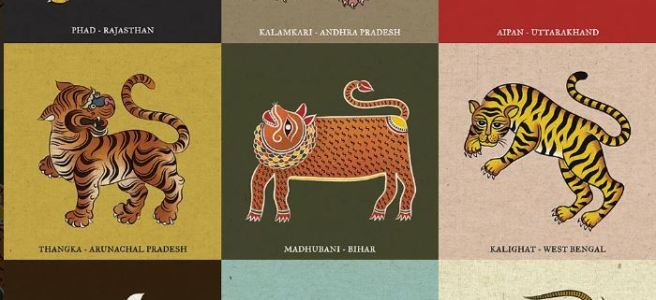
Sudarshan Shaw: Naturally it was in my subconscious because we’d always be looking at these art forms on stone sculptures, wall paintings of different buildings in Odisha and also in homes, as I said earlier. But, consciously I started practising and grasping it after I visited Ranthambore wherein I first had that interaction with Phad paintings of Rajasthan. There are these common folk paintings of Rajasthan, wherein they had drawn stories from the wild in their artworks. For example, in the story of ‘Machhli’ the Tiger, wherein they had depicted the tiger in a very beautiful style in stories from its birth to its death and everything. This was the main reason why I started grasping art forms more and this is how I implemented it. I get a story from one place and try to incorporate the folk-art of that place into it (the art).

Lalitha Krishnan: O.K. That’s very sensitive and thoughtful of you to do that. You have depicted wildlife, for example, the striped hyena, otters etc that are also listed as endangered or vulnerable by the IUCN (International Union for Conservation of Nature) Tell us something about these. I love the little camera trap you have put along with the ‘Black tiger’, the pseudo-melanistic black tiger painting of yours. I don’t know if the Fishing cat’ (see podcast cover) is part of this series but that too just caught my eye.


8:27
Sudarshan Shaw: The Fishing cat was the first painting that I did for this series but that was also a self-funded one. The main idea always starts with a self-funded one and the Fishing cat was one of those. The idea behind drawing the Fishing cat was–which is also a mud painting by the way—during that time, I heard a lot about fishing cats. You know they are found on the outskirts of my hometown. It was very interesting to know that these kinds of creatures live nearby. So, I started looking at images of fishing cats in Odisha and West Bengal and other regions of India. I found images of fishing cats which are mostly nocturnal. The images were quite similar. Once I got a glimpse of a fishing cat drawn in the Kalighat form of painting in Bengal, and I saw a very distinct flavour to it. That cat was depicted holding a fish, it had a stance of its own and it almost looked like that fishing cat is Bengal and it was very different from that of Odisha or any other region of the world. So, a depiction of that species in that art form you know helped in sensitising the people of that particular region regarding that species. That was my whole idea. To incorporate that style and show the world that all these creatures have their distinct characters from the places that they belong to. That was my main idea behind that. The other artworks: the Smooth-coated (otters), the (striped) hyena, you know, they tagged along, people understood my reasoning behind the Fishing cat and they wanted similar species to be shown in their own characters so that they would help in spreading awareness and in sensitising people about the species.


10:30
Lalitha Krishnan: It’s true when you say, (species) have their own stance, their own character of the place. That’s an interesting take. You know, tigers have been part of the Indian psyche forever and they feature a lot in your paintings. I saw one of The 9 Tigers depicted in different folk styles which tells us so much in one go.
I also want to talk about the ‘Tiger Boundary’ piece which is nothing short of mesmerising.
I like that you said somewhere that the boundary in the frame instead of blocking in gives you the artist and the subject, in this case, the tiger, free reign. Did I get that right? What do you mean by that? And what draws to the tiger?

11:17

Sudarshan Shaw: Absolutely. Apart from being as popular as ‘T’ for Tiger, and one of the epic predators of the forest systems in India, I feel tigers are truly beautiful beings in all senses. They are as gentle as they are fierce, the air of pride and mystery around the creature makes them much larger than their actual size -which is both inside the forest and outside. So, what draws me and the whole forest and nation to the tiger are that it’s like another mystery. I never met a tiger in the wild. But fortunately, I met so many in folk art and in my imagination and they are all different from each other.
So, yes, as an artist I always felt conflicted about having boundaries around my artworks. On the face, the borders look like confinements, a kind of limitation but they are very common, if you observe, in all the folk-art forms of India. So, one fine day, during an interaction with a pattachitra folk artist, he was explaining to me why they drew borders on the canvas before they started the painting inside. That was the instance when I thought that is how tigers also mark the territories for themselves in the forest and both the artist and tiger would then paint their minds and live inside it. I could then understand how boundaries set by self, bring a sense of safety, depth of connection and commitment to our responsibility. All of which actually sets us free.


12:56
Lalitha Krishnan: Wow. That’s all I can say. You authored your first children’s book called “When a Forest Wakes up”. Congratulations. The name itself evokes a visual flood but the book is also very magical. Your interpretation of nature… where trees are antlers sending messages and elephants block out the sun and birds fly to flowers in gratitude for the colours and where hills are sleeping rhinos…it’s so wonderous and I can just imagine the wonder and oneness that any child will love. I believe you said, “The basic idea of the book is ‘breaking definitions”. Yes?

13:41

Sudarshan Shaw: yes, one of the ideas behind the book was to see beyond rigid definitions that we have set for ourselves. To dive into a world of imagination and the endless possibilities that it has for us. So, another idea behind the book was actually inspired by animism. A belief system by the various ancient indigenous communities in India, according to which everything from the stones to the mountains to the trees and rivers are living forces and beings bigger than us or just like us. All of these live in relation to each other.

I remember how we were taught in our school days that nature is full of resources and had multiple uses for us humans. And the distinction between biotic and abiotic, the living and non-living things. We have been told to see a river or soil as a non-living resource it would be very difficult to respect and have a relationship with them. This book is an attempt to change that perception from a very young age.

14:47

If I give you another example, of it, when we ask a child to see towards the sky and the clouds, they would always say the clouds look like different animals or objects and everything. Suddenly, with time, you’d see how the animals and the various objects turn towards being a single cloud. When you ask an adult, what is that they would say, “That’s a cloud. Either it’s going to rain or not going to rain. But when you ask the child, “That is a tiger”. “That’s a leopard…that’s a dinosaur” and whatnot. All those imaginations with time are suppressed and you know, along with the coming of rigid definitions, that ends it for us. So, I wanted to break that stereotype fear out of understanding and definitions.

15:38

Lalitha Krishnan:  You’re freeing my mind as you speak. So, I believe you have travelled to Uttarakhand–that’s where I live mostly–and walking in the forests there impacted you. How was it different and is that where you got your studio name. ‘Kyari’ from?

15:56

Sudarshan Shaw: Yes. Uttarakhand has been like a second home. I have travelled to Uttarakhand quite frequently as much as I could. You know, I was in college in Delhi so Uttarakhand wasn’t so far from there. Living there, you can totally understand how special the land is. It is almost beaming with life and beauty, to say the least, and ‘Kyari’ is a very small village near Ram Nagar in Uttarakhand and my studio name lends its name from it and the meaning of it; you know how kyari is a small nursery kind of thing where in they put up small plants and flowers. Then they grow wild from it. That’s the main philosophy of starting my studio wherein I’d be experimenting with different forms and art styles, and stories and those would be going into the wide world.

16:52

Lalitha Krishnan: A nursery of ideas. Lovely

16:54

Sudarshan Shaw:  A nursery I would say is one of my best teachers of all the ways I see the world and understand the world the studio is a lifelong tribute to that.

17:05   

Lalitha Krishnan:  I’d like to know briefly about the ‘My Pictures of Divinity’ series your visual stories about the turtle and sea, and the vulture and the dead e.g. though steeped in lore and also educating us about the animals’ role in the world and their vulnerability today.

17:26

Sudarshan Shaw:  Yes, I strongly believe that existence has its meaning in relation and not in isolation. So, my picture of divinity is the search for that godliness that lies in the relationship between the humble life forms that we see and the magnificent ecosystems of sustenance that surround them.  So, it is an attempt to override conventional portraits of God that centralised humans while all the legendary powers that they invented were inspired by the ways of the wild. So, it’s a tribute to our true ancestors, the teachers, the deities of the art of thriving and surviving. So, e.g.

I’d say, Uttarakhand and Odisha have been my main source for drawing this series. One story would be the Olive Ridley Turtles of the Odisha coast. If people talk about the species, they talk about the species in isolation but if you actually get to experience that place, you would see how the species is actually a connection between the land and the sea. It’s tying both of them together. That’s the beauty of seeing things in relation and not in isolation. –Sudarshan Shaw

18:40

Lalitha Krishnan: Beautifully put. Coming to my last question, could you share a word, concept or something you believe is important—you’ve mentioned a lot of things—something for all of us to know or imbibe.

18:59

Sudarshan Shaw:  Sure. So, being an artist, I’ll say a few lines on how we understand art and nature. For me, art and nature are two sisters of the same fate. Nature has been an inseparable part of native peoples’ being. Folk art has also been practised routinely by all in different ways and forms. So once, the colonial influences came, they alienated our art as a speciality which was quite pristine, exclusive and polished and very far away from us. They did the same to nature and wilderness which became (lost in translation). Art is the nature of all living beings; we must understand this. And, separating them in our words and worlds may have separated us from our true selves and denied us access to the strongest relations which are nature and art. So, I believe we can turn folk art for the reunion and reassurance for everybody, which is free too, we must draw, sing and dance to ourselves and our surroundings better.

20:14 So true, Sudarshan, thank you so much. You’re going to go a long way and all the best for your journey ahead.  I am so touched by everything you’ve said and everything you do. Thank you

20:29

Sudarshan Shaw: Thank you so much Lalitha.

Lalitha Krishnan: I hope you enjoyed this episode of Heart of Conservation. Do check out Sudarshan’s artworks. You might want to buy, commission it or gift it to somebody else or yourself. The transcript for this show will be out very soon on Earthy Matters (my blog). You can listen to Heart of Conservation on several platforms so check it out and spread the word, guys. Thanks.

Birdsong by hillside resident, the collared owlet.

All photos courtesy Sudarshan Shaw including Fishing Cat. Podcast cover artwork by Lalitha Krishnan

Disclaimer: Views, thoughts, and opinions expressed in the podcast and show notes belong solely to the guest featured in the episode, and not necessarily to the host of this podcast/blog or the guest’s employer, organization, committee or other group or individual.

Dritiman Mukherjee: The Philosophy of Photography. EP#11

Show Notes: Episode #11 Dhritiman Mukherjee. [Edited]

You’re listening to Heart of Conservation, your very own podcast from the Himalaya. I’m your host, Lalitha Krishnan bringing you stories that keep you connected with our natural world.
My guest today is Dhitriman Mukerjee one of India’s most reputed & sought out, nature photographers. Chances are you’ve seen Dhritiman’s photographs more than once. His work has been featured and associated with Saveus, Sanctuary Asia, BBC, National Geographic, New York Times. It’s a long and enviable top-notch list that every photographer would love on their portfolio.

But what most people don’t know about him is that he is also a self-taught photographer, a mountaineer, climber, and advanced Scuba diver. Dhritiman is also of the founding members of ‘Saevus’, one of India’s leading natural history and conservation magazines. Dhritiman’s work is extraordinary but here is a photographer with a conscience. His work impacts you as it creates awareness and evokes a sense of pride and, belonging in this beautiful world of ours. This interview was recorded over Skype.

(All photos courtesy/copyrighted: Dhritiman Mukherjee)

Lalitha Krishnan: Dhritiman, Welcome to Heart of Conservation Podcast. I can’t tell you how delighted I am to have you as a guest on my show.

Dhritiman Mukherjee: Thank you and I am honoured.

Lalitha Krishnan: Dhritiman, you’ve been known to jump off cliffs to photographs vultures and get into dry suits and immerse yourself into the sub-zero waters to shoot penguins and seals. Could you describe what attracts you to wildlife in places like this and also explain the process of your photography in inhospitable places? It can’t be easy.

Dhritiman Mukherjee: The way I work; when I discovered people were started working with different subjects. Most people work on easily available subjects; of course, you go to Corbett, or Kahna or Kenya. You can actually drive into the park with a vehicle and see wildlife and shoot them. This is fantastic. Many people are doing this. If I am doing this then it will be a repetition. My point of view was whenever I planned my work, I try to do something which is different- less done or never done- which is actually not readily available to the mass(es). So, what is my goal? Initially, when I started photography, the most interesting part was that there was no better work like this. In wildlife photography life is always beautiful-what more can you want? You get a chance to be in the forest always or the ocean or any interesting landscape. It’s amazing. So that part was initially there. I loved to be in the field because it is away from normal life, which is, of course, good but sometimes….my main point is that I was liking it, I was enjoying it but with addition I realised that I can also contribute to science and you know, social reasons like creating awareness for conservation. For that, I mean, it becomes meaningful. So slowly, along with my enjoyment, I always tried to think about what should I do? Which work can actually contribute to science or create awareness? From that point of view, I always thought of those works that which are not done by many people. That way it becomes exclusive. Exclusive in the sense, whatever I will do, when I share it with people, it will be interesting or contributory. That way I always selected rare subjects, difficult habitats, difficult places, difficult subjects to work with. Because not many people are doing this. Also, my background is I was into outdoors. I was into mountaineering and climbing. I always loved adventure. So that was an added tool for me. So, I thought that I could actually use that tool for my photography, because, that will help in a different way. And, from that point of view actually, I started looking for difficult and challenging places and subjects.


If you talk about jumping into the frozen Baikal or Antarctica or climbing a volcano, or diving with a crocodile or Anaconda, these things I did later. Maybe, in the last three-four years. But there is another reason also. I was mostly working in India, in all landscapes, in all habitats, in different subjects. I worked in most of the landscapes of India—all the states actually— all the states of India. You saw that book I have done, The Magical Biodiversity of India? It was done to show how good our country is from a biodiversity point of view. Because India is amazing.

Lalitha Krishnan: True


Dhritiman Mukherjee: Every time I went out of India, I realised, India is best. It has so much…


Lalitha Krishnan: I agree.


Dhritiman Mukherjee: Yes, all kinds of landscapes. It’s kind of a mini-world.


Lalitha Krishnan: Yeah.


Dhritiman Mukherjee: We have deserts, 10000 km of coast, we have the Himalaya, Deccan plateau, rain forests, mangroves, sets of islands. So, you know, everything, like one complete package. So definitely, India was, you know, a most lucrative place for me to work. And the main important point was that when I started not much was done. India has so many life forms but not much was done.

Lalitha Krishnan: Can I interrupt you? When did you start?

Dhritiman Mukherjee: I started photography in 1997 but started wildlife (photography) in 2000; end of 2000 actually. In India, I covered most of the landscape and did that book Magical Biodiversity of India. Then, I thought, OK, I have done a little bit in India, if I want to see the world if I want to do something interesting outside India… with that continuation, I thought what can be the concept? So, I thought, let’s go for a magical arch; that was the kind of concept I was following. The world is so big and has so much, I cannot cover everything. So, what I can go for? I decided to work on interesting things, so that’s why I decided to include an interesting phenomenon on earth. Like you know, I climbed an active volcano, dived in Antarctica’s icebergs, in Greenland, diving with the crocodiles. Basically, from one point of view, these were difficult and challenging subjects but many people have worked with it and secondly, they (subjects) are very interesting and surprising and so I planned from that perspective. My main goal is to work on less done subjects so that I can bring those events, species or places to the masses who somewhere they are disconnected with those things. I mean, in the last 10-15 years there’s a revolution is connecting the masses with different things via the internet and you know, different media. People who have access to TV have seen a lot of things but still, there are some things that haven’ reached the masses. So that is one of the goals.

Dhritiman Mukherjee diving in the waters of Costa Rica


Lalitha Krishnan: That’ amazing and I think it reflects in all your photography. It’s not just a photograph. When you look at it you see so many things. That’s why I think your photographs are so special. And also, you’re talking of different media. The purpose of this podcast is also to reconnect people to nature. That’s great. So, along the same lines, I want to talk about something I just read about and it’s fascinated me. In 2018, you along with 5 scientists went on the iconic Abhor expedition, right? In Arunachal Pradesh. The expedition is one of great significance because of the amazing biodiversity of the area. Abhor was also visited 106 years ago as a punitive mission following the murder of Mr. Noel Williamson who was the assistant political officer of Assam back then. Your expedition almost sounds like a Darwinian kind of exploratory; a once in a lifetime adventure. You travelled into parts unknown, you discovered and recorded multiple new species as well. Can you tell us a little bit about this expedition? Because it’s huge, it’s humongous, and I think everyone should know about it.


Dhritiman Mukherjee: It is actually super interesting how it started. When I was at WII, I was discussing with my friends. I always thought of this multi-taxa mission because, in India, this kind of thing is not happening in good numbers. At least, I don’t know of any such kind of expeditions where scientists from different subjects participated. So, I always had a dream to go for something like this. I was discussing this there and gave a proposal to all these people, let’s all do something which will be contributory and let’s work in some area which is not explored yet. Actually, Abhijeet gave the idea about the place because he also was thinking about this Abhor expedition which was done 106 years back. So actually, it is a contemplation of the same route and a little more actually. Actually, this area is unexplored so why we called it the Abhor expedition is because that expedition which was done 106 years ago, was the baseline. When we do something in some area, after finishing the expedition, after getting all the data, we can compare the data with the past, available data which was gathered 100s of years back. That helps us see the impact of changes. We can see what is actually not there, if things have improved or what amount of destruction happened; what is the status actually? What are the changes? That gives us some ecological parameters. So, we split this area in where something was done 100+ years back and after that, not much was done. So, we went in one part and travelled along the Siang river then we went to bowling National Park… These scientists are amazing in their own field. So, I was documenting everything. For me, there were two things actually; I could see the entire region which was mostly unexplored and I got a chance to be with five scientists. I got a chance to learn a lot – I always prefer to. And, we got a few new species, new information… But we also got evidence of huge destruction and you know, habitat loss and much more. The final report is about to come but overall it was a very unique expedition for me.


Lalitha Krishnan: it sounds like a wonderful, wonderful opportunity for them and you. You bringing out the beauty of the place combined with the scientific information and discoveries… You said it so casually, “We discovered a few species”. It’s not every day that people discover new species.


Dhritiman Mukherjee: No. The truth is we were expecting more species. We actually failed to give more time in some places. And maybe the timing is very important. We went there in October and if we had gone in May or June, then probably, it might have been much better because for the herpetiform like snakes and other things they are more active during that time. So, I feel if we can do another expedition in the same route in a different time, then, probably we will get more things (species) actually.


Lalitha Krishnan: OK

Dhritiman Mukherjee: That’s the beauty of an expedition. When you go the first time, you will get to know many things you never imagined. After being there you realise OK this can be corrected or we could have done this differently. That’s the best part. So, it will be a good thing if we can repeat the same expedition.


Lalitha Krishnan: I’m going to ask you another question that you’ve been probably asked many times before. The list of cameras, lens, scopes, etc. available in the market these days is endless. How much of photography, do you think, is equipment nowadays? I don’t know if this is a good question. You’re a professional photographer but what would you tell somebody who is sort of mid-way? Is it necessary to buy rather than perfect your art?


Dhritiman Mukherjee: This is a good question actually. A question regarding equipment is a very interesting questioning for others so I would like to share. Equipment is very important for sure but sometimes what happens in wildlife photography is first we buy equipment and then we plan. This should be the reverse. You should plan something and then go for equipment. Equipment is just for your certain need and equipment can’t and shouldn’t restrict your work. Nowadays, everyone can buy equipment, it is all available here. Once upon a time, say 20-30 years back, when very few people had good equipment, the quality was very important for good or bad photography. It defined it. If you had good equipment you could develop good quality photos and people would like it. That was one important parameter. But now everyone has the equipment. People can produce good quality photos. Now what is important is the story in the photo. For me also, quality is OK. If you’re using good equipment or mediocre equipment, there will be a difference in quality but when the story becomes an important factor then, this has no value. If you produce a very interesting story with average equipment then that becomes much more important. The story or the natural history information you are providing – that becomes more important than the quality. At least for me. I take it this way. I have access to most equipment but I am not fussy about equipment these days. Once upon a time, I was very emotional about it. But now, it’s not of much importance for me because the story is the ultimate thing. What I’m showing is very important – what a photo is talking about. That is much more important than how the quality is. People see the quality; it is available actually. You can’t restrict yourself because of the equipment. Sometimes you say, “I don’t have equipment”. Work with whatever equipment you have. Even with a mobile, you can get a great snap.


Lalitha Krishnan: True.

Dhritiman Mukherjee: You can go for different stories that your mobile can take. Wildlife photography is not always about getting some tight shots. I think that time has gone. Now the content is far more important. What you’re talking about and what you’re showing.


Lalitha Krishnan: That’s great advice for anyone who is into any sort of photography I think, especially for wildlife. They just seem to think bigger is better. This is great thanks. So when I see wildlife posts on FB today, especially, if you go to a certain wildlife group or page, it’s mostly full of tiger surrounded by at least 15 jeeps and photographers carrying huge equipment. And they won’t leave that tiger alone till they get that perfect shot. I’m as guilty. I’ve also gone to national parks, gone in a jeep and tried to click a tiger but it is ridiculous. I have seen people change tires, talk on the cell phone if there’s coverage… But the scale of this in our parks today makes me just feel this is not ethical at all. The way the tiger is cornered, the patience of that animal, it’s tolerance for us…tolerating us humans…I feel it’s no different from the old shikar days when the tiger was hunted. Now we just use cameras and jeeps to hassle them. What are your thoughts on this?


Dhritiman Mukherjee: Ah, this is a very complex question.


Lalitha Krishnan: I know.


[Dhritiman Mukherjee: It’s not that easy to explain. Of course, there are issues. I have been to many tiger reserves and I have seen the situation. There are different points of view. I believe tourism is one of the finest conservation tools. If people are not going into the forest, if they are not connected or interested, there will be no lobby for wildlife. We need a huge lobby for all the participants of our ecosystem. Tourism is [word lost in translation] The problem is how we manage it. So, it is not bad if some jeeps are going into the forests. In any case, the tourism zone is not that big. It is a little part of that forest. And in that part, the road is covering 10-20% of that area. In some cases, animals don’t always get stressed. Sometimes, you see photographs of tigers just sitting while many jeeps are standing there. Sometimes it gives way. There is another perspective also. The tiger is a wild animal and it is just sitting in front of the cars. If it wants, it can actually jump 10 feet to be away from everything. But the tiger is not going. It is sitting there. It is not moving. In most of these places or some situations, the tiger can move away from the crowd but they don’t. In tourism zones, these animals are somewhere, comfortable with people. Comfortable in the sense they have accepted the presence of people and are kind of habituated to tourists. Sometimes they just ignore. That is not where you can see the stress level of the animal. But in some cases, there’s a tigress with her cubs, or they’re in a particular area and people are chasing them…sometimes, these things happen. There is no problem with tourism but rather the problem is the way we do it. Some management policies or awareness campaign or something for e.g. when people enter the park and if they can be given some instructions or advise, I think that will be helpful. I feel tourism is always fantastic.

There are some behavioural changes due to tourism that we see in wildlife but I don’t feel it is heavily harmful to animals or for the ecosystem. I feel it is helping rather than it is harming actually. So that way I am in favour of tourism. Of course, it has to be organised and sensitive tourism.


Lalitha Krishnan: : You’re so right. We absolutely need tourism but like you said, the way we do it is more important. Talking about wildlife, nowadays everybody is a photographer. We have our mobile phones and whatever. We all claim we are photographers. What in your opinion is responsible photography? How should or shouldn’t nature be documented? I think coming from you, it will be a lot for people who love wildlife but have no idea on how to be a responsible photographer.


Dhritiman Mukherjee: Ok, I always love to talk about the way I work but I would never like to tell you, “you do it like this or you should do this”. I believe everyone is a sensible human being and they can take a call. I cannot suggest to people to somethings but I can tell you what I believe. If that helps then it’s fine.
For me, responsibility is the backbone of anything I do actually. The word ‘responsibility’ is a very important word for me. So, whenever I work there are two things actually: Why am I doing this? Why I am doing this is very important. There is an ethical point of view. The ‘ethical’ thing is a function of time and space and the situation. 20 years back what was ethical is not ethical now because it’s changing. What is the problem now? 20 years back you could hand count the number of wildlife photographers. But now, the wildlife photographers are close to a million in India…if you count the hobbyist or the amateur. These numbers are huge. In a narrow road, if there are one or two vehicles moving, it’s fine but if a hundred are moving then it’s not fine. It changes with time or the situation. In a park, earlier when one or two photographers were working it was not a problem. If a hundred photographers are there at a time, it becomes an issue. I am telling you this so you understand the dynamism of the situation. You have to take the call. What I do… I have some experience in the field, I try to understand in the field what I should go for or what I shouldn’t do… I take the call on the basis of the situation, not by something which is provided by someone else. It is always a call of mine on the basis of my experience, my knowledge and the present scenery of the place. For example, when 20 or 30 years back, if we saw an image of a charging elephant, we used to be very excited to see the image. We used to clap for it. We appreciated those images. Now, for me, it is no longer a good image. Because, if the elephant is charging me, it’s telling me that I was in its personal space. Someway, that animal was disturbed by me. It can be disturbed by anything. The main fundamental thing is when I am working in an ecosystem, the impact of my presence should be as minimum as possible. A charging animal shows the huge impact of my presence. That way, for me, it is no longer a good image.


Lalitha Krishnan: : You’re being invasive.

Dhritiman Mukherjee: I had images of charging animals before but evolution happens. If I am stuck in the old mindset then it is a problem of mine. We need to move on. We have to take the call. You have to understand that whatever you are doing, you are doing it for them. Why are we doing this (Wildlife Photography)? Because we’re enjoying ——-[word lost in translation]. We are lobbying for wildlife. To connect the masses with animals. And not to disturb them; not to create stress for them. So, as a photographer, I always try to take the call in the field to see to what extent I can go. I take a lot of photographs where I go very close to the subject. But it is not like I’m pushing boundaries. It is based on a lot of experiences. I love to study the individual (subject) before doing anything. So, when I photographed an American crocodile in Mexico-you can see I am taking the photo from one foot away-but it is not like I can do it for every individual. First, I try to understand the situation. If that animal is comfortable with me, it allows me…then only can I do that. I can’t push or stress them with my presence.
For sharks also, for all underwater photography, you need to be very careful, or you cannot take good shots. It is more like the animal comes close to me rather than I go close to them. In most cases, you have to be careful how much you can push. Because, after all, they are important. Whatever we are doing is for them. If we are caring about their comfort or wellness it’s not good. For me, it’s always a personal call.
When you talk about responsibility, I want to give a different example which is not directly related. I heard many people say—when they talk about their children’s career—they say, “If you go for IAS, then you’ll have a lot of power”. You’ll do your office work but if you are an IAS officer, you will have a lot of power. This is confusing. In our society, this is one type of schooling which is not right. It should be: when you are an IAS officer, you will have a lot of responsibility, not power.


Lalitha Krishnan: : Correct.


Dhritiman Mukherjee: The higher you go you will not have more “power” you will have responsibility. That is one perspective I feel we confuse with many things. Because, I have been into wildlife photography for a long time and I work a lot with many institutions, many conservation organisations, many people and many forest departments, sometimes, I get a little more access than others. Some people can think this is power. But this is not power. The more I get into into all this, the more my responsibility increases. Because I am taking that responsibility. So, whatever I do, the word ‘responsibility’ is the backbone of everything I do. I am responsible for this because I am doing this. From that point of view, it is very important for me to be sensible and responsible in the field.
I want to add another thing. There is another kind of issue which I think of which not many people will think of. I don’t know if you’re e going to ask this question…

Coral reefs:Andaman Islands, India


Lalitha Krishnan: Tell me.

Dhritiman Mukherjee: What is your favourite place or what is your favourite animal to work on?


Lalitha Krishnan: I was going to ask you… you know your photography is making an impact but if there is one project you are proud of for the change it has created? Not…


Dhritiman Mukherjee: This is a proper question. This question is fine but if you ask me, what is your favourite subject or species, or favourite places? If I name some species or place to answer that then I feel I am very much irresponsible.


Lalitha Krishnan: Okay. Why?

Dhritiman Mukherjee: There are some ethical responsibilities what I was talking about; that is how we work in the field where we have to keep this word (responsibility) in our mind. Where we cannot do anything which will actually do harm or damage the ecosystem. That is one part. Then, there is another part – our thought process. Though the process which I am going to tell you now about favourite species etc. It’s like this. You have 10 children and I ask you, who is your favourite? If you mention one, it’ll be a very illogical and irresponsible answer. Because in the ecosystem, every species and habitat is equally important.


Lalitha Krishnan: : True. True.

Dhritiman Mukherjee: Whether it’s grassland,——-[word lost in translation] or a mountain, they are equally serving their role. They have their own participants. They are all equally important. If you talk about species, from small insects to bug elephants, they all are important in the ecosystem. They have their own roles. So, you cannot be biased. So, if I am biased about a subject, then I think it is an irresponsible thought process. And you have to develop it. It is not as if when I started, I had these thoughts. Because it is a human tendency, we always love predators. That’s why we love tigers, leopards, birds … that hunt or look ferocious attract us more. It was the same with me but I had to develop This is the part of the evolution of my thought process. I developed that thinking that I cannot be biased about any ecosystem or any species. That becomes irresponsibility. So then, with those consequences you can ask me about certain choices I make: why are you working or selecting these (species)? My thought process is like this. You can have 10 children and you cannot be biased on anyone but there is a chance that one child is weaker than the others and you have to take more care of them. That is not bias. What it is when one species is injured, another is in a good state, you can work on the endangered one or give more time to that species so that it can come out of its current bad state. That is the way of selecting my priorities. It’s not being biased. I work on those subjects or place which actually are in need at that time for different reasons. Endangered species or the habitat has some problems or it is scientifically less documented. So that my way of thinking; of selecting species and places. So, if I have favourites, I think it’s irresponsible for me. This is one perspective I always thought of.


Lalitha Krishnan: Right. I’m glad you said it even though I didn’t ask the question because I’m sure a lot of people have asked you that. It’s a completely different perspective you’ve given and it makes so much sense and seriously my respect for you has gone up many, many notches because it’s all about being mindful I suppose…and responsible (while you’re) out there photographing.


Lalitha Krishnan: Cool. Now I know how you choose your subjects to photograph. But which photographer has been your inspiration?


Dhritiman Mukherjee: I want to add something. Let me answer this at the end.


Lalitha Krishnan: OK.


Dhritiman Mukherjee: I initiated but forgot to tell you; I have some problems with the words, ‘best’, ‘success’, ‘failure’… Let me explain a little bit because I think it’s required. It’s similar to “favourite” things we were talking about. People sometimes people say, “Dhritiman is the best photographer”. I am surprised how one can be defined as best because it is a qualitative thing. For qualitative things, you cannot use these words: ‘best,’ ‘worst’. You cannot even say ‘good’, or ‘bad’. Think of the first tiger-photo. If you see it now, maybe you will think: Oh, it is an average photo. But when it was taken it was surprising for everyone because there were no other (tiger) photos before. It was the first tiger photo. Imagine the first tiger-photo when there were no photos at the time, then it was the best photo (available).


Lalitha Krishnan: Right.


Dhritiman Mukherjee: It is all so subjective. All photos are documentation of some moments, some time and some species. Time, which is already gone so somewhere it is very unique. So, all the photos are unique. It cannot be good, bad or best. So, what do we go for? Basically, what happens is people actually want to see new things. When we mistakenly say it is a bad photo, it’s a ‘seen’ photo, that which we have seen already.


Lalitha Krishnan: Hmmm.


Dhritiman Mukherjee: It is not surprising you. So, what do we go for? We go for different things, new things. We don’t go for old things that are done. What is done becomes a “bad photo”. But it is not actually a “bad” photo. It was very much a good photo at that time. At some point in time, it was fantastic but now because people have seen it, it becomes a little bit boring and then people say, Oh it is OK or not good. So, you have to understand that this good, bad, best…these words do not exist in photography or any qualitative thing. It has to be different. I mean if you are a photographer, what are you going for? You’re not going for a “good photo” or “best photo” but a different photo. Not what is done but new stories, new events.
So, what I’m saying is whether you realise this the word, ‘competition’ does not exist. When you’re out of the competition, your mind becomes healthier.


Lalitha Krishnan: Right.


Dhritiman Mukherjee: Then, you’ll be out of all unethical practices where competition sometimes pushes you to do something unethical. These words don’t exist for me. I cannot be the “best” photographer. It doesn’t exist. Rather I would for being a contributory photographer where I can contribute to science or conservation.
To answer your question, who inspired me…that way, except for me, all that photographers inspire me. Whatever they are doing, all other photographers inspire me. Even what an amateur is doing is new for me. I am not doing that. That surprises and inspires me. So, what all other photographers, naturalists are doing is equally inspiring. So basically, everyone is inspiring me.


Lalitha Krishnan: That’s such a novel way of thinking. Lovely.


Dhritiman Mukherjee: It’s actually a rational way of thinking. For me, the right way. So, when you think like that it’s not novel.


Lalitha Krishnan: Maybe, not novel for you but for anybody else who is competitive for instance? This is just a different perspective no? Makes sense? Can I get back to the question about one project that you’re proud of because of the change it has created or is creating some change while we speak?


Dhritiman Mukherjee: As I told you, I have a problem with some words that I told you.


Lalitha Krishnan: Yes.

The rare Narcunda Horn Bill found only on Narkunda Island, India.


Dhritiman Mukherjee:
I try to solve some issues with these eg. ‘proud’, ‘best’, ’worst’, ‘competition’ or ‘achievement’, success-failure’…These words do not work for me. I can be a little happy not proud. The word ‘proud’ has some sort of unhealthiness. People will have different opinions on that I’m sure. Whatever one does actually, for me, I feel it has not been done to the extent it can be done. I have worked on different subjects, like the Narkundam hornbill…you know about the Narkunda island which is the easternmost island in India. The Narkundam hornbill is only found on this island. They are nowhere else in the world. So me and Dr. Rahmani, Dr. Shirish Manchi, we actually went there, stayed there for 18 days. We worked there and got a lot of information on that hornbill…photographed them. So, that was pretty much a rewarding experience. In later days there were issues with the island. The Indian Navy wanted to put a radar station on the Narkunda island. The scientist and others were not happy to know that because you know, it’s such a tiny island and that kind of activity can actually ruin the ecosystem of the island. Everybody wanted to stop that activity on the island. My photos helped to convey those (conservation) messages. Everyone used my photos, even National Geographic News also used my photos. So somewhere those photos were used for conservation. So, I feel it was a little bit contributory but it’s not like a 100% thing done. It could be better.

Lalitha Krishnan: : Yes. But a start.


Dhritiman Mukherjee: I worked on different subjects. The Bengal Florican which was less documented, then, the snow leopard project was very interesting. I have been working on the brown bear which is very less done. I photographed the Western Trogopan in Himachal Pradesh which is the state bird of Himachal. There weren’t many photos of it in the wild. I did different kinds of interesting things but I never feel I did a great job. I did Okay. Sometimes I was happy about how that work helped conservation but it is not like I am satisfied. I need to be more hardworking or more fruitful with my work. I cannot be satisfied with that or proud even. In any case, I have no relation with the word.


Lalitha Krishnan: I love that. But you set very high standards for yourself and it’s actually very inspiring. So, do you have a conservation-linked term or a photography-linked word or concept that you’d like to share?


Dhritiman Mukherjee: There’s a disconnect between the natural world and the masses and mostly I found, many policymakers are also disconnected with the natural world. So, what I am doing right now, what I am very much concerned about or what is very relevant for this time to me, is about ‘inclusion’. Inclusion of our ecosystem, in regular policy, social structure, everything. Because there is a disconnection, it is not included in our social system. So, whenever we see things, it looks like it’s separate. When we talk about development, we feel like nature, ecosystem, the natural world, forests…is a separate world from the word ‘development’. Actually, it is all included or inbuilt. When we talk about development…if someone is doing some deforestation, and we ask, why are you doing this? They say it’s a need for development.
Development is about keeping the ecosystem inside. Do everything but keep the ecosystem intact. It is about inclusion. It is inbuilt. So, I feel we have to understand that we have to all of this into our regular system. For that, we have to connect the entire masses with nature. I do photography for this purpose. Photos are the strongest tool to connect to people emotionally. If I speak about some species you have never heard of, you cannot be emotional about it. Only when you know a little bit about it even then you can think of it. So, photos actually do that. It connects people with the natural world.
So what I did as my responsibility is to lobby for the natural world or in other words, I can say I am on a mission to create as many as possible voters for the natural world. They will talk for them (wildlife). I am, one by one, connecting individuals with different species, different landscapes so that they will be in favour of them. Actually, it will create a huge lobby for them. For me, it’s one step to the conservation of the natural world. This is what I tell newcomers to wildlife photography. Connect as many people as you can to the natural world. That will be the best step towards other things. Once the lobby is made, then you can play with it. So that’s why I try to show my images to the policymakers whenever I get a chance. Also, students or collages and schools so they will be inspired by the natural world and they will be in favour of it. If something happens where a mass voice is needed it will be easier to get that voice in favour of the natural world. That’s why I make it my baseline responsibility.


Lalitha Krishnan: : That’s a great word and the way to go forward.


Dhritiman Mukherjee: Thank you for initiating this.


Lalitha Krishnan: Dhritiman thank you so much. It’s been a really wonderful conversation and getting to know the person behind the lens is quite fascinating. I’ve put you there as a photographer with a conscience and clearly, you are. So, thanks a lot.


I hope you enjoyed this episode of Heart of Conservation Podcast. If you know somebody whose story should be told, don’t hesitate to write to me at earthymatters013@gmail.com. I would love to hear from you, I would love feedback. Stay tuned, Heart of Conservation is available on Spotify, Apple Podcasts, SoundCloud, Google Podcast, Himalaya app, Android, or where you listen to your podcasts. Bye for now.