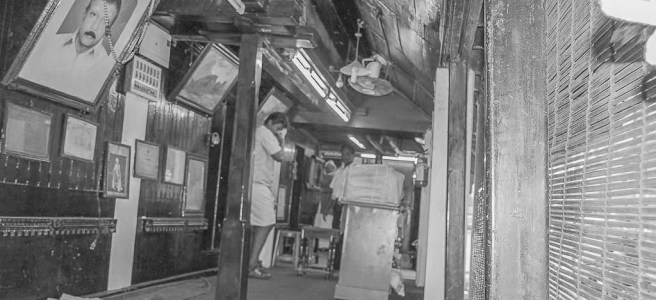
Kaithamukku, the town of my childhood is in Kerala. It’s the place where my mother and her whole tharvad of siblings, cousins, aunts, uncles and numerous grand old relatives grew up under one roof. We used to make the two and a half day’s journey there every summer, travelling in a non-air conditioned train carrying games, homemade delicacies, and bulky canvas bedding. The little that is left of my mother’s world includes two ancient Ayurvedic shops. Read the whole story here:
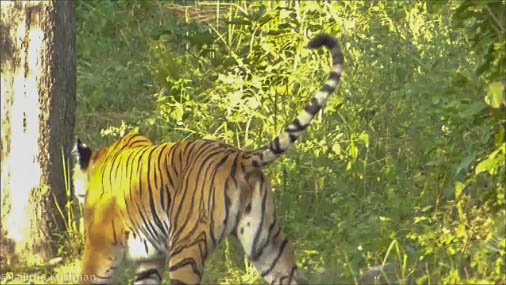
William Blake knew what he was talking about when he penned his poem, The Tiger. I saw this beautiful tigress scent her territory in Corbett, seemingly unperturbed by jeep loads of tourists capturing her every move. It was around 3-4pm , her coat looked like it was aflame in the dappled light. She confidently strolled ahead of us scenting every tree – letting us know we were trespassing.
In fact, it’s all blah. I was invited to Dunda village (Uttarakhand, India) by a colleague who heads ‘Community Engagement’ through the school I work for. These service projects, a collaboration between a hospital, an NGO and my school is a mutually beneficial arrangement between villages and us; mostly, providing opportunities to our students; exposing and sensitizing them to village life, actively engaging them in bringing about change, and hopefully impacting them for life.
Most of these projects are student-driven. They are instrumental in replacing destroyed irrigation systems, roofs, in some cases, houses and providing employment. Besides providing training in revival of more eco-friendly farming, animal husbandry, poultry farming, construction techniques and use of poly houses, building a brand new primary school, creating sand-based water filters and benefiting lives in other small ways. But this post isn’t what is being done and planned for the village but it’s about my undoing!
Green harvest of the Himalayas
The familiarization trip in a glossed-over-by-rain landscape was a great out of office experience. The sound of gushing waterfalls and paddy fields were a sight for sore eyes. In spite of all the green cover we could see where last year’s landslides had covered up fields with rocks and rubble, devastated irrigation channels overnight destroyed the livelihood of several villagers.
I always thought it was impossible to get two neighbouring villages to agree on anything.
There were 2 villages gathered under one roof that day, representing around 75 families. Though voicing their concerns rather rambunctiously at first, they simmered down to discussing and making decisions on their own.
An alcove originally used for oil lamps in a Himalayan village-home
I believed a woman has no voice in an Indian village
The head of the village/gram pradan who is a young woman chaired the meeting while lots of other women attended. They are no less vocal than their menfolk. I found out just how hard their lives are; even basic necessities like sanitary napkins are beyond their reach, making it almost impossible to venture too far from home when they’re menstruating. Plans are on to teach them to make low-cost yet hygienic and eco-friendly sanitary napkins. The younger girls, like all young girls, aspire for more. “English-coaching” and tailoring skills are part of their bucket list.
I was of the opinion that the ‘caste system’ in villages is set in stone
What really made me sit up and take notice was the fact that these villagers whose lives are steeped and driven by caste equations were nonchalantly nodding their heads in agreement when it came to the ‘right’ to education. They promised us that the new primary school would be open to any child from Dunda and the neighbouring villages.
Was it the collaboration between the facilitators that in turn triggered the collaboration between the villagers? I will never know for sure but it was rather unexpected to see them take a common stand. Perhaps once in a while one needs to visit a village to look at life afresh.
Considering I live in Mussoorie, it sounds a bit irrational that I should seek another hilltop to escape to; but there’s something to be said for wanting to get away from it all and I find Ranikhet is the place for me. Here’s why.
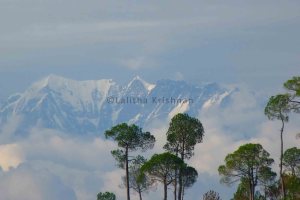
1. There aren’t many places on earth I can see the Himalayan range from Bandarpunch in the Garhwal, spanning across Trishul, Nandadevi, Panchaculi, in Kumaon, all the way to Apa Nampa in Nepal. After a good dousing of rain, the clouds settle and the air gets wafer-crisp. That’s when the peaks start revealing themselves. I can’t begin to describe how dramatically the colour of the setting sun sets the ice-cream peaks aflame. Come September, right through February, you can see the whole range, dawn to dusk. Imagine that! It’s reason enough for me!
Himalayan range up closeHimalayan sky at duskHimalayan snow peaks behind the foothills
2. Connectivity is erratic. Which turns out to be a good thing since the idea is to switch off from the everyday onslaught of data. Going to Ranikhet feels like checking into a spa where without paying spa rates. With the exception of my camera, I travel light into Ranikhet and feel better for it when I leave.
Himalayan Babbler after a dunkingA different hue of Himalaya
3. I can enjoy the simplicity of pastoral scenes that are becoming rarer by the day. I know I’m in Ranikhet when I see women carrying enormous piles of grass on their heads and sickles in their waistband. Or visit smoky tea shops where the tea and ‘fen’ taste better for reasons I can’t quite pin down. I love seeing village girls neatly turned out in school uniforms, their hair plaited with red ribbons, cheerfully walking miles, to school. I enjoy the sound of cowbells as much as I like chatting with locals who treat me like an old friend even time I visit.
Village woman from RanikhetWomen working the fields in a Himalayan villageA Typical Kumaoni house
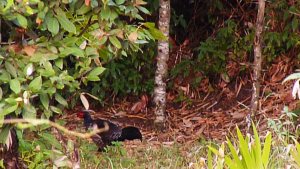
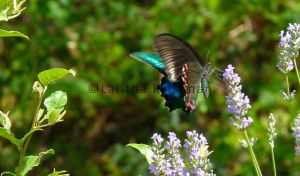
4. Wildlife comes to me. I don’t have to pay an arm and a leg to enjoy nature. Jackals, foxes, martens, Sambar, Barking deer and Serows, Khaleej pheasants and leopards have literally crossed my path. As a nature lover, I can’t help but spew rhetoric about being awakened by the sweet melody of whistling thrushes on my rooftop. Or sipping chai in my garden watching the sunlight bounce off the iridescent head of the Flowerpecker. Or listening to the Francolin clearing his throat before every call. And hearing a carpenter drill only to discover it’s a Yellow-naped woodpecker. Or check out the latest leopard kill on the golf course. And seeing a jackal and a Steppe eagle soaking in the winter sun side by side! Or following butterflies that look so exotic, it’s a miracle they aren’t extinct. Need I go on?
Himalayan Khaleej pheasantHimalayan butterfly
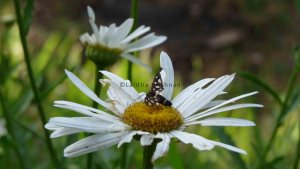
Moth hawk
5. There is no home delivery. No Mc Donalds, Pizza Hut, or Café Coffe Day outlets here as yet. Definitely no malls. And yes, I’m grateful for the “unspoiled ” flavour of the place. There are any number of restaurants and a proper market; so one won’t starve for want of sustenance. For those of us who have homes here, our small soirees end long before city-wallas begin their nightlife.
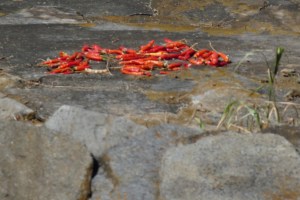
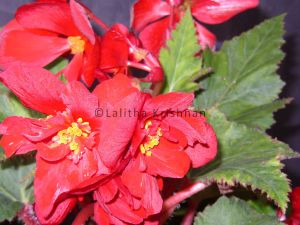
6. Every house has a fruit tree, flowering pots or a vegetable patch. It could be the humble geranium in a rusty tin or the ‘kaddu’ drying on the rooftop; they make Ranikhet homely.
7. Not too many tourists. Funnily enough some of the reasons I love Ranikhet are the reasons why it’s not a popular holiday destination. Lucky for me!
Ever since we moved to the meandering, steep slopes of Mussoorie, I’ve been wondering how anyone, let alone the Brits of yore, could survive the hills without the intrepid Nepali coolie. (Coolie is a corruption of the Tamil kuli=wage or wage worker) I moved here from Ranikhet and we don’t see so many coolies there though I am sure most other hill stations depend on them a great deal. Initially, I rarely noticed the Nepali coolies myself; they do tend to blend into the hillside. You could say, it was my indifference that made me not ‘see’. If you were to remove all these coolies from the hillside, life here would be another kettle of fish altogether.
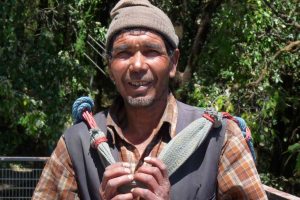
Manoj, one of the nicest coolies on the hillside
I live on a hilltop, a good 45 minute-walk from the market. Hypothetically speaking, if I choose not to leave my home for a month I could get by just by ordering on the phone. The car doesn’t come to our door step. No prizes for guessing who delivers all my provisions, carries sacks of manure for my potted geraniums, the 1/2 quintal of chopped wood for my winter stove… Or worse comes to worst, carries me out on a stretcher if I fracture a leg and can’t walk. For crying out loud, the house I live in wouldn’t have been built but for these coolies carrying the foundation bricks on their backs. At the cost of sounding flippant, I like to think of coolies as the Flipkart of the hills; they deliver. Moreover, they’re far more efficient, their work, far more commendable. I confess I haven’t stood in a queue since I moved here or waited days-on-end for a gas-cylinder refill! If you’re thinking ‘hills’ for an healthy lifestyle, find a hillside without coolies. They make life too easy! Nepali coolies are the hardiest workers I’ve seen; virtually unstoppable. You’ll pass them digging road side trenches bare handed in the grips of our Mussoorie winter and getting soaked to the bone in our cold monsoon-rain for a bread and egg delivery. Despite the cards they’ve been dealt, I find Nepali coolies to be a cheerful lot. I don’t quite subscribe to the theory that being mountain people they have more RBCs than most of us and therefore, are genetically stronger. So what ails our local hilly-billies? Can someone check their blood count and tell?
It’s the attitude and not the altitude that makes the Nepali coolie indispensable. It’s no secret that migrants work harder. Some of these coolies come from remote villages in Nepal 3-4 days journey away from here. For what, you wonder? Every coolie-dependent business is flourishing. Yet, the coolies’ earnest simplicity hasn’t got them too far. They’re ignored till required, kept at arm’s length and left to their own fate. They carry 25-30 kg loads multiple times a day for 5-6 km uphill for peanuts! The rate per load/day probably hasn’t changed for years. What can we do to improve their lot? Acknowledge their existence for starters? Treat them as humans not mules? Realise their worth? What do you think?
12 cartons of milk, 1 tray of eggs, flour, butter, 2 litres of oil et lots more.
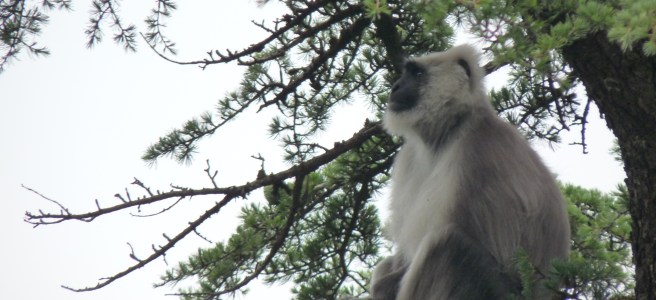
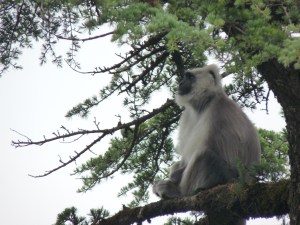
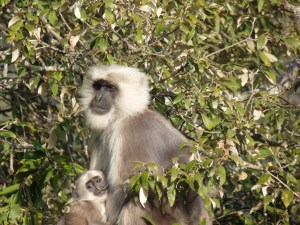
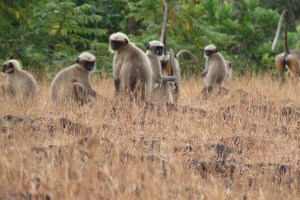
Himalayan Langurs look almost human. You only have to observe them to see the similarities. It’s another matter Langurs behave a lot better than some people I know! They possess the intelligence to leave you alone if you let them be: and don’t normally steal your food or snarl as you pass by like the Rhesus do.
In fact, they seem to know to coexist with the different species that inhabit high altitude terrain unlike most of us; and as I discovered, will even pose for a photograph now and then. I find them fascinating but am no longer surprised by their good behaviour.
I found this “Meditating” Langur looking comfortable in a yoga pose He was perched on the deodar for the longest time looking like he hadn’t a care in the world while his whole troupe was foraging in the trees below.‘Mama’ Himalayan Langur. Just another day in her Langur world!On a Rhododendron diet. The funny part was how he/she was eating the flower a single petal at a time like it was a Michelin star dish to be savour slowly.This little Langur was keeping watch perched on the ramparts of an old Portuguese fort called ‘Cabo de Rama’, in Goa last week. There were a bunch of them – like their Himalayan cousins…keeping to themselves while keeping watch.Langurs of the Coastal Plains
Can’t help myself when it comes to these three mutts. The loves of my life – Chingoo, Kajal and Chokli.
[Unacceptable monkey-behaviour, according to Chingoo] There are moments when Chingoo’s killer instinct surfaces and then he surprises us with his gentleness. Once a troop of 3 monkeys decided to party on our tin roof, antagonizing the dogs to no end. I let the dogs loose; Chingoo went berserk. Next thing I knew, he was pursuing the simians round and round the house with an infant monkey in his mouth; with me yelling “Drop it” in hot pursuit while wondering if the last Rabies shot I took was still valid. Things quickly turned around. It was the turn of the monkeys to act tormented. They screeched the place down and finally, Chingoo let go, of ‘baby-in-the-mouth’, without so much as a scratch. Reunited with their kidnapped ilk, the hysterical primates promptly did the disappearing act in a blur of grey.
[Chingoo and Kajal] Except for delivery guys, Chingoo takes kindly to humans. He used to take it upon himself to escort dog-friendly folk to their homes or on their walks. He returned home one day, brutalised, the bone on his leg showing through the wound and two of his teeth missing. He was pretty shook up by the experience and wouldn’t leave my side for days. It took him a while to get over his fear of people. Perhaps, ‘absolute’ freedom is not such a great scheme in the long run.
[Kajal=Khol] Chingoo inherited his mother, Kajal’s eyes- outlined black. Kajal is a gentle and elegant middle-aged lady who loves her creature comforts besides being the best rat catcher I’ve known to date. She catches and then releases the rodent, sparing it a torturous death and us from dealing with a gruesome carcass. Kajal’s winter coat is as soft as goose down. I often think how cool it would be to knit it into gloves. Collectively, our dogs shed enough to lace the air, our food, and every surface of our home. They would indeed make great gloves. If I only could harness it, instead of ingesting it.[ Kajal with a friendly calf][Chokli as a pup] I found Chokli abandoned in a ditch on the hillside. Mistaking her yelp for a bird call, I whistled. I knew I had found a survivor when she crept out of a bush and yelped back a reply. I was instantly drawn to her brindle stripes, the glint in her bright beady eyes and the white ‘socks’ on her paws. She was one smart little stray. My husband called her a pocket edition. She may have been petite but she charged like a speeding bullet every time she saw a monkey, dog or cow. Fear was not part of her canine vocabulary. She baby-sat Chingoo when he was a pup and let him swing by her tail till he got heavier and bigger than her.[Chokli] Chokli was also way more alert than both Kajal and Chingoo. While they dreamt through the night; fluttering eyes, stirring paws et al, Chokli’s pointed ears would cock-up at the mere hint of a sound. She died prematurely because of a careless vet who overdosed her with antibiotics for a fungal paw infection. She is missed. [The threesome in better days]













![[Unacceptable monkey-behaviour, according to Chingoo]](https://earthymatters.blog/wp-content/uploads/2013/07/p1170270.jpg)
![[Watching the Langur watching him]](https://earthymatters.blog/wp-content/uploads/2013/07/langur-and-dog.jpg?w=491&h=569 "[Watching the Langur watching him]")
![[Khaleej Pheasant]](https://earthymatters.blog/wp-content/uploads/2013/07/female-khaleej-3.jpg?w=491&h=346 "[Khaleej Pheasant]")
![[Chingoo and Kajal] Chingoo has a great trust in humanity except, for the delivery guys. [For which he can be forgiven.] He used to take it upon himself to escort dog-friendly folk to their homes or on their walks. He learnt his lesson the hard way. He returned home one day, brutalised, the bone on his leg showing through the wound and two front teeth missing. Betrayed and all shook up, he wouldn't leave my side for days. He became rather quiet. It took him a while to get over his fear of people. That's when I decided 'absolute' freedom might not be such a great scheme in the long run.](https://earthymatters.blog/wp-content/uploads/2013/07/dsc04315.jpg "[Chingoo and Kajal]")
![[Kajal=Khol]](https://earthymatters.blog/wp-content/uploads/2013/07/eye.jpg?w=491&h=398 "[Kajal=Khol]")
![[ Kajal with a friendly calf]](https://earthymatters.blog/wp-content/uploads/2013/07/cow-dog-team-copy.jpg?w=491&h=367 "[ Kajal with a friendly calf]")
![[Chokli as a pup]](https://earthymatters.blog/wp-content/uploads/2013/07/choks-pup-and-kaj.jpg?w=491&h=572)
![[Chokli]](https://earthymatters.blog/wp-content/uploads/2013/07/choks-ears-cocked-copy.jpg?w=491&h=405 "[Chokli]")
![[The threesome in better days]](https://earthymatters.blog/wp-content/uploads/2013/07/3somecopy.jpg?w=491&h=342 "[The threesome in better days]")
 Earthy Matters