Ethical Writing for Conservation with Journalist, Vikhar Ahmed Sayeed

Photo credit https://frontline.thehindu.com/static/content/frontline/flipbook/20200917161213/index.html#p=93

Heart of Conservation Podcast Episode #39 Show notes (Edited)
00:06

Lalitha Krishnan:

Hi, I’m Lalitha Krishnan and you’re listening to episode #39 of Heart of Conservation. I bring you stories from the wild that keep us all connected with our natural world. You can read the transcript for this podcast on my blog, Earthy Matters.

00:21

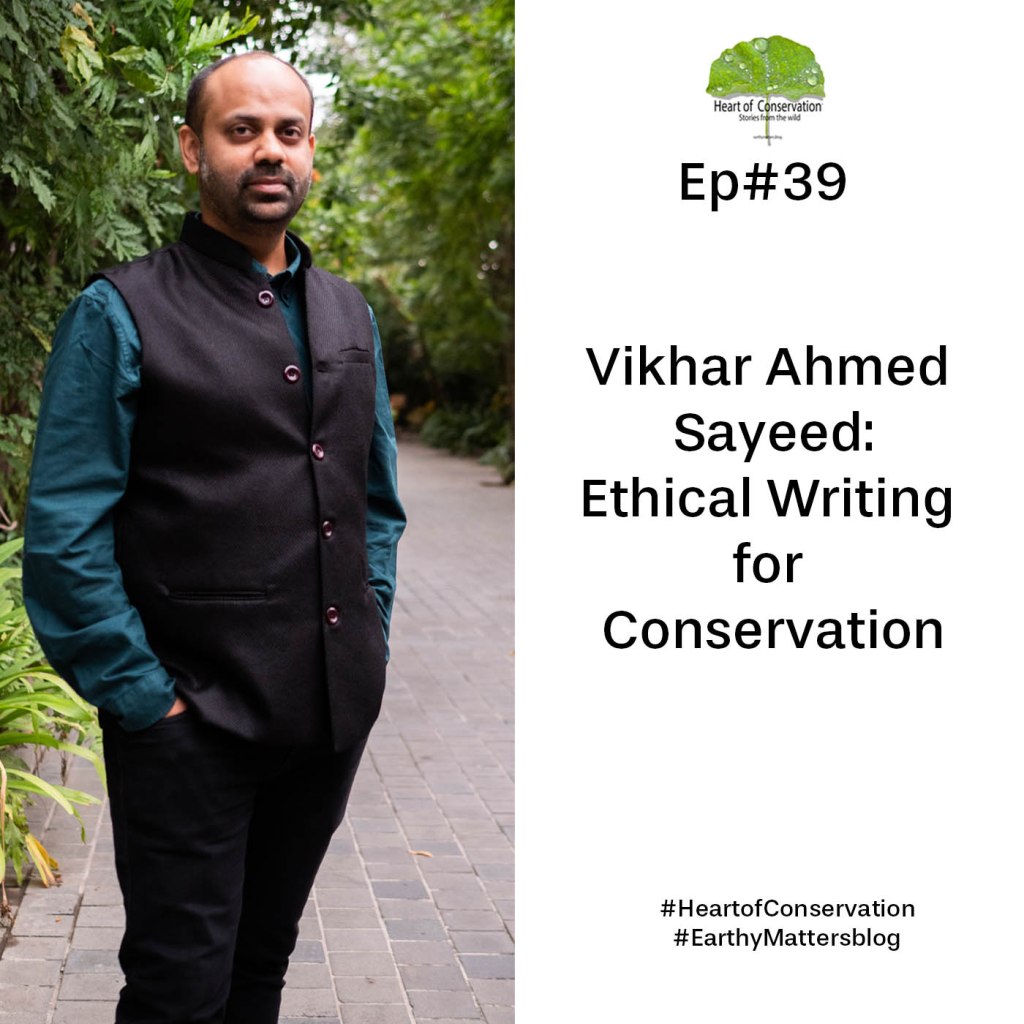
I’m speaking with Vikhar Ahmed Sayeed. He’s a journalist at Frontline magazine. He has degrees in history from JNU -New Delhi and the University of Oxford. I first met Vikhar at the Wildlife Institute of India in 2016, where we attended a course for nature enthusiasts.

00:40

Vikhar considers himself more of a political and social writer, though he has written some wonderful nature conservation articles that are well researched and fascinating to read. We are going to discuss some of those today as great examples of ethical writing for conservation. In a time where short snippets of fake or sensational news draws more attention, I consider Vikhar a rare breed of journalist. I admire his no-nonsense style in the long form, written with the eloquence of the seasoned journalist that he is.

01:15

Vikhar, welcome to Heart of Conservation. I’m so grateful that you made the time between your travel and work to speak with me.

1:20:

Vikhar Ahmed Sayeed: Thank you so much, Lalitha, for being so patient with me while I’ve been travelling these past few weeks. And as I mentioned earlier, most of my work has been on the politics of Karnataka and social issues, rural affairs. I have a very diversified portfolio of work. Since we met in 2016, I’ve tried to sort of also work on issues of conservation through my journalism.

01:53

It’s not easy to report on issues of wildlife, human-animal conflict, but because of the long form that Frontline allows me to use and because it gives me time, I’ve sort of written a few good articles so I’m happy to chat with with you about these.

2:15

Lalitha Krishnan: Thank you so much it’s been worth the wait. You have as you said published a great many stories and one of them is about Kenneth Douglas Stewart Anderson the Scotsman who was born in India. He is considered a pioneer of wildlife conservation in southern India. But unlike Corbett, little is known about Kenneth Anderson. Would you like to tell us something about him?

02:43

Vikhar Ahmed Sayeed: Lalitha, growing up in Bangalore, and you know, when I was a child, I used to read a lot. And at some point, I came across the works of Jim Corbett. And later, I think, if I recall now, I was in college when I first encountered the works of Kenneth Anderson, which resonated far more with me because I learnt that he lived in Bangalore and he would often foray into the forests around Bangalore. And initially my fascination was like, “Oh my God, wow, these were all forests?” I visit these places now and they are part of the sprawl of urban Bangalore.

03:27

And even further on, what were forests once upon a time are now towns. So that was my fascination. And then he was such an eloquent writer and the adventure. When I was young, I primarily used to engage with the works of Kenneth Anderson because of the adventurous element in them. I found that fascinating how he would go and track these man-eating large carnivores such as tigers and leopards and bears and elephants as well at times and he’d write so mellifluously about these encounters. So that was the thrill and then later when I became a journalist, I used to meet a wide variety of people.

04:18

And then a seed of doubt was sowed in my mind when someone casually mentioned, you know, I mean, “You love Kenneth Anderson, but have you ever considered the possibility that he was fibbing, that he was perhaps exaggerating?” So that casual comment made me think more deeply about his work.

04:44

And I wrote a rather detailed article. The primary motivation was to examine the claim of whether he had actually shot all these tigers and other animals that he wrote about or whether he was exaggerating. So through the course of writing the article, I learned a little bit about him.

05:05

So I learnt that he was born somewhere near Hyderabad in 1910 and then shifted along with his family at some point to Bangalore where he lived in the heart of Bangalore. Right now, the place where he lived would be unrecognizable but it was very close to Cubbon Park and he died in 1974.

05:31

You described him as a Scotsman but to add a bit I think he described himself–he was aware that he was an Anglo Indian because his family had been resident in India for several generations. That is one thing that is important perhaps. Also, among the many books that he wrote, he wrote a work of fiction set around the Anglo-Indian community in India. This had this had nothing to do with animals. So this just as a tidbit And then he worked in Hindustan Aeronautics Limited.

06:16

And often he had a wide network of informants in the villages around Bangalore and what is now Tamil Nadu also. At some point he would hear stories or reports of marauding wild animals, he would set off in his trusted Studebaker… I don’t know how you pronounce the name of that car, but he mentions it often in his writings. And then he would go and he’d write sort of very detailed reports of tracking these animals and then shooting them. And, you may also be interested to know what was the result of my sort of delayed investigation, right?

07:10

I set out to examine the claim whether he actually shot these animals as he claimed. The result of my investigation was ambiguous. I cannot certainly say that he did kill these tigers or whether he didn’t kill these tigers.

07:30

But while writing the article and meeting several people who knew him and meeting younger people who were motivated to become conservationists because of Kenneth Anderson’s work, this question became irrelevant. That was the most interesting development through the course of working on this article.

07:56

He has inspired several, I don’t know, maybe thousands of people to be aware of the importance of wildlife. Even someone like Ullas Karanth who is one of the pioneering tiger conservationists in India, also writes very sort of evocatively about his early forays into the forest with Kenneth Anderson. If you look at his book, A View from the Machan, Karanth has written about these encounters and certainly these early encounters inspired him. This is just one person, but apart from that, there must be hundreds, if not thousands more who have taken an interest in wildlife and conservation because of their reading of the Shikar literature of Kenneth Anderson.

8:52

Lalitha Krishnan: So interesting. I didn’t know any of that. Great. So, more recently you wrote a very disturbing article about how snake bites kill more Indians than all other wildlife combined. That was a real shocker. I quote your article now, “The World Health Organization has classified snake bites as a neglected tropical disease.” It’s a complicated subject to write about. So tell us about that.

9:23

Vikhar Ahmed Sayeed: It’s certainly complicated Lalitha, I agree with your assessment and it’s complicated for a few reasons, primarily because it’s so overwhelming, right? When you actually start looking at the statistical data, which is clearly under reported, it is scary, shocking, humongous and extremely complex.

09:54

So just to start off with some numbers. The numbers come from something called the Million Death Study (MDS), which looked at unnatural mortality among Indians. What emerged from this vast work is that more than 50,000 people were dying of snakebites in India annually, which is more than all other instances of man and animal conflict combined in the country. So it just seems it’s also complicated because it is so pervasive, right? It’s not restricted to a particular geographical region. It’s not restricted to one species of snake. And it primarily affects a certain poorer class of the country, primarily agriculturists who are out working in the field. So it just doesn’t get the media attention necessary also. For instance, if a marauding tiger accidentally encounters a human and kills that person, there’s so much attention paid to that one incident. Whereas the snakebites, over the past few months, I have sort of started following reportage of snakebite deaths. And often these are not reported. And when they are reported, they are consigned to some corner in the regional media.

11:44

And they rarely make it to the English newspapers, forget sort of the television channels because they are so widespread and common and also there is a feeling that simply because of the nature of the conflict right?  A snake slithers through a paddy field; a farmer bends down either harvesting or so planting crops the snake bites the victim somewhere below the knee, on the ankle, on the talus, on the heel and slithers away. So what can you do about this? So it’s incredibly complex and it’s a bureaucratic tangle also because unlike instances of conflict with other animals where it’s usually the forest department of the respective state that becomes the mediating state authority when it comes to snake bites–even though the vast number of poisonous snakes are considered… come under the ambit of wildlife protection act these are often…I mean it’s a more wider problem. So the department of agriculture is involved, the revenue department is involved, the health department is involved, the education department is involved. So there is, I mean, it’s a bureaucratic minefield to negotiate with. So, but through the course of working on this article, I did meet some very passionate, diligent, hardworking herpetologists who are coming up with simple solutions.

13:35

For instance, in the rural hinterland of Mysuru, Gerry Martin/Gerard Martin, the well-known herpetologist has been involved in a lot of local outreach, where he, through the aegis organization is distributing gumboots to farmers and advising them not to go out late at night. I mean it’s funny, a lot of these bites happen because of erratic power supply to agricultural fields. Farmers have to pump water and electricity is provided only at night. So late at night, in the middle of the night in fact, the farmers have to go to their fields and turn on their pumps. So a lot of bites take place at this time.

So Gerry Martin by simply encouraging them to wear closed footwear, by wearing gum boots when they go out at night… when they can’t see what’s slithering around them… I don’t know the efficacy of this yet, because it’s still something that he’s put in place recently.

14:49

But there are simple solutions, but it is extremely complicated. And there are other problems as well. The state of antivenom, for instance, is a huge concern. And then also the tendency of villagers to go to a local quack, a local healer who has attained some kind of notoriety for treating victims of snakebites because of which they delay going to a hospital. All of this, you know, means that it is extremely complicated to sort of, find easy solutions to this conflict. Any issue of man-animal conflict, as I’ve reported over the past few years, is extremely, extremely complex to resolve. But when it comes to man-snake conflict, it is the problems are of another degree.

15:50

Lalitha Krishnan: Yes, it’s so complex I don’t even know what to say. As far as your conservation pieces go, you also have a knack for researching and writing about lesser-known people and topics. You wrote about a famous taxidermist also known as Van Ingen of Mysore, I don’t know if I’m pronouncing his name right either, who stuffed shikar trophies for international nobility and maharajas of India. He was considered quite an artist in “making a lion look more terrifying than it looked”. So please share some interesting facts you came upon while writing this story.

16:29

Vikhar Ahmed Sayeed: Thank you Lalitha. This was an article that I enjoyed writing tremendously, you know, because I’m primarily interested in history so it gave me a chance to indulge in my passion for research and combine it with journalism. So this this article that you mentioned, I must congratulate you for finding this and reading this because it is written more than 10 years ago. It still remains relevant. Anyone can google for it, read it. It reads very well even now. What sparked my curiosity, if you can indulge me for a bit, is that I read a very, very sort of brief report in the newspaper, like a one paragraph report around 10 years ago if I remember correctly. And, all it said was, (Edwin) Joubert Van Ingen, leading taxidermist of Mysore passes away. That’s all, right? And the one paragraph news item stated that Van Ingen was the last member of the famous family of the Van Ingen taxidermist. And he had passed away at the ripe old age of 101. So for all these reasons I was very very intrigued.

18:01

And at just at that time I think I had read R.K Narayan’s book where the main character is a taxidermist. It’s called The Maneater of Malgudi. So for all these reasons I was very sort of intrigued and I went off to Mysore and I was so fascinated to learn more about this character. So he was the last surviving member of the Van Ingen family. So they were actually Dutch Boers who had moved to South India and Mysore at some point during the reign of the Wadiars of Mysore when Mysore was a princely state. So, Joubert Van Ingen’s father started this taxidermy firm sometime in the 1920s and he had four sons, all of whom carried on the legacy after their father’s death. and they had a vast factory.

Photo by Lalitha Krishnan

19:10

So this was the time that you should be aware that hunting was wide bred, was considered a sort of, there are many sort of studies on hunting during the British colonial period. But hunting was in a way considered a rite of passage for both colonial officers and the Indian nobility. So, it was perhaps a valued hobby, a pastime, a networking arena if I could sort of use that very modern phrase. And everyone was hunting and they wanted to preserve this memento that they acquired for posterity.

20:01

So taxidermist became very important and it became a very skilled profession. During my research I met a number of people  including employees who worked for the Van Ingen factory and other old residents of Mysore who were aware of the Van Ingens, who had spent time with them, who sort of spoke about Joubert Van Ingen’s great knowledge of the forest and his skill as a taxidermist. it is a little overwhelming for me when I recount this because as I mentioned earlier.

20:46

I mean they had a vast factory and they were the favoured taxidermist across South Asia and thousands of animals, skins primarily, would be sent to them from all over the country, right from Nepal from sort of the furthest boundaries of British India and then these thousands of skins would be processed for example if they are processing tigers they would make full mounts meaning the entire body of the tiger or like only the head or even rug right? And, we now have a population of between 3000 and 4000 tigers in India.

26 Dec 1992, Wankaner, India — Dining Room with Mounted Tiger Heads — Image by © Lindsay Hebberd/CORBIS (Laymens68, CC BY 3.0 https://creativecommons.org/licenses/by/3.0, via Wikimedia

21:33

You will be fascinated to learn Lalitha that just sort of say in a five year period, according to the data that I discovered in the 1930s, when the factory was working at its full efficiency  perhaps, more than 3000 tigers were just processed through the Van Ingen factory in five years.

21:59

This was sort of like a line. So they had sort of prefabricated models, mannequins which they would use. It was an elaborate art also.  But, the Van Ingens could err and refine their models simply because they had thousands and cumulatively perhaps lakhs of animal skins being processed in their factory. So, I mean, when we look back and just say a hundred years ago, this is not even a hundred years ago, say 70-80 years ago, large carnivores were so widespread. Even then, their numbers were depleting because there was no awareness of the importance of conservation. But it was just so easy to foray into the forest, to head to the forest, kill a tiger, shoot a tiger and then transfer the skin, transport the skin.

23:11

And Van Ingens had produced several manuals which were available, I am presuming, all over the country at that time, which described in detail what a hunter was supposed to do as soon as he shot an animal, how the skin should be preserved and how it should be transported safely so that it arrives in immaculate condition and then can be transformed into this great work of art that reflects a living animal itself. So, tigers were just one animal, there were leopards, there were elephants—not full elephants–elephant heads.

23:55

Even now, if you go to the Mysore Palace, right at the entrance there are two elephant heads which are mounted at the entrance. These also have been processed by Van Ingen. In the Mysore Palace there is a restricted enclosure. Enclosure may not be the right word. A room– a state room, a huge large room where you need special permission to go. And because the Mysore Maharajas were patrons of the Van Ingens, several of their trophies are available in this room, including a mount of the pet of one of the Mysore Maharajas, a mastiff known as Brumell. So Van Ingen, Joubert Van Ingen, you know, it is unfortunate that I was a journalist even before his passing, but I was unaware of the stature of this person. And I became aware of him only after his death. And all this, I found out after his death, you know, the only great regret I have is that I never met this man when he was alive.

25:06

Lalitha Krishnan: Wow, now I understand why you were overwhelmed. I mean, a factory processing tigers and elephants. It’s hard to imagine, you know? Vikhar, both your articles, Mumbo Jumbo Responses and Tiger on the Trail, cover again a very serious matter of human animal conflict. I like that you covered both sides of the story, the people’s view and the challenges that wild animals have to face living on the edge of human habitat. Karnataka has the highest count of elephants in India according to the 2017 census and probably, correct me if I’m wrong, human deaths by elephants.
25:47

According to the National Tiger Conservation Authority’s “Status of Tiger Report” (2022), there are 3000+ tigers in the Nilgiri Biosphere.  Despite ‘Early Warning Systems’, trenches, tracking, fencing, relocation, building of corridors, radio collaring etc, this again, is such a complex issue and must have been a very difficult one to cover. What were the challenges you discovered writing about these conflicts?

26;17

Vikhar Ahmed Sayeed: Oh, thank you for that question, Lalitha. These pertain to two of my detailed articles. The first one, Mambo Jumbo Responses is on the human elephant conflict in the hills of Hassan, which has been a pervasive problem over the past few decades. And the second one is titled Tiger on the Trail, which pertains to tiger-human conflict on the fringes of two very well-known protected areas, the Nagarhole Wildlife Sanctuary and the Bandipur Tiger Sanctuary. So both of these are different. I mean, there was a point in my career, in my life when man-animal conflict issues were seen as humans encroaching into forests and because of which all this conflict takes place.

27:14 That was the sense that I had, which as I later learned, I was quite badly informed. So for instance, in the hills of Hassan, there is a resident herd, I mean it is not a single herd. There are several smaller herds and even individual male elephants who form their own bands or who are sort of rambling alone. So there are no forests, there is no protected area or even if they are there, these patches are so small and scanty that they cannot sustain this herd. So basically you have this large group of elephants that are just sort of walking around through the extensive coffee plantations in that region. So that is why you have these instances of conflict and over the past two decades. Some 70 people have been killed and various solutions have been devised but none have worked so far.

28:28

The only solution seems to be that humans and elephants need to learn to coexist and moving to the tiger issue… See, tigers in Nagarole and Bandipur… Bandipur and Nagarole are touted as sort of marquee examples of conservation success, especially of Project Tiger which began in 1970s, somewhere in the 1970s.

28:57

And when Project Tiger commenced, there were 12 tigers in Bandipur. There are more than 200 tigers and as you know, tigers are very territorial. So it is, I mean it is ironic, the conflict is a result of the success of conservation.

29:21

So these areas have been protected very well. So tigers are territorial beasts, they are also very fecund. So they have reproduced, they have taken advantage, there is a robust deer population…cheetal. So the population has grown and considering that these animals are territorial, they do end up on the fringes of these forests and even are often spotted outside the protected areas as well. So it is a little more complicated. Right?  Again, through the course of writing this article where I met a variety of stakeholders there is no easy solution to issues of man-animal conflict. That’s what I realize and the intervention of non-state actors has been crucial in mitigating instances of human-animal conflict.

30:18

Lalitha Krishnan:  Thank you for that. You gave a good explanation or understanding of what the real issues are. So, Vikhar, as a fellow of the Asian Journalism Fellowship, you were lucky to listen to Jane Goodall in Singapore. Your wonderful and erudite article, The Chimpanzee Lady, I presume is inspired by this encounter. So what was the most inspiring thing (I am sure there are a zillion) about her that influenced this article?

30:51

Vikhar Ahmed Sayeed: Lalitha, it’s kind of a very sort of basic question. It’s not a question at all. Because well, Jane Goodall… but we need to go back to the time that we spent together at Wildlife Institute of India (WII ) and one of the classes there which was a discussion on wildlife literature.

31:22

So I carefully sort of made a list of all the books that were recommended and the first book that I read once I came back from Dehradun back to Bangalore was Jane Goodall’s In the Shadow of Man. And I felt so deeply moved by that book and the honesty of Jane Goodall and her sincere effort at conducting what is now clearly seen as pioneering research on the ethology, on the behavior of chimpanzees that I sort of told myself that if ever an opportunity presented where I could listen to this great lady directly,I’ll sort of move heaven and earth to get there. Coincidentally, after that time after reading her book I was in Singapore and she was speaking at a venue in Singapore. And in Singapore, unlike a lot of events in India where everything is free and people can just walk in where in fact there’s a paucity of attendees sometimes… Singapore, it was a ticketed event. Someone, I think if I recall correctly, my fellowship administrators procured a ticket for me after they became aware of my eagerness to listen to Jane Goodall. So I went. I listened to her. Jane Goodall’s work is fascinating on many many levels. There are many other greater people who can comment more authoritatively on the extensive corpus of her work. But for me, what struck me was, I haven’t gone through advanced postgraduate academic studies. It’s very difficult to challenge the established discourse that has been set in academia. It can be in any discipline.

33:41

So Jane Goodall goes to Gombe in Tanzania and she doesn’t have any background, she doesn’t have a degree even in wildlife sciences or anthropology or anything and very intuitively starts studying the chimpanzees of Gombe and builds such profound relationships with generations of chimpanzees. And she writes very beautifully about this connection that she built. So I heard her and also a very interesting point that she made was at some point, Goodall does enrol for a PhD and even completes it at Cambridge University. But when she realises that her research has greater significance, she very brutally, very confidently disconnects with academia, which I think is a very bold sort of move to make because how do we legitimize knowledge, right?

34:57

How do we legitimize that a certain mould of research is the correct way? We strive for recognition by a peer community and she breaks away from this and moves full-time into conservation. She says, no, I don’t want to be a wildlife scientist.

35:20

She takes this decision sometime in the 1980s. She’s done so much for conservation all over the world. What I recall very sort of clearly, is how optimistic she is. You and me are perhaps more pessimistic but even at her advanced age she remains very optimistic that humans and animals in the wild can coexist.

35:51

Lalitha Krishnan:  What conservation needs!  Hope. Optimism. I think she’s 90 now and still inspiring so many generations. She’s amazing. I had to ask you that question. I’m sorry. Besides, I am so jealous… Thanks for that, Vikhar. And, this is for budding conservationists or journalists, writers and documenters. What guidelines would you suggest for ethical representation?

36:22

Vikhar Ahmed Sayeed: That’s a tough question, Lalitha.

Lalitha Krishnan: Well, they can just read your articles.

36:29

Vikhar Ahmed Sayeed: Yes, yes, I certainly recommend that. Along with that, see, I mean, I came to writing about issues of wildlife and conservation in a convoluted way. At a midpoint in my career, I’d like to think… I’ve been a journalist for 16 years now. So I started paying attention to issues of man-animal conflict /conservation only over the past few years. So before that, my journalistic sense was finally honed. So using that same methodology and tools, I sort of applied it to understanding issues of conservation.

37:21

And very practically, what I did is, first, I befriended wildlife scientists as well as conservationists. And there is a fine difference between these two categories of people.  I befriended these people who are working towards on issues of conservation and then started sort of hanging out with them and getting a sense of how they engaged and interpreted issues of wildlife because wildlife science is a very advanced discipline. So obviously I couldn’t master it, right? But I tried to familiarize myself with how they think, how they thought. And using this sort of connection, I gained the confidence of writing on these issues. So these friends have been of great help.

38:32

When it comes to issues of conflict, again, I sort of work very clearly in a very straightforward manner as a journalist. Some people who identify themselves only as environmental writers or wildlife writers make the mistake of approaching the story with a bias. The bias is towards animals and even me, I mean, the whole purpose of my work is to ensure that how conservation can be improved. But I sort of don’t go to the field with this bias. I go with a very open mind and issues of conflict are extremely complex, right? They cannot be seen in terms of a black and white understanding.

39:19

They are very grey, they are very complicated and I enjoy that process of unravelling the intricate complexities of these issues. So, I savour that challenge. So, my advice to people who are writing about the wildlife and issues of conflict especially, is to be aware that there are multiple stakeholders and it’s very tricky to sort of unravel the complexities of conflict. But the advantage with these stories is first that wildlife. Scientists and conservationists are very studious people, right? So you have an incredible and rich source from which you can draw.

40:07

These people have been thinking so they would have generated data, they would have a strong perspective, they would have developed a strong point of view. So that is one advantage compared to the reportage that I do on other issues. I report in Karnataka and the bureaucrats of the forest department—I don’t know, I can’t speak for the forest department bureaucrats in other states—but at least in Karnataka are accessible, which means that to understand the state point of view, the government point of view, you have an avenue for a journalist or for a writer. Because, like I’ve mentioned that I report on a wide variety of issues, right? Agriculture, caste issues… communalism. Often my struggle is to gain access to an officer or a bureaucrat of some authority who can comment articulately and clearly on an issue, which half the time is a big struggle.

41:19

Whereas when it comes to issues of wildlife, there is some struggle. People are not sitting as soon as you call them, they are just waiting, rolling out the red carpet for you. But at least they are willing to talk, which is important. So those are some learnings. And I don’t know if it works as advice, but certainly those are learning and which is why I’m excited to write more about issues of wildlife and conflict from Karnataka.

41:48

Lalitha Krishnan:  I so look forward to that. Thank you so much.

41:51

Vikhar Ahmed Sayeed: Thank you. You’re welcome Lalitha. I mean, I’m so happy that we had this conversation because I know that, you keenly read my articles. So it’s always a pleasure engaging with someone who takes your work seriously, who pays close attention to it. I should thank you for taking the time to read, go through some of my own articles, which I had forgotten.

42:20

Lalitha Krishnan: Absolutely my pleasure. I learnt so much. From listening to you even more.

The end.

Listen to the podcast here.

Birdsong by hillside resident, the collared owlet. All photos courtesy as mentioned in caption /photo. Guest photo credit: Vikhar Ahmed Sayeed. Podcast artwork by Lalitha Krishnan
Disclaimer:Views, thoughts, and opinions
expressed in the podcast and show notes belong solely to the
guest/guests featured in the episode, and not necessarily to the host of
this podcast/blog or the guest’s employer, organization, committee or
other group or individual.

Know Your Dugong. A High Priority Species Like the Tiger.

Dugong photo by Darius Quadros

Ep#32 Heart of Conservation Podcast Show Notes (Edited)

00:00

Audio: Collared owlet 

00:09

Hi I’m Lalitha Krishnan and you’re listening to episode #32 of Heart of Conservation. You can listen to Heart of Conservation on several platforms but you can also always read the transcript right here, on my blog Earthy Matters. Today we are going to be talking about an animal that is an old relative of the elephant but it lives in water. I’m talking about the Dugong spelt ‘Dugong’. It’s also a cousin of the manatee. The dugong is a marine mammal that once lived in large numbers in Indian coastal waters and yet we know very little about it.

I am very excited to be speaking to not one but three amazing researchers Prachi Sachchidanand Hatkar, Chinmaya Ghanekar and Swapnali Gole about their work with Dugongs and their habitats.

Prachi Sachchidanand Hatkar is a PhD Scholar, Project Fellow- CAMPA Recovery of Dugongs and their habitats in India at WII. Currently, she is working on seagrass-associated fauna in the gulf of Kutch and Gujarat. Chinmaya is a wildlife biologist and certified scuba diver. She is currently working on projects involving seagrass, fish, dugongs and their threats under ‘CAMPA Recovery of Dugongs and their habitats in India.’ She is pursuing a Ph.D. in seagrass-associated fish and works in the Gulf of Mannar and Palk Bay region.

Swapnali Gole is a marine researcher and a National Geographic Explorer. Affiliated with WII, she has been working on the insular population of dugongs in the Andaman and Nicobar Islands, India, for the last seven years.  Between the three of them they have all the dugong habitats of India covered, I think. 

A special thank you to Dr Dr. J. A.Johnson, Scientist and faculty at Wildlife Institute of India and also Head of Department of Habitat Ecology for facilitating this conversation. And for the lovely ladies on my screen, welcome and thank you all for joining me.

2:14

Lalitha Krishnan: Swapnali do you want to start with what are dugongs? 

2:18

Swapnali Gole: When I start introducing dugongs, what I have experienced is that there is a big question mark on everybody’s face. “Do you want to say ‘Dolphin’? Are you talking about some whale species?” Generally, we are always bombarded or greeted with these kinds of reactions. Dugong is a very simple elusive animal which is a marine mammal species. A marine mammal is an animal that lives its life in the sea–of course there are variations–there are some marine mammals that live partly in the sea and partly on land but dugongs are exclusively marine mammals which means right from when they are born to the time they die, they spend their entire life cycle in the sea. And, they are just like dolphins and whales; also, marine mammals.  But they are more popularly known compared to dugongs. 

Dugongs are also more popularly known as sea cows; the reason being the dugong is the only exclusively herbivorous marine mammal. Which means the only diet a dugong prefers is a vegetarian diet in layman’s language. And, they are generally found in around 42 countries in the world globally in the Indo-Pacific belt out of which in India we have only three distribution sites i.e., Gujarat, Tamil Nadu and Andaman and Nicobar Islands. So, people must remember the dugong as animals that live in the sea, they give birth to animals–they do not lay eggs like some other marine species and there is strong parental care in dugongs. From the time the calf is born, the calf will be strongly dependent on its mother for one to two years. These dugong mothers nurse their babies which is why they fall in the category of marine mammals. Marine means related to the sea and mammals mean animals that give birth to the calf and not lay eggs.

4:23

Lalitha Krishnan: That is so interesting. There is so much we do not know. How long have you three been researching dugongs and how extensive is the area you work in in these three different parts of India? 

4:39

Prachi Hatkar: I have been working in the Gulf of Kutch for five years now. The Gulf of Kutch is situated between the Saurashtra and the Kutch peninsula so the coastline of the Gulf of Kutch is about 170 km long. It starts from the Okha to the inner gulf and the mouth is about 75 km wide at the mount and the water spreads around 7300 square kms across the Gulf of Kutch. So, the Gulf of Kutch is a Marine National Park and marine sanctuary which was established in 1995. It was the first Indian marine sanctuary which was declared and it has 42 islands which covers various habitats like the grasses, corals, mangroves and intertidal zones etc. 

5:32

Lalitha Krishnan: What about you Chinmaya?

5:34

Chinmaya Ghanekar: So, like Prachi, I have also been working in Tamil Nadu – in the Gulf of Mannar and Palk Bay. These are two regions of separate seas.  One comes in Bay of Bengal which is Palk Bay and one is part of the Indian Ocean which is the Gulf of Mannar, so we kind of work at the confluence of both.  The area, to describe it, is a long, long stretch of Indian coastline – around 500 kilometres. So, from Adirampattinam if you consider till Kanyakumari it is approximately 500 km of the shore line.  And then the sea extends…in Palk Bay it extends to Sri Lanka but because of international borders we cannot access that area. But we generally restrict our area to 10 to 12 kilometres of coast. So, it is around 5000 square kilometres we cover for our study for dugongs and sea grasses and other fauna, and other factors of the project. To tell you about Park Bay, it is a very closed sea; it is like if you see Palk Bay – like I saw Palk Bay for the first time. I thought it was a lake.  It is very calm and has very glass like water most of the time but Gulf of Mannar on the opposite hand has waves and islands. These are two completely different areas so you working in both of them is pretty different from each other. Palk bay has a lot of sea grasses. Gulf of Mannar has corals, sea grasses, algae beds, rocky patches, habitat diversity so to say.  We can encompass most things of marine habitats in both areas.

7:28 

Lalitha Krishnan: Amazing. It also means that the dugong likes both habitats.

7:33

Chinmaya Ghanekar: They definitely do.

7:34

Lalitha Krishnan: Interesting. Swapnali?

7:37

Swapnali Gole: I have been working in the Andaman and Nicobar Islands studying dugongs for more than seven years now. Our study site if you see…because it is an insular set-up, it adds up to the work of our team. Because, the entire stretch is around 1962 kms, right from the northernmost island……..  till Great Nicobar it is 1962 kms. And, we have more than 800 islands, 836 to be precise. Then on each island there is a coast because it is an island, hence, we have more study areas I would say. For every island there are four coasts. And, what we have been doing is working in patches because it is not possible-considering the manpower that we have-to be present everywhere. So, we started our survey with say, the north……Andaman covered that and slowly came to the southern side. And, very recently we covered the Nicobar groups of islands. Practically the entire Andaman and Nicobar is our study area.

8:48

Laitha Krishnan: Sounds like a lifetime of work.

8:50

Swapnali Gole: It was. It took us six years to do what we did and it was very intensive.

8:57

Lalitha Krishnan:  When you say ‘team’ wherever you are, what size teams are you talking about?

9:05

Swapnali Gole: For the islands we never had a team of more than three. There was always a lot to do. I do not know why but we always had the smallest team…two or three people. For the seagrass and dugong (study) especially, the maximum I remember we had was a team of four, never more than that. 

9:27

Chinmaya Ghanekar: I have been fortunate enough to work with a team of eight people on a boat working on different aspects of the project and then we work together and it’s amazing.  But then sometimes we are just two people who are going by an auto to a coast then doing our surveys and coming back so there is variation across the years. 

9:52

Lalitha Krishnan: Prachi, I am going to ask you this question just to know more about the dugong. If a Dugong were a person, how would you describe it? 

10:03

Prachi Hatkar: I would like to describe the dugong as a gentle giant.  We have heard stories that describe the Dugong. If you see dugongs, they look similar to somewhat like a pig you can say, or mermaids… the stories we have been hearing about sailors saying, “We have been seeing mermaids in the sea”, they weren’t mermaids, they were actually seeing dugongs but perceiving them as mermaids. 

10:32

Lalitha Krishnan: Where do these stories come from?

10:36

Swapnali Gole: It was given by Christopher Columbus. In his excerpts—while he was voyaging around the West-Indies side–he wrote that, “I happened to see three mermaids today but they are not as beautiful as they have been described.” Honestly speaking, dugongs do not look like mermaids (or what we think we know of them). Only the tail resembles the mermaid but also later it was detected that maybe he did not see dugongs but manatees which are sisters of dugongs.

11:10

Lalitha Krishna: Right. Chinmaya, where can we find dugongs? In India of course, we now know but where in the rest of the world?

11:19

Chinmaya Ghanekar: So, in India as we have already mentioned it is in Gujarat, Tamil Nadu and Andaman Nicobar. So, these three areas are like pockets. If you see the map, it is like one pocket on the left-hand side of the map, one on the south and one on the right-hand side. So, we call this a pocket distribution of dugongs.  

But in the world scenario, we have the greatest number of dugongs as of now in Australia. So, after that, we have this population in Red Sea, so that is also kind of pockets so these mostly as distributed in Indo-Pacific region; very technically saying and they are present in some island countries like Philippines, Indonesia…Southeast Asian countries. They are also there in our neighbouring countries like Sri Lanka. So, they extend from the Indian ocean to the Pacific Ocean completely. But China had dugongs a few years ago and very sadly they have now declared them as functionally extinct so the population cannot grow basically any more. They do not have dugongs anymore which is kind of sad news but we should be alarmed that populations in other countries also are quite threatened. We should look at them and give them the importance they deserve.

12:51

Lalitha Krishnan: True. Swapnali, talking of habitats where do dugongs prefer to live? Tell us a bit about their biology. How long they live, up to what size they grow etc. I know you call them gentle giants but exactly how big are they?

13:15

Swapnali Gole:  Dugongs spend considerable time in the day-I am not talking of their whole night -in shallow waters. So, it is directly linked to the sea grasses that they feed upon. And seagrasses being true plants they need sunlight just like any other plant on land for creating their own energy i.e. their photosynthesis process. So, wherever light reaches the water – and this is a very local concept. In the Andamans for example, the water is very clear so it (sunlight) is going to reach much deeper there compared to Gujarat for example where the water is very turbid. So, depending on how deep the sunlight reaches, it decides on where sea grasses will be found and that automatically regulates where dugongs will be found. It is all very linked. And, because dugongs primarily feed on seagrasses, wherever their food is, their distribution is going to be centred around those areas the most and that differs from place to place. That being one. Also, there have been tagging experiments done in Australia where it has been scientifically proven that more than 70- 80% of time of a day, dugongs have been found in shallow/sheltered waters 1 metre to 5 metres because they were spending a lot of time just feeding on seagrasses. On a similar line, dugongs, as I said, feed on seagrasses. An adult dugong will eat up to, say, 35-40 kgs of sea grasses, that is a lot of seagrasses for an individual. And, when l say, ‘adult dugong’ it goes up to 3.5 to 4 metres. So, the gentle giant’s size limit is 4 metres. Dugongs are generally not recorded to grow more than that. I have never heard of dugongs growing to say, 7-8 metres. Generally, people mistake dugongs for other species. There has been misidentification in my experience also. My informant spotted a whale and thought it was a dugong. He said it was 10 metres long. That is not biologically possible because the limit for dugongs is 3.4- 4 metres. When a dugong calf is born, it is around the 9-1.2 metres size range and around 40 kgs. But as the baby grows older, and it puts on weight after eating a lot of seagrasses, the maximum weight of a dugong, I can say, can go up to 350- 400 kgs on an average. Which is why they are called gentle giants. They are massive. They are very docile animals.

15:45

Lalitha Krishnan: When you say they grow to 4 metres, has this been their size historically? I do not know if there have been any fossil finds etc? 

15:56

Swapnali Gore: Whatever documentation we have come across where dugongs have been mentioned it is beneath the size range of 3.5 to 4 metres. Relatives of the dugongs–there was a species called Steller’s Sea cow– which was really massive. It was much larger than the dugongs in size. But if you talk about the species of dugong the upper limit of dugong size is always given as 3.5-4 metres

16:20

Lalitha Krishnan: OK. Thank you so much. Prachi, now to you. You know the term seagrass meadow paints a lovely picture in the imagination. What are they really like? Also, I read that dugongs regulate seagrass ecosystems. How so?

16:42

Prachy Hatkar: So, as Swapnali mentioned earlier, dugongs are vegetarians; that they prefer seagrass. So the seagrass are present in shallow waters where the dugong reside so they are basically residing where the food is. They graze upon beds of seagrasses regulating the biomass of seagrasses. In the clear water of the Andamans for e.g. the seagrass bed looks like a football field or ground basically. It will be spread across the whole land. It is a beautiful sight. Dugongs prefer a seagrass species called Halodule specifically. Halodule and Halophila species have low fibre content and rich nitrogen content. So basically, the dugongs graze upon the seagrass meadows regulating the biomass and type of varieties of seagrass that grow in these meadows. So, they actually act as gardeners.

17:53

Lalitha Krishnan: Are you three covering aspects of dugong research in the Gulf of Kutch, Gulf of Mannar and the Andamans and Nicobar Islands?

18:02

Chinmaya Ghanekar: To talk about Tamil Nadu, Palk Bay, Gulf of Mannar, we are covering research aspects of dugongs and seagrass projects. We are also covering the outreach and capacity building and these are true for both the other sides. So, these are main four objectives which are divided into a lot of smaller sections. So, if we are talking of dugong research, we are looking at where dugongs are distributed. What are they eating? Where are they going? If they are breeding in some areas how frequently are they sighted? These are some questions we answer with dugongs. With seagrasses we look at what species are there. What types of meadows are there. What are the associated species of fish – on which my PhD is based upon. So, I am looking at how seagrasses and fish interact with each other. How they are dependent on each other. This is not exactly I would say, a direct connection to see but when we say “fish” we obviously think of food. And we have already addressed this previously; dugongs are regulating the sea grasses, and seagrasses are habitat for fish and we are connected to dugongs.

This connection and the layers in between are what we are trying to study. So, there are two things which are my main-focus. I mentioned seagrass-associated fish. What is the diversity? How do they utilise seagrasses? Are they using the space between these? Are they eating seagrasses? Are they hiding in it? Are they laying eggs on them? I am trying to answer these kinds of questions.

20:00

In terms of dugongs, I have mostly looked at the distribution of dugongs and threats associated with them. There are many, many threats like possibly a boat dashing into them or a net entanglement or pollution or coastal development. The threats that we generally hear about in marine ecosystems are also threats for dugongs. I also study that; something like plastic pollution and then we have also looked at primarily what dugongs eat in India. So, the dugong research in India has not investigated this before this so I and one of my colleagues Sumeet have done gut-content. When we get a dead dugong, we get the gut content out of it and we see what seagrass they have eaten and what they prefer. And, we have also found some plastic fragments in the gut. Those aspects we investigate from the research point of view.

In the outreach and capacity building, we mostly interact with people, different stakeholders like the Forest dept., police, marine police…all of those and try to make them aware of dugongs and give them more and more training to continuously monitor dugongs and their habitats.

21:21

Lalitha Krishnan: Well said, So, it’s not one mammal but it’s the whole world around it. Swapnali, my next question was about interacting with fishers and other folk in the coasts that you work in. What have their reactions been?  What are the challenges? And, how do dugongs behave when they encounter humans? Are we perceived as threats? Sorry, that’s a lot of questions.

21:50

Swapnali Gole: The first question is always my favourite question, honestly. It is all about communities and that is my favourite part of the work that I have done. To talk to people- the local people. So, it started with me just interacting with the fishermen. For all marine researchers, the primary stakeholder is always the fisherfolk of that particular area because they have practically spent their entire life by the sea. And nobody can have that kind of knowledge or degree of curiosity, honestly speaking. The interaction that they have with the sea and the creatures living in the sea is immense. So, we started talking with the fishermen initially to understand their idea or perceptions of dugongs and seagrasses. Also, where dugongs and seagrasses are found. So, that would be used as a baseline for our research work.

22:46

Eventually we started talking with many other people who are going out to sea in the Andamans. The benefit is that the entire area is an insular set up. Whether you are a sea-person or not, you are dependent on the sea even for commuting from one island to the other. So, your interface with the sea and these areas is going to be very much pronounced. So, we started talking to different stakeholders you know…sailors, scuba divers or for the first time, the Indian Navy and Indian coast guards. Because, there are many, many regions in the islands which are firstly geographically isolated. So, considering the limited logistics we have, we don’t always get to go to these islands. Secondly, there are restricted areas. So, there is a defense-restricted area, there is a tribal-restricted area. Again, as researchers, we don’t have permits or we need to work on the permits a lot and that takes considerable time. So, we started targeting different stakeholder agencies, who are sea-farers. That’s the only mandate required to be part of this programme which turned out to be something called The Dugong Monitoring programme – a citizen science approach. And, initially whenever we interacted with these stakeholders, not just fishermen but other people also, there was this big question mark on their face as I had mentioned in the opening statement. When you say, “dugong’, people say, “What? Are you talking about dolphins? 

Multiple times, they also correct us. “No Ma’am, you’re probably talking of dolphins.”

“No, we are talking of dugongs.”

That was the kind of response we got initially. Most of the people we spoke to were clueless of what we are studying.

The saddest part is that the dugong is the state animal of Andaman and Nicobar Islands.

24:30

Lalitha Krishnan: Really?

24:31

Swapnali Gole: Yes, even in local schools, we were surprised that the local school kids were not aware of what a dugong is. Our work starts there, with that. It’s like Chinmaya mentioned, there are many elements to the work we are doing. It starts with resources but a massive, massive chunk of our work in all three sites is sensitisation of the people. Right from dugongs to the species identity, telling them, “There is a species that lives near you and why it is important, and how you can contribute to saving them…”  in a nutshell is the kind of work we are doing at three sites.

23:11

To answer your second question, I would not say that dugongs avoid humans but in Andamans especially there is an island called Shaheed Dweep which is full of tourists. There is so much anthropogenic footprint in that area and boat traffic. You will see every type of boat there, from ferry boats to speed vessels to normal dinghy boats of fishermen. All sorts of boats are there in the water and dugongs are still coming into those areas again and again. It is said globally also, that in places like Southeast Asia which are hubs of harbours and anthropogenic footprints, dugongs are still coming into those areas.

I would like to add that dugongs behave individualistically too which goes for any species. Even in the Andamans, in Shaeed Dweep, I have seen the dugongs coming into areas where there is a lot of human interfaces. But a neighbouring island group which is a Marine National Park area…when we spotted a dugong there, and got into the water, this is my personal experience, those individuals just swam away to the other island altogether. So maybe because those individual dugongs were inside a marine protected area and not used to human-interface, they were not okay with humans coming close to them but in some other areas where humans were coming in and out every day, maybe the dugongs living in that area have become adapted to that traffic or pressure.

26:39

Lalitha Krishnan: This is so interesting, thank you.

26:42

Chinmaya Ghanekar: Can I add something?

26:44

Lalitha Krishnan: Of course. Please go ahead.

26:45

Chinmaya Ghanekar: Very recently, a week ago, a fisherman told us by phone that, “We are seeing dugongs every day in the Gulf of Mannar” in an area which is kind of a tourist area–the Tourism dept. also manages tourism there. So, he (fisherman) said that, “whenever we go out for fishing, we see dugongs daily. They come near the boat at so close a distance, you can almost pet them”. This is a different kind of interaction they have with the dugong and there is a kind of friendship between them. So, the boat comes, the dugong comes, they see it and feel happy about it. So, it is also a very, very positive interaction between the community and the dugong.

27:28

Lalitha Krishnan: That is such a wonderful thing to hear. It is making me love the dugong, a mammal I have never seen in my life. Dolphins are also known to behave like that. Maybe it is one of the reasons why they mistake them.

27:42

Chinmaya Ghanekar: Maybe but people will have different interactions with different individuals or populations differently. Like Swapnali rightly said, “There are individual reactions”. Something like in the Red sea. If you follow #dugong on Instagram, every day, you will see a photo of the Red sea where the dugong is  surrounded by divers. And, it’s feeding and kind or sleeping or doing its thing. But, that doesn’t happen here. So, the individualistic behaviour is very pronounced and it may vary with different populations also.

26:15

Ep#32 Podcast label design by Lalitha Krishnan. Dugong Photo Credit: Darius Quadros. Researchers photos courtesy Swapnali, Chinmaya and Prachi.

Lalitha Krishnan: So, the dugong is also been accorded the highest protection status i.e. Schedule-I of the Wildlife Protection Act, 1972. How does it translate in the real world? Would you like to answer that?

28.33

Chinmaya Ghanekar: 

This Wildlife Protection Act is considered one of the strongest conservation acts in the world because it has schedules. It has a lot of animals that receive protection. There are different schedules in the Wildlife Protection Act giving different status of protection to different species. The infamous one is the tiger out of all. The tiger has Schedule I protection, so do dugongs. Which is the highest kind of protection the Wildlife Act can provide. There are so many restrictions. Like, you cannot touch that animal. You cannot research that animal without permission. You cannot utilise any part of the animal in that case, not any part…even if it is excreta which happens in ambergris fish like whales. It is still part of the whale so we cannot utilise that. To even touch that kind of animal, you need permission. It is that kind of protection.

-Chinmaya Ghanekar

29:41

Lalitha Krishnan: Sorry…does that apply to even a dead animal?

29:43

Chinmaya Ghanekar: Yes, even for dead animals. Wildlife Institute of India has acquired all the permissions and we collect those samples and work with it. So, with this kind of protection, we always need permission from the government and the government is always very, very strict about it. We cannot work without permission anywhere. 

30:11

I will give you an example which happened in Thondi (Palk Bay), when I joined the project. It was a case of dugong hunting. It created a lot of fishermen agitating because it is part of their tradition and we struggle with it. They hunted it (the dugong) and the marine police put charges on them. Their boat was confiscated, their nets were confiscated. They were put in jail for seven straight years. The fisherman was about 50 years old. This kind of completely puts all kinds of restrictions on their lives. They cannot get their boat back, they lose all the money they put in for their equipment. So, the implementation of the Wildlife Protection Act is very strict in the real world.

31:05

There is one more story. When I was going on a boat, by mistake, there was a communication gap between the highest forest official and the field people and they did not allow me to go on the boat and research the dugong. So it is that strict, you need all things in place and the Wildlife Protection Act makes things happen at least in case of dugongs which I have seen personally.

31:35

Lalitha Krishnan: It is actually a good thing, isn’t it? In a way, it is protecting the animal which is what it is supposed to do.

31:43

Chinmaya Ghanekar: It might not be so straightforward as it sounded in the answer. There are a lot of agencies that come into it but then it happens. It does happen.

32:00

Lalitha Krishnan: Prachi, what part of the dugong research do you like personally? Or what has been your most amazing take away or encounter.

32:05

Prachy Hatkar: As I mentioned that I have been working with dugongs since the last five years. When I started working in Gujarat, like Swapnali said, when we went for the awareness programme, in schools or interacted with the locals, the fishermen, they mentioned that they had sighted dugongs in Gujarat-in the Gulf of Kutch-long back. Maybe 15-20 years ago. Recently they have not seen any live dugongs as such.

We were fortunate enough to see a live dugong which was the first photographic evidence in the Gulf of Kutch two years ago through the drone survey with one of my colleagues who accompanied me in the field. When we went seagrass mapping, we could actually see two dugongs.

33:02

Lalitha Krishnan: Really? Were they of the same size?

33:05

Prachy Hatkar: They were actually adult sized. We thought we could see a mother and calf pair in another sighting. But we were fortunate enough to have a dugong sighting. We knew then the dugong was not locally extinct from Gujarat.  

33:26

Lalitha Krishnan: Such a positive sighting. Swapnali, how about you?

33:28

Swapnali Gole: On a similar line, I have spent more than seven years studying dugongs. And my first sighting…from boats I had spotted dugongs. Honestly speaking, in the Andamans it is pretty possible to spot a dugong considering the water is also clean. My first underwater sighting–despite diving so much throughout the islands, happened after five years. I remember I had spent 45 minutes with this individual. I had almost given up all hope… “I won’t see it” I said to myself. 

So then when I spotted that individual, it was like “Wow”. You know, your entire journey as a dugong researcher flashes just right in front of you. I was literally crying underwater. I cried so much my mask filled up with my tears.

-Swapnali Gole

I was so happy and then I realised I had left all my friends who had been diving with me behind and I was literally following the individual.

34:38

And in those 45 minutes, it was just me and the dugong. You know, it was a surreal moment for me. Then I was a very happy soul. Finally, after all the hard work I had put in.

34:48

Lalitha Krishnan: That’s an exclusive. First of all, who gets 45 minutes alone with an animal? You are extremely lucky.

34:55

Swapnali Gole: I am lucky. I have so much gratitude for those 45 minutes.

35:01

Lalitha Krishnan: But you all deserve it for the work you have done. That is your reward to see a free, happy, healthy animal living in its habitat. Chinmaya, do you want to add to that?

35:17

Chinmaya Ghanekar: The first ever live dugong sighting I had…  I was dying to see a dugong. Because, everybody was telling you they saw a dugong here, a dugong there but you are not seeing one. It is frustrating. It’s very frustrating after spending a long, long time in the sea. I was talking about the other work I was doing per different aspects of seagrasses and other related fauna… So, we were doing that, sitting on the boat, and sieving the sand out. So, I was doing the sieving and behind me, I just heard this loud breath in the water. It was a loud, loud breath. I left the sieve down and when I turned around, I saw the tail of a dugong which was going underwater. I cannot tell you how beautiful that was. I have a picture-memory of that and I really want to see that again but the first experience will always be special. And this was special.

36:21

Lalitha Krishnan: True. Talking of breath, are dugongs vocal?

36:27

Prachy Hatkar: Yes, they are very much. They chirp like birds. They actually chirp under water. As you know, sound travels four times faster underwater compared to land. So, obviously, that’s the only communication that works for them – underwater sound.

36:49

Swapnali Gole: in addition to what Prachy said, there are various categories of vocalisation patterns which have been identified for dugongs. We unfortunately do not have any dugong vocalisation study happening in India by WII or any other researchers. But in Japan, people have studied dugong vocalisation patterns. So, they have categorised dugong vocalisation patterns…they also bark. So, it is a different frequency range for each category. And, then they chirp as Prachy has mentioned. But then, there is the possibility that dugongs will vocalise very rarely; and only when it is fully needed. They are not like dolphins who echolocate and communicate.

17:28

So there have been studies where the sample size of what researchers have put forward to study communication patterns has been immense but compared to the efforts that have gone into it, there have been very few recordings of dugong communications. So, that is also one point to be understood: that not always do dugongs communicate as dolphins do or other marine mammals do.

37:53

Lalitha Krishnan: Sounds like such a very self-sufficient mammal and very smart too. What is the role of WII in Dugong conservation in India? What are the government initiatives in place right now for protecting it? And what is the way forward? Also, I always ask three questions at a time.

38:18

Chinmaya Ghanekar: Yes, because they are very much connected to each other. Wildlife Institute of India is part of the government. Though it is autonomous it works very, very closely with the government…different, different departments; not only the forest department. As Swapnali mentioned we also work with the Indian navy, coast guard, all of these defence bodies. 

The Wildlife Institute of India initiated the CAMPA dugong recovery programme in 2016. From that time, Swapnali is the most eligible person to comment as she is one of the first researchers from WII who has started work on dugongs. Before that, in 2013, Dr ShivKumar and one more researcher called Aditi Nayar. They both had a research programme regarding dugongs in Gujarat, Tamil Nadu and Andamans and Nicobar; where they have seen the perspective of people about dugongs typically, the local communities who interact with the sea on a daily basis. From that they had come up with something called the Critical Dugong Habitats where dugong sightings or populations are more. And also, human pressure is a lot in the area. So, both those things combined are called Critical Dugong Habitats.

39:45 

And based on that we started our work in the CAMPA Dugong Recovery Programme. But as I mentioned earlier, we started with four objectives. One is dugong research, the other is seagrass and associated fauna research; one is outreach and the other is capacity building. So, WII has been actively working on all four of the objectives.

40:17

Research we have touched upon what kind of research we do. But in outreach programmes, there is this highlighted programme called the Dugong Scholarship programme which is a very novel initiative as it targets the fishermen-kids. So, we go from school to school, identify fishermen-kids and we give scholarships to them which is Rs 500/- per month and these scholarships are  given at such a time-in 9th or 11th grade-when they might not have money to go for further education.  At least they will have this one 10th pass certificate or 12th pass certificate which is at least the basic level of education one would expect from someone. So, the scholarship is given at that time.

41:09

And through them, as Swapnali mentioned, the dugong volunteer network or volunteer programme network. Their scholarship student-parents being fisherfolk, they also provide us information. So, we give them the scholarship and we get information. It’s a barter and it’s a beautiful barter because we get to know so many things which we might not be knowing about dugongs through research papers. Because, the local experience is somebody’s father who has been fishing probably for the last 20 years. He will have the experience which we might not expect. Something like, the dugong-friendship story we told you about. This Dugong Scholarship programme has immensely grown in all the three main states. We now have about 500 students who are part of that programme. And we will continue it for the next few years or so. 

42:05

In terms of capacity building specifically–the word capacity building itself says we need to strengthen the stakeholder’s capacity. So, we give them scuba diving training programmes or drone training programmes to monitor and understand more about their habitats. Because, in the end, maybe we will be there, or somebody else will come, but the forest department and other stakeholders…they’re going to stay forever. So, they are the people who should actually see this diversity and have long term monitoring, and WII is kind of hand holding them all the time. And it’s not true only for dugong projects, iit’s for all the outreach and research combined projects WII has, hand holding is a huge, huge part which we play all the time.

42:57

We have also held Marine mammals stranding workshops in Tamil Nadu to state veterinarians and range forest officers. In that, what happens is –you always see videos on facebook or other social media or the news that a whale is stranded or a dolphin or turtles are stranded/dead or something similar. It is a pretty unique situation because we don’t know what to do. If it is a live animal, we may want to rescue it but how, we do not know. Or if it is a dead animal, should we bury it? What samples should be collected? What information can we get out of it? Since marine mammals are very distinct, as researchers or forest officials also, we cannot interact with them on a daily basis. It is only part of the job we do. We have so many other things. So, if a dugong is stranded, we can actually understand the size of it, why it has died or is there any other associated information viz. the gut content I was talking about.

44:07

To get this kind of response, they should be trained people and there should be veterinarians to understand what the reason of death is. Are there any diseases? Are there any infections? All those kinds of questions, veterinarians can answer. So, giving them training on what to do, how to do was a huge, huge part of that workshop.

44:29

We also came up with a book on how to respond to these events. And, hopefully that workshop is going to be repeated with other sets of people so more people can be aware of what to do. WII always provides these kinds of workshops to strengthen the data collection and in the end it all strengthens our understanding of dugong and seagrass populations, of course other marine life populations.

And, the government has been very proactive in dugong conservation. Recently, and this is a huge success story for the government, a new Dugong Conservation Reserve has been declared in north Palk Bay which is around a 50 kms stretch and 10 kms of shore, so approx. a 500 sq kms. area which is a specifically designated area. And, this is the first conservation reserve for dugongs in the country. So, we were notified in 2022. Now they are coming up with a management plan for local people. How to give training to say, stakeholders like tourists. They are planning a dugong conservation centre, an interpretation centre where people can learn more about dugongs. Maybe learn snorkelling, see the fish, seagrasses, and all of it. So, this is a government initiative which they are doing really, really proactively.

46:13

Lalitha Krishnan. Well, good to know. There’s so much work you’ll are doing, individually, as an organisation and with the government, That’s great. OK. The next question. Prachy, I am going to start with you. Could you share a word that will help us increase our understanding/vocabulary of dugongs? Maybe a concept or a word. Something that is significant to you.

46:42

Prachy Hatkar: It (Dugongs) is a part of our marine life and needs to be preserved. The fact is I didn’t know about dugongs before joining the project. I literally saw an advertisement and I did not know such an animal existed, that is a vegetarian mammal. The manatees are already there but they are basically living in freshwater. This one (dugong) is one which is still surviving after so many years and that is so incredible. That’s my thought that we should be saving this marine animal which will go extinct if we don’t make the effort.

47:40

Swapnali Gole:  If I must send this message across in one word, I would say, people should remember the word ‘umbrella’. When it rains and you open the umbrella, whoever is standing under the umbrella gets saved from the rain.  That is exactly, that is exactly what dugongs are for seagrass meadows. It is also called an umbrella species. So, if you save dugongs, you save seagrasses. Chinmaya said she was working on fishes. It saves fish. Me and Prachy are working on associated invertebrates of seagrass habitats for our PhDs. They also get saved. Every single individual which is associated with seagrasses, including dugongs will be saved if you save dugongs. An umbrella. 

48:22

Lalitha Krishnan: Fantastic. And, also eventually, the humans around those habitats. 

48:49

Swapnali Gole: Exactly. And also, the economy. Sorry, I missed out on that. So, the people who are dependent on seagrasses will be saved.

48:42

Chinmaya Ghanekar: I would say, ‘family.’ Not only because as researchers we have developed this emotional connection with the animal over the years but it’s the family structure they have. It is mostly a maternal family. And, the bond between the mother and the calf is so beautiful, so special that people may imagine having the bond with their own mother. It is as special as that.

We must also recognise that these animals will have their life and we are kind of interfering with that so maybe we need to hold back a little and see what we are doing to the families.

-Chinmaya Ghanekar

49:34

Lalitha Krishnan: Very good. Thank you all.

49:45

Prachy Hatkar: I wanted to say a few things. We celebrate World Dugong Day on 20th May every year. We have a huge month of celebration; we carry out activities in the field. So, please stay tuned on our social media, website where we keep updating our activities. There was this school teacher from the Andamans, Chanchal Singha Roy who wrote a book called “Dugong My Friend’. We have translated that in regional languages and we do circulate these in schools. So that copy is also available on the website if somebody wants to check.

50:18

Lalitha Krishnan: Hey guys, that was fantastic. You’ll rock, really! Three amazing women. There is so much you’ll are doing. I am genuinely grateful for you’ll coming on for this interview and speaking your hearts and minds and sharing everything you know. I learnt so much, I really feel like going out there and checking these places out….

50:47

Chinmaya Ghanekar: You’re always welcome. Please come.

Audio: Birdsong

Birdsong by hillside resident, the collared owlet.

Dugong Photo Credit: Darius Quadros. Researchers photos courtesy Swapnali, Chinmaya and Prachi. Podcast cover/label design by Lalitha Krishnan.

Disclaimer: Views, thoughts, and opinions expressed in the podcast and show notes belong solely to the guest/guests featured in the episode, and not necessarily to the host of this podcast/blog or the guest’s employer, organization, committee or other group or individual

Tigers of The Tide, Breathing Roots et al. The Sundarbans with Dr Radhika Bhargava.

Heart of Conservation Podcast Ep#31 Show Notes (Edited)

Introduction:

Hi, I am Lalitha Krishnan and you’re listening to Ep# 31 of Heart of Conservation. I bring you stories from the wild that keep us all connected to our natural world. You can listen to Heart of Conservation on several platforms and also read the transcript right here on my blog Earthy Matters.

Today’s episode is about the Sundarbans. I recently made a trip there and I have to tell I am so spell bound by the immensity and biodiversity of the world’s largest delta which we share with Bangladesh. To be honest, I didn’t know about these 2 facts earlier.  Almost everything I saw was unique somehow, something I had never seen before. I knew I had to find an expert to learn more about the Sundarbans ecosystem. As luck would have it, I came across a social media account @onesundarban which belongs to Dr Radhika Bhargava, my guest here on episode # 31.

In her own words, Dr Radhika wears multiple hats as a coastal geographer, geospatial analyst, and a National Geographic Explorer. She is a Research Fellow at the NUS Centre for Nature-based Climate Solutions working with wetland conservation in Asia. She recently completed her PhD at the National University of Singapore. We will discuss her research some more but for now, Radhika, welcome and congratulations on your PhD. I feel so privileged to have you share your knowledge and experiences with us.

Radhika Bhargava: Hi Lalitha, thank you so much for having me on your podcast. I am so excited and I am so happy that you recently visited the Sundarbans. I am really looking forward to your questions and interacting with you on Sundarbans. 

Lalitha Krishnan: Lovely. So, let us start. Radhika, what made you, first, focus on the mangroves for your research and why must we be watching the mangroves to check on the health of our planet? 

Radhika Bhargava: I started working on mangroves during my Masters actually. I was part of a project where they were looking for someone to do coding or use coding /computer languages to identify mangroves of South East Asia. So, you use satellite images and you have to interpret where the mangroves are. There were many other forest classes that I was interested in studying but somebody had taken up those classes or somebody had taken up those forest areas to study using satellite imagery. They were only left with mangroves and then, I joined the lab. Nobody was willing to take up this project because there was a lot of computer coding required. And, coming from ecology, biology or management backgrounds, we were not trained in it. I saw this gap and even I didn’t know any computer programming at that time. But then, looking at this desperate need that nobody is doing, I said, “Sure, why not? I will give it a try.” I started learning coding from scratch and then my focus was mangroves. So, that is how I learnt a lot about mangroves. I became so curious that through the two years of my Masters which was at University of San Francisco, the focus was Environmental Management. I ended up with all my class projects or side projects related to mangroves. That’s how I came across the Sundarbans.

3:56

You asked me, “why must we be watching the mangroves to check on the health of our planet?” There are many reasons. Especially that mangroves are coastal protectors. They protect the sea from storms and cyclones. Their roots help in purifying water but specially they store or remove carbon dioxide which causes global warming. They store it within themselves and keep it there for millions and millions of years. They have such characteristics that can tell about the health of the planet and actually help in improving the health.

4:30

Lalitha Krishnan:  That’s quite amazing. I love the part about you learning coding from scratch. Look where it has taken you.  Radhika, I’m curious about your social media handle. Why its called ‘One Sundarban? There must be something to it. There must be a good reason why you have called it so?

4:56

Radhika Bhargava: So glad you asked me this question because initially, people thought that maybe I did not get the handle “Sundarbans’ and that it why I went with ‘One Sundarbans’. Also, I think, I have had that account for maybe two years. I only joined social media because I felt the urge to share about the Sundarbans. When I realised that a storm can come, a cyclone can come in that area and nobody would even know that somethings happening…  So, I felt that I am at a place that I can share so I should take that initiative. So, I only joined social media to share about Sundarbans.

And why ‘One Sundarban’?

Sundarbans is across India and Bangladesh. It is one ecosystem. As a researcher, it really annoyed me initially when I would come across studies or management plans or government records that focused on just one side-either India or Bangladesh. So, for me, ‘One Sundarban’ is one ecosystem so hence ‘One Sundarban’ but after I pondered about it a bit more, about the terminology, I realised that “sundar” is in Hindi, In Bangla and in many local Indian languages, “sundar” is beautiful and “ban” or “van” is forest. So, it is just one beautiful forest. If I branch out of onesundarban, this name still holds.

-Radhika Bhargava

6:37

Lalitha Krishnan: Right. That is a beautiful thought and it makes so much sense because you cannot save it in part. It is half the story then. Radhika, how much ground did you cover during your research and what techniques did you employ to cover this vast area?

6:59

Radhika Bhargava: Right. So, I worked across India and Bangladesh. So, Sundarbans, for those who are not familiar, is 10,000 sq. kilometres of just mangrove forests. It is made up of many small islands-I do not even know the exact count-but, adding both India and Bangladesh, it is going to be more than 200 islands. My initial idea was to capture the ecosystem. Since I use geo-spatial analysis, which means using satellite maps and satellite data to understand what is happening on the ground, I was able to understand that from one aspect, right? Since satellite images can help you cover that vast area but when I went into the field, I still intended to go from the easternmost to the westernmost and northernmost to the southernmost island. For that, I first recorded shorelines from on top of a boat. I installed a Go Pro camera on a boat and then we would go parallel across shorelines and then I would be doing a commentary on those videos. Later on, I converted those videos into multiple images, and so from the observations in those images and my commentary, I collected some data.

8:25

So, we covered around 240 kilometres just of observation. The travelling kilometres were much more. And then, I went to around 16 villages to conduct interviews with the communities to understand their part of the story of the work I was doing.

8:53

Lalitha Krishnan: That is very extensive. You must have learnt a lot. That is quite amazing Radhika.

 9:01

Radhika Bhargava: Thank you so much. If not for COVID, I had another few methods I wanted to try out too which would have made me go into the forest to collect some  forest bio-physical  measurements  within the forests but because of COVID, I had a shorter amount of time and PhD scholarship and all restricted me. So, there was still more that I wanted to do.

9:24

Lalitha Krishnan: But you must have amassed quite a lot of information.

9:29

Radhika Bhargava: It took a long time to process it. I think I would still go back to that data set although I have written my thesis on it, there is still so much more to get from it. I hope I get a chance to do that in the future.

9:41

Lalitha Krishnan: I am sure (you will). These things never go to waste – what you’ve observed, what you’ve learnt and what you have surveyed. You know, even though I have lived by the sea, I never bothered to familiarize myself with mangroves. It was in the Sundarbans, that too on a boat that I witnessed up close, the diversity of mangroves species.  They are quite different from each other apart from the fact that they seem to be thriving in this cocktail of river and sea. Could you talk about some of these mangroves species and how unique they are? The snake roots, breathing roots for e.g. or the way some species propagate themselves with seed balls that float till they find a suitable location? It is all so fascinating.

10: 34

Radhika Bhargava: In just a few lines you actually explained how one comes across and becomes fixated with mangroves. Initially you lived by the sea, I come from a land-locked place. So, I had not even heard the word ‘mangroves’. So even today when I tell people I am doing research on mangroves, they assume I am researching mangoes. The word is so unfamiliar.

Lalitha Krishnan: There’s somebody worse than me that means.

11:13

Radhika Bhargava: I was worse than you. Despite visiting coastal areas with my parents, I never processed why there are trees on the beach or why there are trees on the water. Especially in Bombay. Goa, Gujarat side of India. So, I also learnt about it through books and through reading research papers until I went to the Caribbeans to do some project on coral reefs. So, we had a small project where we were snorkelling and looking at fish nurseries around mangrove roots. So, I thought that was cool. But I did not realise that there’s this amazing ecosystem like Sundarbans  or Bhitarkanika in Odisha, where in sediment-rich mangroves you can’t even see what’s happening under water. So, I also came to mangroves in a similar way; I said “what are these crazy roots?” A lot of people whom I have talked to say mangroves for them are like some sci-fi movie, when they come to the Sundarbans.

12:14

It is mainly because of the roots like you said. Mangroves have this crazy kind of roots, especially to adapt to the extreme environment they grow in. By extreme environment, I mean they grow at the interface of land and water. So, they are often flooded with salt water although they receive some fresh water from rivers as well. They get flooded twice a day during high tide. They are exposed to extreme waves. When I am explaining this, I like people to imagine that these mangroves are humans. Or to become mangroves themselves. So, if you’re standing at such a place or if you are to stay there for so long, you would develop some kind of adaptation that would help you first, stand there steadily. That the hold of the roots… the snake roots or the prop roots as it is called. that helps them stay aground. There are four to five kinds of mangroves roots. Basically, the first role they play is help them stay in that silty, flooded land. The second thing specially in the Sundarbans or Bhitarkanika, where there is a lot of sediment that these mangroves are standing on, the second thing they need to do is to be able to breathe. But the soil and the water mix are so poor in oxygen content that they have to grow their roots up or their roots have to come from their branches and then go into the ground, unlike other plants which grow roots hidden in the ground. So the roots that are propping up from the ground-there’s a type of root called pencil roots- which look like if you’ve stuck pencils in the soil, they look like that. Or buttress roots… All of these roots apart from giving them stability, they also help them get oxygen from the air. So, many plants get oxygen from the atmosphere directly and through their leaves and through their stems but mangrove roots also get oxygen content from the air to support breathing for the plants. So, these are some adaptations that mangroves must bring in to stand tall in that extreme environment.

Source: Nature Picture Library

You also asked about propogation of species. How mangroves grow mangrove babies, right? So, if you are a mangrove and you’ve figured out how you are going to stand and how to breathe in this fragile, dynamic ecosystem then the next thing is to figure out how are we going to reproduce? Unlike many trees which produce seeds–those seeds get propagated by wind or by animals or by water–some of the mangrove trees do produce fruits. And then within these fruits, there are seeds which finally find a ground and grow. But, it’s also common in certain kinds of mangrove species to not produce seeds but produce a mangrove propagule. That propagule is just a mangrove baby that’s growing on top of its mom. You might have come across these green sticks hanging from the tree, they are mangrove propagules. They hang from the tree and until they are ready to go- the weather conditions, the time of year, the tidal conditions etc are good-the mom drops them in the water. Now they are floating in the water but these are not seeds ready to be germinated. These are germinated plants which function like any other plant and it keeps floating until it finds the right elevation, the right tidal conditions, the right slope, and the right area to settle in. So, that stick or propagule has that much sense to find the right place for its survival.  It floats horizontally. Once it finds the right place, it becomes vertical, the centre of mass changes and it automatically goes into the soil. Which is just mind-blowing for me. In a way, they are like mammals. In mammals…humans, babies grown within the mum until they are ready to come out. I find equal similarities.

17:19

Lalitha Krishnan: It sounds like they have an intelligence of their own. There is so much we do not know.

17: 25

Radhika Bhargava: There are things people who study these processes are still finding out. Things we know have been published but there is so much more, so much unknown when it comes to mangroves.

17:41

Lalitha Krishnan: Thank you so much for explaining that. Talking of species, the animals that exist in the Sundarbans also seem to have adapted to this unique environment. We saw the rare Mangrove pitta, the Fishing cat we didn’t see but I know it’s there and the swimming Bengal tiger, which is the only tiger that lives in a mangrove system. How cool is that? What makes them so different or what can you tell us about them?

18:19

Radhika Bhargava: If we are talking about Sundarbans, how can not (talk) about the tiger? The Royal Bengal tiger is found in many places in India or in the South Asian subcontinent. However, the subspecies of the Royal Bengal tiger—I’m not sure if sub-species is the correct word—but the evolution of the Royal Bengal tiger that found in the Sundarbans is quite different from the other Royal Bengal tigers that are found, in say, Central India, where I come from.

18:59

The main difference in their adaptation to living in the Sundarban Delta. In those mangroves, in that flooded ecosystem. Just like I was explaining earlier how mangroves adapted to this soil, sediment, flooding conditions, the tigers of the Sundarbans also have to.

19:22

If you are a tiger, you would need sweet water or fresh water, as they say, to survive. But the tigers of the Sundarbans are living in a delta filled with salt water. Their houses or their land or their habitat, gets flooded twice a day which tigers of Central India do not experience.

They go to a fresh water pond within their forest to get water but then they can go back to their caves to chill. But there are no such structures that are dry all year around for the tigers of the Sundarbans. And if they want to go from one place to another, there are huge rivers and streams in between which they have to traverse. So, tigers and other kinds of cats can swim naturally but the tigers of the Sundarbans use swimming as their means of transportation. When their islands get completely flooded because of high tide they climb on to a tree and stay on the tree twice a day during high tide conditions. Hunting also, for  for these animals is very different. Now you don’t have a grassland to run and catch deer but you have to very strategically traverse the silty, quick-sand type or quick-mud type of terrain where you cannot run a lot because of the roots–that I just explained about earlier—would stop you from running far distances.

 21;10

So, it so amazing how the Royal Bengal tigers of the Sundarbans have adapted to live in these conditions. However, these extreme conditions- lack of habitat these days, lack of availability of sweet-water ponds and extreme environmental and anthropogenic pressures are affecting these tigers in a way that now, they are more exposed to the local villages. A lot of human and tiger negative interactions have started to take place. There are a lot of theories of why some of these tigers are also maneaters. These theories that make sense to me are related to the extreme environment and increasing environmental and anthropogenic pressures that are making them encounter humans in a negative aspect.

22:19

Lalitha Krishnan: Right. I imagine tigers or for that matter any other animal there having to climb a tree twice a day to escape drowning if they cannot swim. I never would have even thought that far.  Thank you for explaining that.  It is quite a hard life even for a tiger. I was thinking of the deer…

22:40

Radhika Bhargava: Did you see any tiger?

22:41

Lalitha Krishnan: No, we did not see any tiger and we did not expect toeither. They told us not to expect to see a tiger. But we did see paw prints. What is fascinating is that—I have seen scratch marks of tigers on trees but here, we actually saw scratch marks on the mud. We had such an excellent forest guide. Mud looks like mud; it was all wet but he manged to point that out to us. It was quite distinct. That was fascinating.

23:14

Coming back to the Sundarbans and the ravages of nature, Cyclone Bulbul in 2019, Cyclone Amphan in 2020, Cyclone Yaas and Jawad in 2021 have all struck and affected these low-lying islands.  What makes them so defenceless? What were the losses incurred with every cyclone-hit?

23:50

Radhika Bhargava: The “defenceless” word here is something I should talk about. It’s Yes and No. Mangroves are known to protect inland areas from the impacts of storms and cyclones. So, in a way they are not defenceless. They have those defences. And, even the all the cyclones that you named just now; Kolkata was the least impacted if we are speaking from India’s perspective or Khulna or Dacca if we are speaking from Bangladesh’s perspective. They were impacted but the impact was so small compared to what it could have been if the Sundarbans was not there. So, Sundarbans is still holding ground, defending inland areas.

However, because of ongoing anthropogenic pressures; to name a few: the shipping channel that has been formed within the Sundarbans which is a protected area. It should not be converted into a water highway.

Or a coal plant coming into Sundarbans or other aspects, the extreme erosion of land; the loss of land which was the focus of my research, causing mangroves to degrade and get lost is causing them to reduce the amount of defence they could have provided.

25:28

When you are talking of defence I would also talk about the people. The people of the Sundarbans, I feel are resilient especially in terms of how they manage when these reoccurring cyclones, with the frequency of three to four times a year, impact them. However, with reduced options of livelihood, with reduced preparedness because they are managing a lot of land, and cyclones, lack of livelihoods, lack of protection altogether, their resiliency is also getting reduced.

So, although the people are not defenceless to start with, the conditions are making them such. So, if you hear, I just made a parallel between the resiliency of the mangroves and the resiliency of the people; yet both their resiliencies are getting reduced or impacted. Which on a side note is the conclusion of PhD thesis.

26:38

Lalitha Krishnan: Good. So, during my visit to the Sundarbans, I noticed that the embankment to my resort was half washed away. I was told it was the cyclone which is a recurring factor there. Is there more to it?

26:51

Radhika Bhargava: Great observation Lalitha. I am so glad that you didn’t buy into just the story that a cyclone comes and destroys the structure. So, to give a bit more context to our audience, the soil in the Sundarbans , the sub-sediment in the Sundarbans is silty;  it’s clayish. So, if you want to understand this, clay that a potter uses to mold clay into, it is that kind of clay, on which if you put a step, just as a 55kg human, the soil is going to get compressed and you’re going to slip away.

Imagine putting concrete slab on this silty and soft soil? It’s like creating a hard line in a very dynamic system. That concrete is going to eventually collapse. I’ll explain very quickly how. So, there’s a concrete slab but underneath, is a soft silty soil. And underneath, there are waves that are coming in and out throughout the day, So the waves are going to take some of that soil with them. Or that soil which may be a bit harder during low tide is going to get mixed with water and become soft. So, the concrete slab on top is eventually and slowly and slowly going to collapse. And, then, it’s going to be like the embankment that you saw during your visit.

So, when a cyclone comes, all of this just gets exaggerated. But these processes are happening on a daily basis, causing these embankments to fall and collapse. Yet, when these embankments fall, another embankment of such poor design is built maybe 200 mts. away from the current shoreline. This keeps on repeating to the point where the place you stayed, you saw the 5th embankment collapse in the past 40 years or so. This is something I also worked on during my PhD to understand why this poorly designed embankments are still around and how are they impacting the local people. So, what I explained earlier about the reduced preparedness or resiliency of the people, that lack of preparedness, that lack of having other options make them rely on these quick yet poor solutions. So, the demand also increases for these. One thing collapses, yet the second time, they want the same thing to be built so that they can get some short-term benefits of prevention of flood or some people start living in tents- who have also lost houses because of all of this, start living around the embankment. So, it becomes like a vicious cycle of land loss, poorly designed embankments come in, poorly designed embankments cause more land loss yet more of these embankments come in and the cycle continues.

30:00

Lalitha Krishnan: Again, I never thought of it. I am learning so much from you Radhika.  Finally, my last question for you. Could you share a word that was perhaps part of your research or significant to you in some way? Something new for all of us.

30:16

Radhika Bhargava: So, the word I want to use, building off of what I just explained about embankments, is a word called ‘maladaptation’. It is very relevant because in the last IPCC report, it was used to highlight a pressing issue in our fight against climate change. I will explain it in pieces. Adaptation means any form of project, idea or implementation that comes in to reduce impact or anything. But in climate change context, climate change adaptation is an adaptation such as building a sea wall, or other things that help you reduce the impact of climate change. So one impact could be flooding, sea-levels rising and so on. Maladaptation to climate change means when that adaptation which is built to reduce the impact of climate change fails but not only does it fail but it causes other negative impacts to the local community or the global community.

31:31

So, when an adaptation fails and causes more negative impact it turns into a maladaptation. This is a word that I realise through the work I have done in the Sundarbans, or through my research in the Sundarbans, and I am hoping that I can contribute more to the growing literature of maladaptation.

31:56

Lalitha Krishnan: You have increased our vocabulary. Thank you so much Radhika, we have covered a lot and learnt a lot from you. It’s been a real pleasure talking to you.

Radhika Bhargava: Thank you so much Lalitha. I love talking about the Sundarbans and sharing about it from a place where I did not know and then I had the privilege to go and learn about it. So, I feel that it’s my responsibility in a way to share about it in any medium and form I can. So, thank you so much for giving me this platform to talk more about Sundarbans and the issues people and the forests are facing over there.

32:35

Lalitha Krishnan: Thank you Radhika, I feel the same way. I feel there’s so much we don’t know and I want to share. I am luck I found you.

32:47

Radhika Bhargava: One quick thing to add for our listeners. So, you learnt a lot about Sundarbans, and mangroves. So, one takeaway you can do for me and Lalitha would be if you can go and tell more people in your social circles about how cool and awesome mangroves are and how amazing Sundarbans is. Thank you.

Lalitha Krishnan: I hope you enjoyed listening to episode #31 and Dr Radhika as much as I did. If you know somebody who is doing incredible work and his/her story needs to be shared do write to me at earthymatters013@gmail.com Watch out for my next episode. Till then, take care. Bye.

Birdsong by hillside resident, the collared owlet.

Cover photo: courtesy Dr Radhika Bhargava. Podcast cover artwork by Lalitha Krishnan

Disclaimer: Views, thoughts, and opinions expressed in the podcast and show notes belong solely to the guest featured in the episode, and not necessarily to the host of this podcast/blog or the guest’s employer, organization, committee or other group or individual.