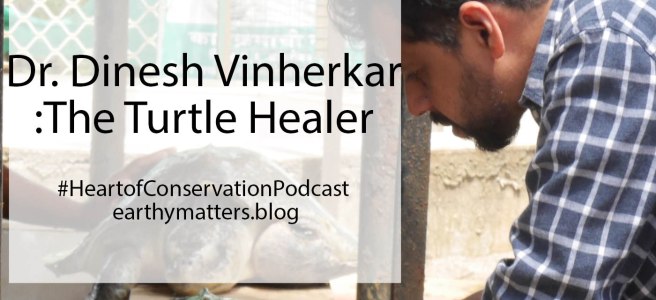
Ep#4 Show notes (edited)
Lalitha Krishnan: You’re listening to Heart of Conservation podcast Episode #4. I’m your host Lalitha Krishnan bringing you stories from the wild. Stay tuned for exciting interviews and inspiring stories that keep you connected to our natural world.


Lalitha Krishnan: Around a 100 km from Bombay lies a sleepy coastal town called Dahanu, famous for chikoos (sapotas). I braved a three-hour train ride Dahanu to visit the NGO where Dr. Dinesh Vinherkar treats injured turtles before releasing them back into the Arabian sea. I met Dr. Vinherkar in Dehradun in 2016 when we had both joined a short course at the Wildlife Institute of India. Ever since I heard what he does, I have been wanting to visit the turtle rescue center where he is treating injured turtles in partnership with the Dahanu Forest Dept, an NGO and a bunch of dedicated volunteers.
Dr. Dinesh Vinherkar practices in Mumbai but for the past several years, he has been visiting Dahnau every Friday to treat the turtles. I was surprised by the number of turtles being treated, the dedication of the volunteer and the awareness that has been created in the neighbourhood under the quiet and effective leadership of Dr. Dinesh Vinherkar. I asked him to share his story. This interview was conducted outdoors by the sea.
Dr. Dinesh Vinherkar: It all started in 2010 when this particular centre wasn’t there. There was one forest official, the Deputy Conservator of Dahanu Division, Mr. Narawne, who was also very enthusiastic overall about wildlife. This particular NGO, which is right now WCAWA, used to do snake rescues and small wildlife rescues only nearby. After getting them to the forest office and doing proper documentation, they would release the snakes back into the wild. Suddenly one fine day they found a dead turtle on the beach. And then they kept getting calls related to wildlife and again got dead turtles on the beach. Then they realized that there is something wrong and they started patrolling. One day they got a turtle which was in a very bad condition, and they got it to the centre. They did not know to treat the turtle. At that time I was doing practice in Mumbai…I was also having, you could say, an inclination towards reptiles. I used to do treatment in other NGOs who kept reptiles. Somehow they got connected with me and the DCF of Dahanu, asked me to come for this turtle’s treatment. When I came here, at that time, there was no facility available here. I suggested a few things and we made our first plastic pool. When we made this plastic pool we used to take seawater in buckets and fill up that pool. It was a very small pool of 3ft by 3ft. We created it by digging a hole in the floor (ground), then we put the plastic and we then poured sea water into it and kept this sea turtle alive. Our volunteers and others used to keep this turtle alive by feeding it Bombay duck (kind of fish) and other fish. In the meanwhile, I used to do the treatment. It started this way. Looking at our efforts, the Dahanu Forest Division also took an interest. Then they started supporting us by keeping the turtles on their own premises because all sea turtles are Schedule I species and are protected under the Wildlife Protection Act of India. So, nobody can keep them at home. So they gave us a place where we made a bigger pool of 10ftx10 ft with tarpaulin and we kept the turtles there. That year passed the same way with that one turtle. This was 2010-11 By, the time this whole procedure started we already started creating awareness about sea turtles. We started talking to school kids; we started talking to fishermen to tell them about the scenario and tell them how they can help. Slowly the network was building. We started getting more calls and started getting more injured sea turtles. I also have got totally involved in this. I started coming every week to give treatment to these turtles. For the last 10 years, I have been coming here to give treatment to the turtle. The turtles starting coming in and the plastic pool also started overflowing. Then, Mr. Narawne took a good stand and created this place. Right now, we have two big swimming pools, which can accommodate around 15 turtles in each tank which gives them a place to move around and exercise. There are two more cement tanks which we’ve kept for turtles which are aggressive or the ones that are very critical and can get damaged(harmed) by the other turtles. We keep these turtles in a small tank which is called an Isolation tank.


Lalitha Krishnan: Do turtles come to you more injured or ill?
Dr. Dinesh Vinherkar: In the wild, there are only two things. Either you should be fit to survive or you should not survive only. Any animal which is having any disease doesn’t come to us because they die there and then. Unless and until they are thrown away by high tide or some physical conditions where they come or they are taken in by us or some other NGO. Only then, they will come to us. Otherwise, mostly 99% of turtles come to us when either there is some physical disability because of which they cannot survive in the wild and are thrown out of the sea by (sea) waves. Or mostly they come out because they are badly injured. The flippers are injured and they can’t swim well…they can’t find their food and are thrown out of the sea. So, by the time they come to us, they are already very weak. They loose a lot of blood before coming to us…so they are mostly anemic. They mostly have some injuries which have got septicemic and toxic. Sometimes, they even have parasites on their body. Many fishermen also get freshly caught turtles to us which have fewer injuries but they have some or the other physical factors or other developing after being trapped because each turtle needs to come to the surface to breathe. When these turtles get caught in the net, they don’t get time to come up and breathe. So, they aspirate water. This water creates lung infections. Sometimes, they even develop some other lung injuries or conditions where they can’t dive back into the water, which is called floating syndrome, a condition, which we see very commonly. This way, the turtles started coming to our centre. By 2013-14, we had our own two swimming pools and two small tanks for turtles. Then we realized in 2014-15, that we needed to upgrade our centre furthermore. In between, I got an opportunity to visit the Georgia Sea Turtle Center in the USA and I was there for around one month and 15 days or so. There, I have taken their training and learned how they are taking care of their turtles and what things need to be done. So I realized, that we are doing nothing.
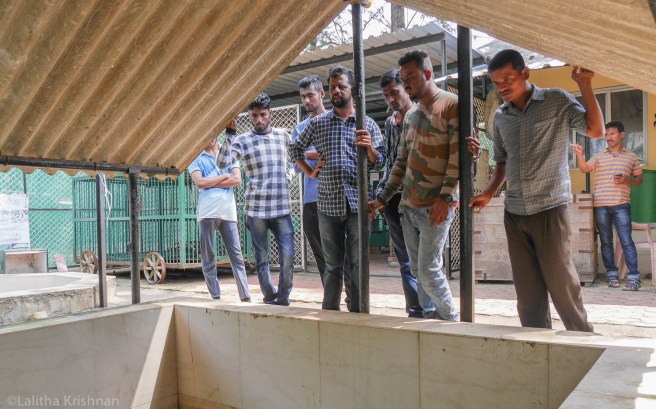
We don’t have that kind of infrastructure, we don’t have that kind of instruments, and we don’t have that kind of people who are involved in taking care. So when I came back from the USA, I started building up the centre in that way. So, we don’t funds and we have very few but very dedicated volunteers on (whom) we are totally dependent on. We all came together and started doing betterment of the centre. In the first lot, we got three fiber plastic tanks which are holding tanks for these turtles and you can see these three tanks which are given to us by Vasant J Sheth (Memorial) Foundation and we started using these tanks for the turtles. We also realized that we don’t have any filtration units for sea water. Seawater of Mumbai and Maharashtra coast is highly polluted. Most of the turtles are getting polluted water to stay in. We also thought of doing something to get clear water. We used two ways to get this water. One is to prepare a filtration unit by which we filter water and use and secondly, we are using natural filtration by creating a small pond kind of a thing, on the beach itself, where the river water gets accumulated. We syphon out that water with the help of a pump. We are using that here; it is very clear and carries less sand in it. Abroad, they use artificial marine salt water, which I feel we don’t need because we have a very beautiful beach right next to us. This artificial marine salt water is very costly and expensive, so compared to that our natural seawater is doing good.
Lalitha Krishnan: Could you tell me the kinds of species of turtles that are in your centre or are getting washed ashore?
Dr. Dinesh Vinherkar: In Palghar district and nearby areas, we predominately have four species which we get every year. Out of these, the most common species is Olive Ridley. Olive Riddle turtles, as the name suggests, are olive green in colour. They are the most abundantly found turtles here. The second one is called the Green Sea Turtle, which is a very beautiful sea turtle, you can say. They predominantly eat sea grass and greenery available at the base of the sea. The third category is the Hawksbill Turtle. The Hawksbill Turtle is also a very unique kind of sea turtle, which has a beak like a bird. That’s why the name is Hawksbill. They normally eat all crustacean species like crabs. They also eat corals and even shells. The beak is provided to crush these types of food—crustaceans—and eat. The last one (species) we normally get but very rarely we get is the Loggerhead Turtle. The Loggerhead Turtle is named because of their head. Their head size is very big like a wooden log. Compared to their body size, the head is very big and they are yellow in colour. So they are also one of the beautiful sea turtles I can say. All these four species we regularly see here.
Lalitha Krishnan: I was very lucky to meet the RFO (Forest Range Officer), Mr. Rahul Marathe, who is very interested and supportive of all the work done at the rescue centre.
RFO, Mr. Rahul Marathe: There are 10-15 members of WCAWA—actively participating NGO— working in the Dahanu jurisdiction in collaboration with the Forest Dept., If they receive any call, regarding various types of snakes or leopards, from a single call they go to the rescue. Similarly, they are participating in turtle rescue activities. In the last 60 days, in the months of July and August, they have rescued at least 40-50- turtles. One major aspect is that, in collaboration with the Forest dept., WCAWA members and our eminent veterinary consultant, Dr. Dinesh Vineharkar Sir, has done microchipping 10-15 days back. This will give good results and that the project has been appreciated all over India. All forest officers are majorly appreciating this (effort of) of microchipping. It is probable that in future, the Forest Dept. will think of microchipping each, and every wildlife.
Lalitha Krishnan: (to Dr. Dinesh Vinherkar: Do you think there is enough natural resources in our sea for the turtles right now or is pollution affecting their food source?
Dr. Dinesh Vinherkar: I always get amazed to see these sea turtles still surviving in our sea and I don’t know in what condition they are surviving but nature is great. And we are still having such a huge population of sea turtles in our sea. But on the other side, we are not taking care of this wealth—whatever natural wealth we are having here. We are creating problems for all sea creatures by dumping unnecessarily into the sea and I think there is no responsible waste management available here. We really need to do something to reduce waste dumping into the sea. And we have to make sure that whatever goes into the sea should be well treated to reduce the impact on the lives which is there under the sea. Right now whatever cases are coming to us, they are coming because of irresponsible behavior of fishermen. They are coming because of the irresponsible behavior of normal public, you know? When they are thinking of disposal waste products, I always try to convince people that they should understand that they should leave a green footprint on the earth instead of all the artificial things we are creating and dumping on this earth. That is going to create a lot of problems and this will continue and get all of us to the end where they not a be a way back.
Lalitha Krishnan: Dr. Dinesh, you are the only person in India to give a turtle an artificial flipper. Can you tell us about it?
Dr. Dinesh Vinherkar: Actually an artificial flipper is just appendages I thought of making it for a turtle because whenever I see these turtle with the loss of flippers I always feel like it must be very difficult for them to survive in the wild -though, there are papers where even a two flippered turtle can survive very well in nature without any help. But, the only thing is how we get depressed if we lose our limps; most of the animals get so depressed, that they stop eating and slowly they die.
So, my intention for creating this flipper was to give them an aid so they can get their confidence back. This flipper is definitely not going to be a permanent flipper. You cannot release a turtle with an artificial flipper back to the sea. It is just an aid for a turtle to gain his confidence back. Whichever turtle we’ve used this flipper on, we’ve observed that when they just have had an accident and lost a flipper they get confused. They don’t know how to survive or turn to the left or turn to the right. It takes some time to come out of that shock. Most of the time, this is when mortality happens –during this period. So, when we attach this flipper to them—of course, this flipper is attached to the particular turtles only who have some stump where this flipper can be attached. So we make sure that if any, that kind of a turtle comes to us, we put this flipper on him. This flipper is like a shoe you can say —how your leg goes into the shoe—the same way the stump goes into the flipper and gets locked. As the stump moves, the complete flipper moves and it gives a little bit of support to the turtle while swimming. When the turtle get adapted to the flipper, then it moves faster and which I think is very important for their survival. Then intermittently, we remove the flipper so that when the turtles start moving on their own with the three flippers. And it makes them exercise more which helps to develop muscles of the other three flippers which otherwise goes into, you know, goes into emaciation. The other three flippers become stronger and the emaciation process tops, muscle development starts and the other three flippers become stronger. Once they become stronger enough, we release them back into the sea.
Lalitha Krishnan: That is incredible. You’re the only one that’s done this right? Or do you know if it’s been done before?
When we used this flipper, there was a news item in the newspaper but that’s it. After that, nothing happened. But I went to Venice for a conference on reptiles, where one Dr. Douglas Mader was there. He is one of them, you can say, the God person in Reptile Medicine. He was preparing a flipper and wrote a paper on that. In his presentation, he mentioned our turtle’s name. I was there in the same conference and I was so happy to know that our turtle; we had named him ‘Namo’. That Namo turtle’s Dahanu Flipper he mentioned in his presentation. He also mentioned that he had gone through four different flippers that were already made, including, he mentioned, the Dahanu flipper from Mumbai, prepared by me. Taking history and some notes from these flippers, he made his flipper. He mentioned and also clearly said that some others, had already made these efforts, also. So, I was very happy to know that if not in India but at least, abroad, it got pointed out.
Lalitha Krishnan: Did you get to meet him?
Dr. Dinesh Vinherkar: Yes, yes. I met him and he was very happy to meet me also. We are very good friends now. If there is any difficulty I face, I always send that case to him and take his advise also. It was a nice experience.
Lalitha Krishnan: (I took this opportunity to talk to some of the volunteers.)
Volunteer Raymond D’souza: (Translation) I work with Wildlife Conservation and Animal Welfare Association. You asked me about the artificial flipper. We had given our ‘Namo’ turtle the artificial flipper. It was the first use of an artificial flipper in India. It was also successful.
The other first in Maharashtra is that we put microchips for sea turtles and released them into the sea. The idea of microchipping is that if and when the turtle returns after 2-3 years, we can identify that the turtle, by taking a reading and know it has come to us before.
Lalitha Krishnan: I asked Dr. Vinherkar about the other wildlife that they rescue.
Your facility also rescues other wildlife over here, isn’t it? And because you do it so often, there is also a lot of awareness. So, what all do you rescue and what has changed in the locality…in this community?
Dr. Dinesh Vinherkar: That is also interesting. When we started, at that time, people used to kill snakes. Here, whatever used to move, the first response was to kill. When we received calls earlier, before we reached, the animal used to die. So, we started doing a lot of awareness programmes and mostly in schools. I believe that so many children come to school and each represents one home. In each home, there is a student who comes to school. Through the students, we reach the parents. We gave them the message that they can make a difference…”You can be a part of a system where you can save wildlife and where you can coexist with wildlife.” That message these small children have taken home….they started arguing with their parents: “ No, we will not kill. We will contact this NGO. We’ll call them.” Slowly that movement started. As you have seen today… we went for a small rescue—actually it was a small lizard—but still people did not kill it, they tried to save it.
This is the difference where previously people used to run after the animal to kill it now they run after the animal to save it. I think that is the biggest difference I can see. -Dr. Dinesh Vinherkar
Lalitha Krishnan: That’s great. Really. Is this the only (turtle) rescue centre on this coastline?
Dr. Dinesh Vinherkar: This is only one in India.
Lalitha Krishnan: You’re kidding.

Dr. Dinesh Vinherkar: Everywhere else there are nesting sites and release takes place. Nobody bothers about the adult ones. Why I am worried about this adult one is… when a turtle nests, it gives around 100 babies. Out of 100 babies, 5-10 get killed there and then itself just before reaching the sea. Another 20-30% get killed while going through their lifespan of one year. Remaining 10-15 only get up to adulthood, and of these, maybe 6-7 may get actual opportunity to get mated, come back to the beach, lay eggs and go back. So, from being a baby coming out of an egg to being a productive adult male or female (turtle) takes 15 -18 years. And, after that, you see this precious animal that you are seeing right now. Maximum, adults are getting affected. Our aim is to save these adults because along with these nesting sites and small hatchlings, these are your future producers. If you will not save them the100 turtles go to waste.
Lalitha Krishnan: That’s quite a point.
Dr. Dinesh Vinherkar: Because out of these 100s, these few have come to their adulthood and are ready to lay eggs next year. That’s why we are trying to save these ones so there will be an immediate effect. There are papers (which state) that even three flipper turtles lay eggs. So, that is our aim…that even a physically unfit turtle which would have died by now, if we make them a little better to survive back strongly and lay eggs. That will add up to the whole population. So why not use their reproductive ability by supporting a little bit? That is our main aim to create awareness. Secondly, see to it that they reproduce. Whether, a four flipper turtle or three flipper turtle, when they are fit enough to go back into the sea, we are of the hope that one day they will lay eggs and add up to the community. That’s our aim.
Lalitha Krishnan: You’re giving them a fighting chance to survive. I don’t think anybody has actually thought of it that far. (On the other hand), hatchings are such a photo op…
Dr. Dinesh Vinherkar: Yes, people are actually neglecting the ones that are the producing the hatchlings.
Volunteer Prakit Agarwal. (Translated): My name is Prakit Agarwal. In this last year, in 43 days, we rescued five leopards. Three leopards were rescued in Dahanu and two on the border between Dahanu and Gujarat. One of the leopards had attacked people then we trapped it in a cage and rescued it.
Lalitha Krishnan: I have never seen such a bunch of enthusiastic and dedicated volunteers. They’re basically a group of college students or businessmen who drop everything they are doing to rescue wildlife….and if they got a call at night, they’d still turn up..m as enthusiastically.
Volunteer Sagar Patel. (Translated): I’m Sagar Patel. I am a committee member of WCAWA. I have been working here for the past 7-8 years. Our main problem is to rescue injured turtles that are caught in nets. Once they are out, we treat them and once again return them into their natural habitat.
Our area falls in the green zone. There are a lot of snakes here. Why should we rescue snakes? Snakes actually eat rats. They help farmers. Where do snakes come? Snakes come where there are rats. Snakes follow rats into homes. Earlier, people here used to kill a lot of snakes. When we started an awareness programme, the mortality rate of snakes came down. They call us when they see a snake and ask us to rescue it. We get 15-20 calls per day..we rescue that many snakes per day.
Sometimes, when people go into the jungles with their animals, ie goats or cows and suppose the python catches them, then people injure it. So we also treat it then in the wild. What is possible for us, we do. We don’t have proper facilities, we do the best we can with what we have.
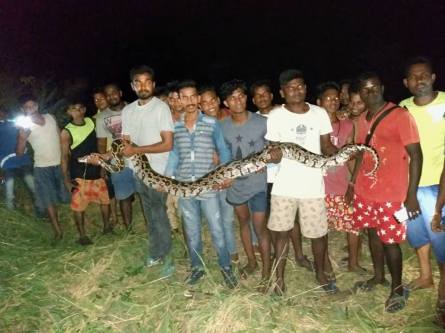
Our senior members are working for 17 years. I joined 7 years ago. WCWA has been registered for five years in 2013. We are going forward and forward. Our motto is: Go forward, don’t see backward.
Dr. Dinesh Vinherkar: All these volunteers have been here before me. From childhood maybe, some have been involved in this great work. They are doing amazing work and I am very happy to say that they are doing this voluntarily without thinking of any gain they are going to get out of it. Of course, when our centre will grow, I will definitely see to it that each one of them will have some livelihood doing something they love. I don’t want them to do some work where they don’t have any interest. Their whole interest is in wildlife so they should get a good job here itself and they should do whatever they love. Because I feel what you love, you will do with more interest. They have this beautiful interest.
You call them at two o’clock in the night, you call them at three o’ clock in the night, within one call, they will be standing in front of you.
Lalitha Krishnan: They were saying you get snake rescue calls ..how many times a day?
Dr. Dinesh Vinherkar: 15-20 times minimum. They are always on call.
Lalitha Krishnan: Today I saw the rescue and they didn’t have any protection. I think you really need some equipment.
Dr. Dinesh Vinherkar: We have already suggested and demanded all these things. It will take time definitely. We have all our kits with us…but not every time. We make sure on every rescue that we go that we carry relevant equipment. Sometimes when we are in a rush we forget but we make sure in the final rescue will be proper. Now you saw it was only a lizard—for a lizard I don’t we need any equipment–but
Lalitha Krishnan: if it was something else…
Dr. Dinesh Vinherkar: Then, we would have waited, arranged for equipment and then left. We take the utmost care of our own safety. In the last 17 years, you can say that there is no causality in our rescue operations. But, a few scratches here and there happens. You can’t help it.
Lalitha Krishnan: Yes. You even deal with leopards.
Dr. Dinesh Vinherkar: Yes
Lalitha Krishnan: That is incredible. Thank you so much for joining me on this podcast. You’ve taught us so much more about turtles than we ever knew before.
Lalitha Krishnan:. I hope you’re enjoying the conversations about conservation. Stay tuned for news, views, and updates from the world of conservation.
If you think of someone interesting whose story should be shared write to me at earthymatters013@gmail.com
Birdsong by hillside residents

 Earthy Matters