When Street Dogs Attack Wildlife

Dogs on the hunt

nilgai

I was out with friends in the Little Rann of Kutch on 18th Jan 2016,  exploring the sanctuary for Asiatic wild asses and birds, when we came across this beautiful lone Nilgai (Indian Antelope) standing perfectly still. It was a great photo-op. As I zoomed in I noticed its eyes were focused at a point somewhere behind us.  Thinking it odd, we took our shots and moved on. Before we knew it the Nilgai turned around and started sprinting away with two dogs in hot pursuit.  Very soon a third dog joined the hunt. The chase continued for a quite a while. The antelope was tiring but the dogs looked like they would go on forever. As much as I love dogs,  I mentally rooted for the Nilgai.We didn’t quite expect to see wild dogs or a hunt. I did a second take when I realized these were strays. The sanctuary fringes a village. Never before have I seen strays attack wildlife.  There was nothing friendly or domestic about these dogs. They were plain wild. There was something wrong with the whole scenario. It wasn’t the same as watching a wild animal hunting another wild animal!

We kept our eyes on the animals till they disappeared from sight. What happened to the Nilgai? I’ll never know but I’m beginning to think something more needs to be done with managing strays. The incidents of humans being attacked by strays are multiplying. Now they seem to have found new hunting grounds.

Watch the chase here on YouTube: Street Dogs Chase Wild Nilgai

Black-and-Yellow Grosbeaks Return to Woodstock School

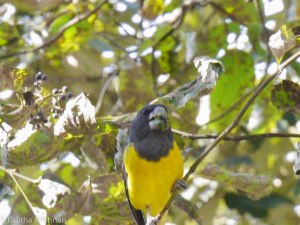
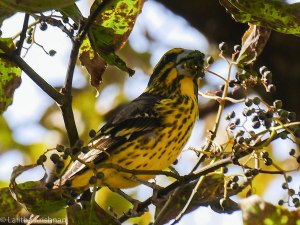
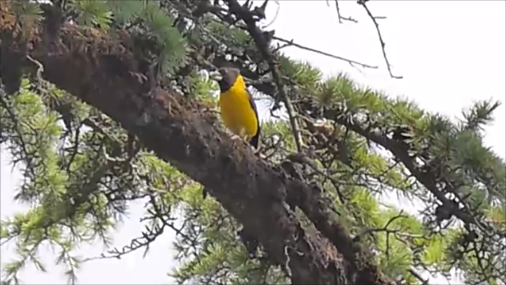
The Black-and-Yellow Grosbeak (Mycerobas icterioides) is of the finch species(Fringillidae family). Old schoolers, they return every year to the same trees on campus in the quad*. You can hear them before you can see them because they are so well camouflaged. All you hear first is a gentle clicking sound as they nibble away. It’s almost relaxing! The stout conical bills are quite distinct and they’re fascinating to watch… if you can find them!! The male is a brighter egg yolk yellow and black. The female is speckled.  They seem oblivious to the sound of school children and the bell, and they return faithfully eachyear. They’re obviously at home in Woodstock…like many of us.

The Black-and-Yellow Grosbeak. Photo: Lalitha Krishnan
The Black-and-Yellow Grosbeak (Male).
P1110968-3
The Black-and-Yellow Grosbeak

P1110988-7

*I did spot one in June though.

Grosbeak Alert From My Neck Of The Woods

#Black-and-yellow grosbeak (Mycerobas icterioides)

Last month I was drawn to a new sound. Turned out to be a Black-and-yellow Grosbeak. I have seen them here in winter, in clusters on a bare tree. Their bright foilage and distinct bills made them hard to miss. Frankly, I think the word ‘gros’ is bit unflattering.

Here is my recording of the solitary (June) visitor who seems quite content with perching and pecking. Watch:http://youtu.be/A0D_BTcW6TQ

#Black-and-yellow grosbeak (Mycerobas icterioides)

Himalayan Cuckoo Atop A Deodar

#HimalayanCuckoo

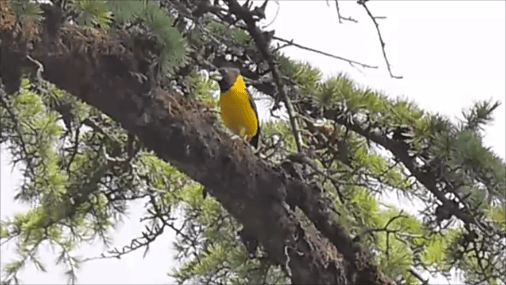
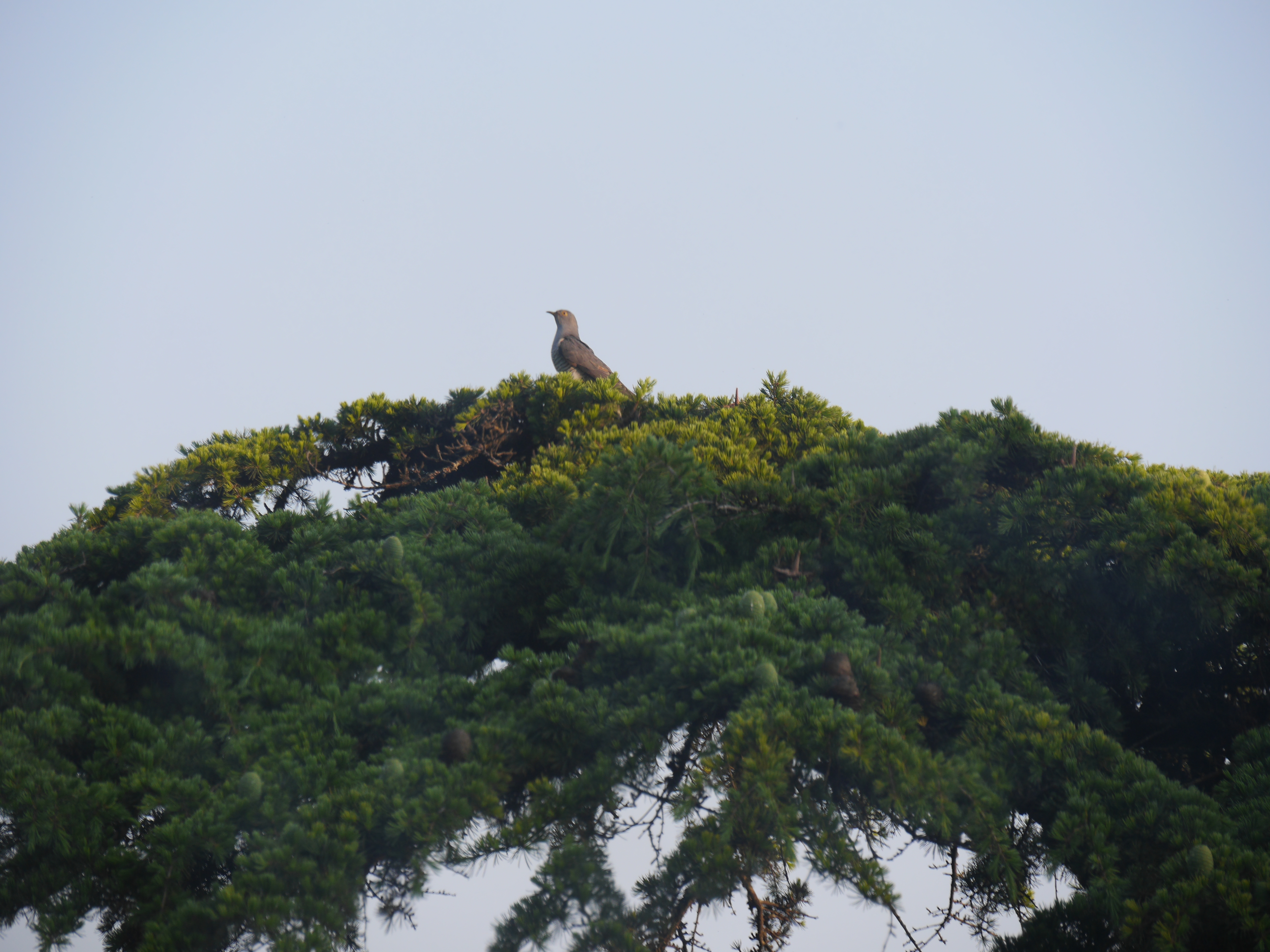
This beautiful cuckoo graced the deodar outside for just a few minutes. The call was a distinct giveaway but I wasn’t fast enough to capture it. The video and stills were shot through a glass door so they’re not very sharp.

Watch my video:http://youtu.be/2j56MpEaimc

Cuckoo (himalayan)
Himalayan_Cuckoo_atop_a_Himalayan_Cedar
#HimalayanCuckoo
#HimalayanCuckoo(Cuculus saturatus)

Related sites: Click on the link to hear cuckoo calls: Via xeno_cantohttp://www.xeno-canto.org/species/Cuculus-saturatus

Via wiki:http://en.wikipedia.org/wiki/Himalayan_cuckoo