EP#13 Heart of Conservation Podcast. Shownotes.
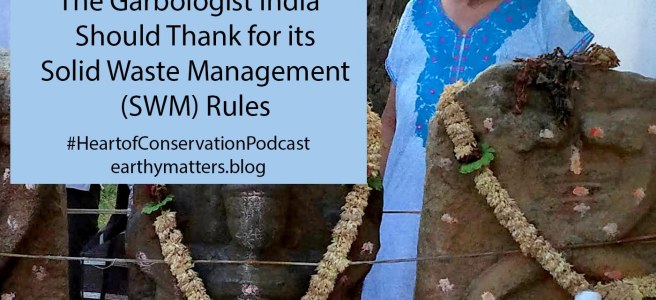
Lalitha Krishnan: Welcome to Heart Of Conservation Podcast Season 2, This is episode 13. I’m Lalitha Krishnan, your host, bringing you inspiring stories that keep you informed and connected with our natural world. I’m talking to Almitra Patel today. She’s an environmental policy advocate and anti-pollution activist, and also one of the most unusual and amazing persons I know. Her Public Interest Litigation in the Supreme Court against the open dumping of municipal solid waste was instrumental in the drafting of the Municipal Solid Waste Management Rule in India. Her clean up India campaign started 20+ long years… long before it hit our billboards and screens perhaps even our conscience. While you and I were travelling to pretty places she was visiting garbage dumps all over the country. Somewhere in between these visits, she lost her sense of smell.
Her endless energy and determination have resulted in waste management policies being implemented at the home level, village level, small and big towns and cities all over India. It’s no wonder then that she was the best-qualified person to draft the Swach Bharat manual. Not one to sit still, Almitra is now looking into phosphorous carrying detergents that are polluting our water bodies. She wants manufacturers to label their products so we make the right choice. Her’s is an ongoing journey of activism but let’s hear it from her.
Welcome and thank you Almitra for being a guest on Heart of Conservation Podcast. Almitra, I’ve known you for 25+ years and I’ve never been able to keep up with all the incredible things you do. In 1959 you became the first Indian woman engineer to graduate from MIT. You’re also associated with saving the Gir Lions, being a tree warden, saving Ulsoor Lake, and building low-cost homes. Our country has its first ‘Municipal Solid Waste Management Rule or MSW thanks to you. It all started when the frogs stopped singing in your backyard. Is that right?
Almitra Patel: On the beautiful country road to our farm. Because Bangalore was dumping its garbage on the roadside there. It was a horrifying thing with stray dogs turning feral with no leader of the pack. They would gather together in the evening; and attack children going to school in the mornings, farmers going home after dusk and, killing livestock by day or by night…coming into farms and killing fowls…chickens, ducks. So there was no human restraint to their behaviour. They all became wild and followed a pack leader and at dawn and dusk, the dogs would gather in packs and chase two-wheelers, chase farmers and go out marauding and killing animals, even in the day time, even at midday. So, when I tried to help Bangalore clean up its act…in the meanwhile, there was a Capt. S. Vellu, from EXNORA, Chennai. I had been in touch with him for almost a year. Then there was the Surat plague on 24th September 1994. He said, “India is sitting on a time bomb.” Surat became like that because the garbage blocked the drains. The choked drains flooded the rat holes which made them come out and (caused) the plague and so on. So he said, we got to do a Clean India campaign- 30 cities in 30 days, starting on 2nd October. Which was what, 8,9 days away? And, we did it. We did the 30 cities and it was such an eye-opener because all the municipal people we met-all the commissioners-when we asked, “So what are you doing with your garbage?” They’d say, “I don’t know.” Ting. Ting. Ting. Call the sanitary inspector. He’d yell out, call the driver. And only the lowest man knew where he chucked anything. So all the municipal officers… when we explained, “Keep your wet and dry waste unmixed so both can be recycled, and have doorstep collections so there’s no waste on the road, and so on, they said, “Oh Won’t you start a scheme for us? Won’t you come back at the end of your tour?’’ And so, it became apparent that there was a need to do something on a national level. We went around in my high roof red Maruti van and the banner which Velu put up at the back (read) ‘Clean up and flourish or pile up and perish’.
Lalitha Krishnan: I like that. So, the municipal commissioners did take you seriously?
Almitra Patel: They did. They welcomed us. They said, “Nobody has ever told us what to do. We only see pictures in the newspaper of overflowing dustbins, choked drains, burning garbage and no one says what to do. That was the need for the rules so that everyone could have a road map.
Lalitha Krishnan: Sounds like Capt. Vellu knew what he was doing
Almitra Patel:He had worked with EXNORA in Chennai- Excellent, Novel, Radical. This was MB Nirmal banker who went to Hong Kong with 11 other bankers on a study tour. The others went shopping and sightseeing and he kept going around, wondering, “How can this place be so clean?” And he came back to Chennai and he conceptualized this. He found the waste pickers grubbing in dustbins and he asked them, “What are you looking for?” (They replied) “Trying to take out recyclables to feed our families and educate our children. So then he said, “I’ll give you uniforms, I’ll call you ‘street beautifiers’ and I’ll ask you to collect dry waste, clean separate dry waste from every home.” Then he called some actor, cricketer for a neighbourhood meeting so everybody came. Then, those people said, “Keep your waste separate, don’t chuck it 24 hours a day at your neighbour’s gate, you know? Wait till it will be collected.” So, the whole policy which we have, I mean the rules, actually came from NB Nirmal’s EXNORA. And, Vellu had been sent to Bangalore after a year in Vijayawada, to spend a year in Bangalore implementing that model somewhere. Then he said, “I can’t be sitting around. If I take a year per city it will take 300 years to cover India’s 300 Class I cities, means, one-lakh plus populations. That was the drivers first for the Clean India Campaign and after that, I was told, “If you want to get anything done, then go to the Supreme Court and ask for it.
Lalitha Krishnan: That must have taken a great deal of patience and determination. Tell us how that went?
Almitra Patel: Well, I thought I’d walk in, ask the court that municipalities need land for composting. Municipalities can’t do composting within their limits in a big centralised way. Because they can’t purchase land outside their municipal limits, the state has to give it to them. So, I thought I’d just ask for waste management sites, say thank you and go home. And the case took 20 years. 54 hearings in the Supreme Court…for three-four years… nothing happened. Then it went to the NGT and I think there were 15 hearings there till December 16. So, from December ‘96 to almost to the date, December ’16, it finished.
Lalitha Krishnan: Goodness. Hats off and thank you from all of India. I heard you have visited multiple dumping grounds, over 170?
Almitra Patel: Now it is 206 dumping grounds and their municipalities in that ’94 trip all over India. And, if I visit one, more than once, I don’t count them twice. 206 different ones. Some, I’ve been 3, 4 5 times.
Lalitha Krishnan: Really?
Almitra Patel: Yes. Over these 25 years.
Lalitha Krishnan: it’s pretty potent stuff. Frankly, I am not sure if I would be able to stomach that. I am not sure how many listeners could either.
Almitra Patel: A fortunate thing that happened is my nose stopped functioning about 17 years ago. Everyone goes around with a hanky on their nose and feeling sick. I don’t notice a thing and I have to ask my driver, “Has the smell begun? Is it worse?”
Lalitha Krishnan: I love the way you’re laughing about it. Without meaning to sound rude, not smelling anything sounds like a good criterion for checking out garbage dumps.
Almitra Patel: The most amazing thing is that the court-appointed this expert committee in Jan ’98 and we gave an interim report in November ’98 that’s eight of us, meeting every month and so on. And then, one of the members said, “Eight people cannot decide for the whole country. And so (we) asked the court for permission to present this interim report to all the commissioners of 300 Class I cities. So, 75 each, at Calcutta, Chennai, Bombay and Delhi. Delhi had the least attendance. Calcutta had the best from the eastern region. One of them presented all our things and said, “Do you have comments and so on?” There was very good buy-in and I am very proud that these rules are perhaps, the first to my knowledge, that is framed by a committee with consensus. Otherwise, you have a group of 6-7-8 out of which 2-3 are active, and it’s a rule for everybody. Luckily, the 2000 rules-it was early days. People didn’t even know the difference between compostable food waste, which we call, ‘wet waste’ for short and recyclables, which we call ‘dry waste’ for short. In those days, there was only compostable, recyclables and debris-innards, the third kind. It was only between then and now; now the 2016 Rules which have come are much more detailed and elaborate. At that time, you couldn’t afford to tell someone, “You shall…”. You could only say, “You should advise citizens to do this…”. Now it is a rule. Everyone has to do this because the situation has gone so much more out of hand. Kids in schools are also learning about it now. ‘Wet’, ‘dry’, ‘doorstep’, ‘recycling’, ‘composting’. These are all now household words.
Lalitha Krishnan: But not terms like leachate, windrow, biomining etc. I know you are going to explain all of this.
Almitra Patel:I also, as a city person in Bombay, would give my waste to the servant to take downstairs. I never followed him downstairs to see what he put it in. Or ask the people in the vehicle, “where is the waste going?” “To Deonar?” Or anything like that. So, only after I got onto this journey, did I begin to worry about where is it ending?
Lalitha Krishnan: Garbage has become such a huge issue but most of us don’t know much about handling it or know where it’s going or rather choose not to know.
Almitra Patel:I think it’s important for people to know from Vedic times, until the late 70s, there were no dumpsites. No Indian city needed a dumpsite because there was no plastic. The only thing that came out of a house was kitchen waste. And farmers, after bringing their produce into town would actually fight over the dustbins and have a teka, “this is my lane”, “my lane”, and take it back for composting on their farms. Two things killed this. One was the Green Revolution which told the farmers, “You just add urea and your crops will jump out of the ground and you don’t need to worry about composting” Second thing, the plastic yug began. When people said, “I don’t need this food waste, this plastic waste…in those days if we had the wits and foresight and told people, “Don’t chuck plastic in the food”, we wouldn’t be where we are today. So, there were no real mountains of waste at that time. It began, as I said, in ’91 and in ’94, we decided to do something about it when they started dumping this unwanted mixed waste on the roadside.
Lalitha Krishnan: What can we do at home to minimise the pile up on the dumping sites?
Almitra Patel: The whole idea is people will keep their dry and wet waste separate. It will not lead to mountains of mixed waste in some poor villager’s backyard with the leachate going into their groundwater and methane coming out and causing global warming. My latest interest has been to bring down these old heaps and that is done by bioremediation or biomining. What cities are doing at present; they’ll drive to some dumping ground, they’ll unload the truck, have an earth mover level it, drive over it, compact it…maybe, cover it with earth occasionally. But, instead, if they would simply only do which has to be done in every compost plant…that is to unload the waste in windrows which means, long, narrow heaps-parallel heaps, about 2-2.5 metres, not more. And these heaps can be very easily formed as a tipper truck moves slowly forward while unloading. So, it can just unload it in a long heap. You need one parking lot manager-type person saying, “This row is over, now start a parallel one and Truck no. 6, 7, 8, 9 can form the next one. Then, if you spray that with bio-cultures and turn it weekly, then the moisture goes out and some of the carbon turns to carbon dioxide with air. That’s why it’s called ‘Windrows’. So, wind can blow between the rows and aerate the heaps. And the volume comes down to 40%. Imagine that?
Lalitha Krishnan: That’s nearly half. And not so difficult to do either.
Almitra Patel: Almost half. So, if they do that then, you won’t have a big new heap. And, after four turnings, that waste is stabilised like leaves on a forest floor. There’s no leachate, no methane, no smell. That stabilized waste can be used anywhere. If we give it wet waste, compostable waste, then all of that can go straight, as is, to farms or restoring degraded land. So, now there are new options available where if you go to YouTube, Almitra Patel and look for Gurugram, Faridabad or look for Nagpur or Kumbakonam. These are three which describe simple ways of bioremediating. What they want to do which gets them a lot of money and a lot of excuses for land to flog to someone and pollute is ‘capping’. This means just covering with a plastic sheet, soil and grass, so it will look pretty but it’s like lipstick on mouth cancer. Everything is still decomposing inside generating leachate into the ground and the methane is slipping out of the sides of the cover. You can’t seal it because it was not lined in the first place. So, this capping is what they do in the West when they have a full bottom and side-lined pit and then if you put a liner on top – what they call a dry tomb. So, it makes no sense when you have an unlined dumpsite in India or anywhere else.
Lalitha Krishnan: I just hope people are listening. It just seems like we don’t know enough about handling solid waste.
Almitra Patel: Another thing which is a new kind of solid waste is fecal sludge. Septic tank sludge. This is something that your listeners should know. We have been coned by advertisers into using phenyl, bleach and strong microbe -killers which all go through your toilets and drains into your septic tanks killing the microbes which are supposed to live there and digest your solid waste. People complain why they have to empty their septic tanks every year, at huge expense – six to seven thousand (rupees) or more. At our school in Devlali, near Nashik, with 4000 kids, all day scholars, they used to empty the septic tank annually. After we started adding a bio-culture, from one supplier, for eleven years we haven’t emptied the septic tank. That’s because we stopped using phenyl, and we started using liquid soap, one tbsp in the bucket to clean the toilets or composting bio-culture itself to wash the toilets so that it would end up in the septic tank. All the sludge would get digested in the septic tank. So, you never need to clean it. And that water doesn’t overload your sewage treatment plants which empty into lakes and destroy the lakes. Because the sewage treatment plants in India only lower the Ph. They monitor the Ph and COD which is Chemical Oxygen Demand, and BOD which is Biological Oxygen Demand. They try to reduce that but they don’t reduce the nitrogen and phosphorus which are nutrients that are flowing with wastewater into the lakes and growing water-hyacinths and all the aquatic vegetation.
Lalitha Krishnan: Where can one access bio cultures? Is it easily available?
Almitra Patel: Not yet but if people begin to ask their supermarkets for them then it would show up on the shelves. Otherwise, just use Fem and that kind of liquid soap, not the microbicidal, bactericidal handwash. Use plain liquid soap. That’s good enough to wash your toilets.
Lalitha Krishnan: Almitra I know you must have many stories to tell but what part of your journey gave you made you feel satisfied or made you say This is what I hoped for?
Almitra Patel: What was for me, a great success, in this case, was, you know, I had asked for hyenic, eco -friendly management for 300 Class I cities, (I Lakh plus population) but the rules came out applying to all urban, local bodies, which means even 20,000 plus populations. So, that covered 4-5000 more cities. Another thing; in the beginning when the court directed all the states to give composting sites to their major cities, it happened. And I was happy about it. But all the cities misused this. Instead of dumping it on the highways, they said. “Yeah, now I got land and they rushed and dumped everything is a huge dump pile on a site which was meant for composting and doing it properly. So, what was non-point population along the highways – no man’s land of road-shoulders suddenly became point pollution for the villagers around these dumps. So, my dream became my nightmare. Now what we’re saying is that cities don’t have a right to ruin the life and heath of villagers outside for no reason with waste that isn’t there’s even. So, the trend, in the 2016 rules also, they are preferring decentralised composting with the city. There’s a lot of push back. Everyone says, not in my road, not in my park, not opposite my house…” But it’s your waste.
Lalitha Krishnan: That’s so typical. We don’t want to see anyone else’s garbage; we barely want to see our own.
Almitra Patel:So that has to change.
Lalitha Krishnan: What’s (a fitting example of a city/town) that comes to mind which has adopted good waste management practices.
Almitra Patel: Bangalore is the first in HSR layout park which has a Compost learning centre where they’ve got a shed with 13 different ‘home-composting models’ from -1,2-5-10 kgs. and a row of 7 open-air ‘community composting’ solutions. Anything from 50-500 kilo or one ton a day. What I like the best are lane composters. They are like large well-lit boxes raised off the ground so that air can go in from below and you put in some dry leaves; the waste can go in from some 40 houses and (you) sprinkle some bio-culture…it can even be sour curd and jaggery water or purchase bio-culture. Or a dilute 5% solution of fresh cow dung and again, some leaves. And you need twin boxes like this. One fills up in 15 days and you work on the second, leaving the first one to mature in 15 days. Then you empty that and begin again. And, that is so inconspicuous. You need people in the lane whoa re prepared to host it in front of their gate and take responsibility for managing it in order.
Lalitha Krishnan: Almitra thanks for sharing these But, if we want to know more about your work or delve into solid waste management a little more deeply where would you direct us.
Almitra Patel: http://www.almitrapatel.com/ So on the home page, top right, is a winking thing saying, ‘Free download. SWM guide Book’.
Lalitha Krishnan: Excellent.
Almitra Patel: That’s a 70-page manual that I wrote for the Swach Bharat Mission. Unlike the other manuals which the Ministry of Housing and Urban Affairs brings out, which starts with metro cities, this one begins with villages. Then goes to tiny towns, little bigger towns, medium towns and so on.
Lalitha Krishnan: In your long mission to clean up India, you must have come across some interesting people.
Almitra Patel: I’d like to share with people my hero. In 2003, I heard about a commissioner in S. A. Khadar Saheb, in Suryapet, which is about 3 hours east of Hyderabad. On his own, without even having studied the Solid Waste Rules, he just came up with the same idea. So, if people will look up Suryapet on my website, they can read about him. He also broke away from this common practice of Group-cleaning. So, after the morning work, a dozen workers are put together to clean the street. One or two do it while you can see the others sitting around. So, he gave a half kilometre stretch of a drain to one person with a wheelie-bin to take out the silt and not leave it on the drain-side. Then he had a separate leak-proof lorry going around so that the wet silt from the drains could go from the wheelie-bin into the lorry and then it went on to road shoulders for road widening, pothole filling. He needed no dumpsite at all. The amazing thing was this was a town of one lakh, three-thousand population. And, he managed everything on a half-acre site right in the heart of town. Quarter-acre was where he did compost. Stack composting (which on my YouTube channel, you can look at Kolar). After the stack compost was partly decomposed, he put it into vermi-bins for earthworms. And the driveway he constructed a shed on the quarter-acre with partitions for walls and he engaged, on salary, eight waste pickers saying, “Put your thin plastic, thick plastic, paper, cardboard, wood, metals in different gallas. He invited the kabbadi-wallasto come and purchase it from them. And within 6 months, his income every month from a one lakh population was one lakh rupees. Rs 45,000 from compost sale. Rs. 55,000 from the dry waste sale. Minus four workers for the composting and eight waste pickers for the dry. It was an amazing self-sustaining model. He didn’t get a pie of support from the state, the centre…no grant, no NGOs…nothing. Just manging with municipal funds. So, he innovated beautifully. He took eight self-help groups to the bank and said, “The municipality is going to engage them for door-door collections so a tractor would drive every 6-7 houses and stop and collect the waste (wet and dry, separate) from the houses. Near the driver was a high well-meshed cage for dry waste and near the tail the wet waste. And everyone standing there could see clearly that the wet and dry were being managed separately and that their efforts were being valued. He went to the bank and said, “Give them a loan for brand new tractors. And the EMIs for it, the municipality will pay directly and deduct from the fees which we are going to pay them for the collection”. At the end of five years, the tractor belonged to a self-help group. Even while they were doing the collection, after they collected the waste in the morning, in the afternoon, if they wanted to move sand or lumber, they could use them and use the extra income on their own. It was their tractor. That was a beautiful model.
Lalitha Krishnan: Definitely sounds like it. Almitra so when it comes to small towns v/s big cities where so do you think SWM will work more efficiently?
Almitra Patel: My hope these days is for small towns. Because the big towns think they know it all. They are dragged away on foreign tours to sell them inappropriate technology like ‘waste to energy’. How do you burn waste which has 60% food? Waste, which is 85% moisture? How do you get energy out of a rotten tomato? Unless you are doing bio methanation which is OK but incineration is an absolute No No. Big cities go for all these promises. These foreign people dare to come and say, “Don’t bother with your rules. Don’t bother to segregate. Just give your mixed waste, we’ll take care of everything. But you see what’s happening in Delhi. They promise 100% waste will end up as 5% ash. But in Delhi, Jindal in the middle of Okhla is sending over 30% of their intake as semi-burnt stuff to the dump. You can see charred coconut shells. Partly burnt cloth… Obviously, it’s not reaching temperatures of 1200 or whatever temp. it should if you can recognise it as a cloth or coconut. So, it’s a big fraud. Waste to Energy is the current big scam. So, my hope is with all the small towns. I think small-town people all know each other and can get together easier.
Lalitha Krishnan: Knowing you Almitra I can ask confidently ask what else is on your plate?
Another thing I have been working on is the pollution of surface waters. Ulsoor Lake in Bangalore. Village ponds. Nobody can go and swim in the village pond like their fathers or grandfathers used to. It’s all fully choked with water hyacinths. And the reason is—which was discovered by scientists in the US and Canada, when Lake Eerie between the two countries was turning green with aquatic vegetation, which would sink to the bottom, die, consume the oxygen, kill all the fish. That’s called eutrophication. And they wondered what to do to save the lake. They found that in the late 60s, synthetic detergents had been invented and they were using phosphorous. Sodium tripolyphosphate as an ingredient in synthetic detergents. Not soaps but in synthetic detergents. So, over a three-year battle, we fought in the courts with all the multi-nationals also. They succeeded in limiting the phosphorus content, in 1973, to 2.2% phosphorous, by weight, in the detergent. And that rule is still followed and practiced today though the Washington State says, “We will have no phosphorous in dish-washing and clothes-washing machine detergents and so on.” Europe also followed suite with 2.2%. India has not. And the same MNCs who are following the rules abroad-in US, Canada, and EU…they control 80% of the detergent market in India. There may small, small brands who are all making detergents for the big guys and they refuse to lower the phosphorus content.
Phosphorus is what is called a limiting nutrient. If you cut off the phosphorous, you cut off the aquatic plant growth. If you give phosphorous, it’s like a special booster nutrient for aquatic vegetation. Just like what urea or nitrogen is for land crops, phosphorous is for aquatic vegetation. So it’s so simple. I’ve been saying if the government doesn’t want to bite the bullet and restrict it at least make it mandatory to label the phosphorous content in detergents so that environment-conscious citizens can buy a low-phosphorous detergent. It’s an ongoing battle which hasn’t been won yet. But we need more voice to demand it.
I was speaking with environmental activist Almitra Patel. Check out her website almitrapatel .com. I hope you enjoyed this episode of Heart of Conservation Podcast. I’d love your feedback. Do write to me at earthymatters013@gmail.com. If you know somebody whose story should be told or is doing interesting work, do contact me.
You can download Heart of Conservation podcast episodes for free on Soundcloud, Apple podcast, Spotify, Google Podcast or wherever you listen to your podcasts. You can also read the full transcript on earthymatters.blog. Bye for now.













 Earthy Matters