Heart of Conservation PodcastEp#31 Show Notes (Edited)
Introduction:
Hi, I am Lalitha Krishnan and you’re listening to Ep# 31 of Heart of Conservation. I bring you stories from the wild that keep us all connected to our natural world. You can listen to Heart of Conservation on several platforms and also read the transcript right here on my blog Earthy Matters.
Today’s episode is about the Sundarbans. I recently made a trip there and I have to tell I am so spell bound by the immensity and biodiversity of the world’s largest delta which we share with Bangladesh. To be honest, I didn’t know about these 2 facts earlier. Almost everything I saw was unique somehow, something I had never seen before. I knew I had to find an expert to learn more about the Sundarbans ecosystem. As luck would have it, I came across a social media account @onesundarban which belongs to Dr Radhika Bhargava, my guest here on episode # 31.
In her own words, Dr Radhika wears multiple hats as a coastal geographer, geospatial analyst, and a National Geographic Explorer. She is a Research Fellow at the NUS Centre for Nature-based Climate Solutions working with wetland conservation in Asia. She recently completed her PhD at the National University of Singapore. We will discuss her research some more but for now, Radhika, welcome and congratulations on your PhD. I feel so privileged to have you share your knowledge and experiences with us.
Radhika Bhargava: Hi Lalitha, thank you so much for having me on your podcast. I am so excited and I am so happy that you recently visited the Sundarbans. I am really looking forward to your questions and interacting with you on Sundarbans.
Lalitha Krishnan: Lovely. So, let us start. Radhika, what made you, first, focus on the mangroves for your research and why must we be watching the mangroves to check on the health of our planet?
Radhika Bhargava: I started working on mangroves during my Masters actually. I was part of a project where they were looking for someone to do coding or use coding /computer languages to identify mangroves of South East Asia. So, you use satellite images and you have to interpret where the mangroves are. There were many other forest classes that I was interested in studying but somebody had taken up those classes or somebody had taken up those forest areas to study using satellite imagery. They were only left with mangroves and then, I joined the lab. Nobody was willing to take up this project because there was a lot of computer coding required. And, coming from ecology, biology or management backgrounds, we were not trained in it. I saw this gap and evenI didn’t know any computer programming at that time. But then, looking at this desperate need that nobody is doing, I said, “Sure, why not? I will give it a try.” I started learning coding from scratch and then my focus was mangroves. So, that is how I learnt a lot about mangroves. I became so curious that through the two years of my Masters which was at University of San Francisco, the focus was Environmental Management. I ended up with all my class projects or side projects related to mangroves. That’s how I came across the Sundarbans.
3:56
You asked me, “why must we be watching the mangroves to check on the health of our planet?” There are many reasons. Especially that mangroves are coastal protectors. They protect the sea from storms and cyclones. Their roots help in purifying water but specially they store or remove carbon dioxide which causes global warming. They store it within themselves and keep it there for millions and millions of years. They have such characteristics that can tell about the health of the planet and actually help in improving the health.
4:30
Lalitha Krishnan: That’s quite amazing. I love the part about you learning coding from scratch. Look where it has taken you. Radhika, I’m curious about your social media handle. Why its called ‘One Sundarban? There must be something to it. There must be a good reason why you have called it so?
4:56
Radhika Bhargava: So glad you asked me this question because initially, people thought that maybe I did not get the handle “Sundarbans’ and that it why I went with ‘One Sundarbans’. Also, I think, I have had that account for maybe two years. I only joined social media because I felt the urge to share about the Sundarbans. When I realised that a storm can come, a cyclone can come in that area and nobody would even know that somethings happening… So, I felt that I am at a place that I can share so I should take that initiative. So, I only joined social media to share about Sundarbans.
And why ‘One Sundarban’?
Sundarbans is across India and Bangladesh. It is one ecosystem. As a researcher, it really annoyed me initially when I would come across studies or management plans or government records that focused on just one side-either India or Bangladesh. So, for me, ‘One Sundarban’ is one ecosystem so hence ‘One Sundarban’ but after I pondered about it a bit more, about the terminology, I realised that “sundar” is in Hindi, In Bangla and in many local Indian languages, “sundar” is beautiful and “ban” or “van” is forest. So, it is just one beautiful forest. If I branch out of onesundarban, this name still holds.
-Radhika Bhargava
6:37
Lalitha Krishnan: Right. That is a beautiful thought and it makes so much sense because you cannot save it in part. It is half the story then. Radhika, how much ground did you cover during your research and what techniques did you employ to cover this vast area?
6:59
Radhika Bhargava: Right. So, I worked across India and Bangladesh. So, Sundarbans, for those who are not familiar, is 10,000 sq. kilometres of just mangrove forests. It is made up of many small islands-I do not even know the exact count-but, adding both India and Bangladesh, it is going to be more than 200 islands. My initial idea was to capture the ecosystem. Since I use geo-spatial analysis, which means using satellite maps and satellite data to understand what is happening on the ground, I was able to understand that from one aspect, right? Since satellite images can help you cover that vast area but when I went into the field, I still intended to go from the easternmost to the westernmost and northernmost to the southernmost island. For that, I first recorded shorelines from on top of a boat. I installed a Go Pro camera on a boat and then we would go parallel across shorelines and then I would be doing a commentary on those videos. Later on, I converted those videos into multiple images, and so from the observations in those images and my commentary, I collected some data.
8:25
So, we covered around 240 kilometres just of observation. The travelling kilometres were much more. And then, I went to around 16 villages to conduct interviews with the communities to understand their part of the story of the work I was doing.
8:53
Lalitha Krishnan: That is very extensive. You must have learnt a lot. That is quite amazing Radhika.
9:01
Radhika Bhargava: Thank you so much. If not for COVID, I had another few methods I wanted to try out too which would have made me go into the forest to collect some forest bio-physical measurements within the forests but because of COVID, I had a shorter amount of time and PhD scholarship and all restricted me. So, there was still more that I wanted to do.
9:24
Lalitha Krishnan: But you must have amassed quite a lot of information.
9:29
Radhika Bhargava: It took a long time to process it. I think I would still go back to that data set although I have written my thesis on it, there is still so much more to get from it. I hope I get a chance to do that in the future.
9:41
Lalitha Krishnan: I am sure (you will). These things never go to waste – what you’ve observed, what you’ve learnt and what you have surveyed. You know, even though I have lived by the sea, I never bothered to familiarize myself with mangroves. It was in the Sundarbans, that too on a boat that I witnessed up close, the diversity of mangroves species. They are quite different from each other apart from the fact that they seem to be thriving in this cocktail of river and sea. Could you talk about some of these mangroves species and how unique they are? The snake roots, breathing roots for e.g. or the way some species propagate themselves with seed balls that float till they find a suitable location? It is all so fascinating.
10: 34
Radhika Bhargava: In just a few lines you actually explained how one comes across and becomes fixated with mangroves. Initially you lived by the sea, I come from a land-locked place. So, I had not even heard the word ‘mangroves’. So even today when I tell people I am doing research on mangroves, they assume I am researching mangoes. The word is so unfamiliar.
Lalitha Krishnan: There’s somebody worse than me that means.
11:13
Radhika Bhargava: I was worse than you. Despite visiting coastal areas with my parents, I never processed why there are trees on the beach or why there are trees on the water. Especially in Bombay. Goa, Gujarat side of India. So, I also learnt about it through books and through reading research papers until I went to the Caribbeans to do some project on coral reefs. So, we had a small project where we were snorkelling and looking at fish nurseries around mangrove roots. So, I thought that was cool. But I did not realise that there’s this amazing ecosystem like Sundarbans or Bhitarkanika in Odisha, where in sediment-rich mangroves you can’t even see what’s happening under water. So, I also came to mangroves in a similar way; I said “what are these crazy roots?” A lot of people whom I have talked to say mangroves for them are like some sci-fi movie, when they come to the Sundarbans.
12:14
It is mainly because of the roots like you said. Mangroves have this crazy kind of roots, especially to adapt to the extreme environment they grow in. By extreme environment, I mean they grow at the interface of land and water. So, they are often flooded with salt water although they receive some fresh water from rivers as well. They get flooded twice a day during high tide. They are exposed to extreme waves. When I am explaining this, I like people to imagine that these mangroves are humans. Or to become mangroves themselves. So, if you’re standing at such a place or if you are to stay there for so long, you would develop some kind of adaptation that would help you first, stand there steadily. That the hold of the roots… the snake roots or the prop roots as it is called. that helps them stay aground. There are four to five kinds of mangroves roots. Basically, the first role they play is help them stay in that silty, flooded land. The second thing specially in the Sundarbans or Bhitarkanika, where there is a lot of sediment that these mangroves are standing on, the second thing they need to do is to be able to breathe. But the soil and the water mix are so poor in oxygen content that they have to grow their roots up or their roots have to come from their branches and then go into the ground, unlike other plants which grow roots hidden in the ground. So the roots that are propping up from the ground-there’s a type of root called pencil roots- which look like if you’ve stuck pencils in the soil, they look like that. Or buttress roots… All of these roots apart from giving them stability, they also help them get oxygen from the air. So, many plants get oxygen from the atmosphere directly and through their leaves and through their stems but mangrove roots also get oxygen content from the air to support breathing for the plants. So, these are some adaptations that mangroves must bring in to stand tall in that extreme environment.
Source: Nature Picture Library
You also asked about propogation of species. How mangroves grow mangrove babies, right? So, if you are a mangrove and you’ve figured out how you are going to stand and how to breathe in this fragile, dynamic ecosystem then the next thing is to figure out how are we going to reproduce? Unlike many trees which produce seeds–those seeds get propagated by wind or by animals or by water–some of the mangrove trees do produce fruits. And then within these fruits, there are seeds which finally find a ground and grow. But, it’s also common in certain kinds of mangrove species to not produce seeds but produce a mangrove propagule. That propagule is just a mangrove baby that’s growing on top of its mom. You might have come across these green sticks hanging from the tree, they are mangrove propagules. They hang from the tree and until they are ready to go- the weather conditions, the time of year, the tidal conditions etc are good-the mom drops them in the water. Now they are floating in the water but these are not seeds ready to be germinated. These are germinated plants which function like any other plant and it keeps floating until it finds the right elevation, the right tidal conditions, the right slope, and the right area to settle in. So, that stick or propagule has that much sense to find the right place for its survival. It floats horizontally. Once it finds the right place, it becomes vertical, the centre of mass changes and it automatically goes into the soil. Which is just mind-blowing for me. In a way, they are like mammals. In mammals…humans, babies grown within the mum until they are ready to come out. I find equal similarities.
17:19
Lalitha Krishnan: It sounds like they have an intelligence of their own. There is so much we do not know.
17: 25
Radhika Bhargava: There are things people who study these processes are still finding out. Things we know have been published but there is so much more, so much unknown when it comes to mangroves.
17:41
Lalitha Krishnan: Thank you so much for explaining that. Talking of species, the animals that exist in the Sundarbans also seem to have adapted to this unique environment. We saw the rare Mangrove pitta, the Fishing cat we didn’t see but I know it’s there and the swimming Bengal tiger, which is the only tiger that lives in a mangrove system. How cool is that? What makes them so different or what can you tell us about them?
18:19
Radhika Bhargava: If we are talking about Sundarbans, how can not (talk) about the tiger? The Royal Bengal tiger is found in many places in India or in the South Asian subcontinent. However, the subspecies of the Royal Bengal tiger—I’m not sure if sub-species is the correct word—but the evolution of the Royal Bengal tiger that found in the Sundarbans is quite different from the other Royal Bengal tigers that are found, in say, Central India, where I come from.
18:59
The main difference in their adaptation to living in the Sundarban Delta. In those mangroves, in that flooded ecosystem. Just like I was explaining earlier how mangroves adapted to this soil, sediment, flooding conditions, the tigers of the Sundarbans also have to.
19:22
If you are a tiger, you would need sweet water or fresh water, as they say, to survive. But the tigers of the Sundarbans are living in a delta filled with salt water. Their houses or their land or their habitat, gets flooded twice a day which tigers of Central India do not experience.
They go to a fresh water pond within their forest to get water but then they can go back to their caves to chill. But there are no such structures that are dry all year around for the tigers of the Sundarbans. And if they want to go from one place to another, there are huge rivers and streams in between which they have to traverse. So, tigers and other kinds of cats can swim naturally but the tigers of the Sundarbans use swimming as their means of transportation. When their islands get completely flooded because of high tide they climb on to a tree and stay on the tree twice a day during high tide conditions. Hunting also, for for these animals is very different. Now you don’t have a grassland to run and catch deer but you have to very strategically traverse the silty, quick-sand type or quick-mud type of terrain where you cannot run a lot because of the roots–that I just explained about earlier—would stop you from running far distances.
21;10
So, it so amazing how the Royal Bengal tigers of the Sundarbans have adapted to live in these conditions. However, these extreme conditions- lack of habitat these days, lack of availability of sweet-water ponds and extreme environmental and anthropogenic pressures are affecting these tigers in a way that now, they are more exposed to the local villages. A lot of human and tiger negative interactions have started to take place. There are a lot of theories of why some of these tigers are also maneaters. These theories that make sense to me are related to the extreme environment and increasing environmental and anthropogenic pressures that are making them encounter humans in a negative aspect.
22:19
Lalitha Krishnan: Right. I imagine tigers or for that matter any other animal there having to climb a tree twice a day to escape drowning if they cannot swim. I never would have even thought that far. Thank you for explaining that. It is quite a hard life even for a tiger. I was thinking of the deer…
22:40
Radhika Bhargava: Did you see any tiger?
22:41
Lalitha Krishnan: No, we did not see any tiger and we did not expect toeither. They told us not to expect to see a tiger. But we did see paw prints. What is fascinating is that—I have seen scratch marks of tigers on trees but here, we actually saw scratch marks on the mud. We had such an excellent forest guide. Mud looks like mud; it was all wet but he manged to point that out to us. It was quite distinct. That was fascinating.
23:14
Coming back to the Sundarbans and the ravages of nature, Cyclone Bulbul in 2019, Cyclone Amphan in 2020, Cyclone Yaas and Jawad in 2021 have all struck and affected these low-lying islands. What makes them so defenceless? What were the losses incurred with every cyclone-hit?
23:50
Radhika Bhargava: The “defenceless” word here is something I should talk about. It’s Yes and No. Mangroves are known to protect inland areas from the impacts of storms and cyclones. So, in a way they are not defenceless. They have those defences. And, even the all the cyclones that you named just now; Kolkata was the least impacted if we are speaking from India’s perspective or Khulna or Dacca if we are speaking from Bangladesh’s perspective. They were impacted but the impact was so small compared to what it could have been if the Sundarbans was not there. So, Sundarbans is still holding ground, defending inland areas.
However, because of ongoing anthropogenic pressures; to name a few: the shipping channel that has been formed within the Sundarbans which is a protected area. It should not be converted into a water highway.
Or a coal plant coming into Sundarbans or other aspects, the extreme erosion of land; the loss of land which was the focus of my research, causing mangroves to degrade and get lost is causing them to reduce the amount of defence they could have provided.
25:28
When you are talking of defence I would also talk about the people. The people of the Sundarbans, I feel are resilient especially in terms of how they manage when these reoccurring cyclones, with the frequency of three to four times a year, impact them. However, with reduced options of livelihood, with reduced preparedness because they are managing a lot of land, and cyclones, lack of livelihoods, lack of protection altogether, their resiliency is also getting reduced.
So, although the people are not defenceless to start with, the conditions are making them such. So, if you hear, I just made a parallel between the resiliency of the mangroves and the resiliency of the people; yet both their resiliencies are getting reduced or impacted. Which on a side note is the conclusion of PhD thesis.
26:38
Lalitha Krishnan: Good. So, during my visit to the Sundarbans, I noticed that the embankment to my resort was half washed away. I was told it was the cyclone which is a recurring factor there. Is there more to it?
26:51
Radhika Bhargava: Great observation Lalitha. I am so glad that you didn’t buy into just the story that a cyclone comes and destroys the structure. So, to give a bit more context to our audience, the soil in the Sundarbans , the sub-sediment in the Sundarbans is silty; it’s clayish. So, if you want to understand this, clay that a potter uses to mold clay into, it is that kind of clay, on which if you put a step, just as a 55kg human, the soil is going to get compressed and you’re going to slip away.
Imagine putting concrete slab on this silty and soft soil? It’s like creating a hard line in a very dynamic system. That concrete is going to eventually collapse. I’ll explain very quickly how. So, there’s a concrete slab but underneath, is a soft silty soil. And underneath, there are waves that are coming in and out throughout the day, So the waves are going to take some of that soil with them. Or that soil which may be a bit harder during low tide is going to get mixed with water and become soft. So, the concrete slab on top is eventually and slowly and slowly going to collapse. And, then, it’s going to be like the embankment that you saw during your visit.
So, when a cyclone comes, all of this just gets exaggerated. But these processes are happening on a daily basis, causing these embankments to fall and collapse. Yet, when these embankments fall, another embankment of such poor design is built maybe 200 mts. away from the current shoreline. This keeps on repeating to the point where the place you stayed, you saw the 5th embankment collapse in the past 40 years or so. This is something I also worked on during my PhD to understand why this poorly designed embankments are still around and how are they impacting the local people. So, what I explained earlier about the reduced preparedness or resiliency of the people, that lack of preparedness, that lack of having other options make them rely on these quick yet poor solutions. So, the demand also increases for these. One thing collapses, yet the second time, they want the same thing to be built so that they can get some short-term benefits of prevention of flood or some people start living in tents- who have also lost houses because of all of this, start living around the embankment. So, it becomes like a vicious cycle of land loss, poorly designed embankments come in, poorly designed embankments cause more land loss yet more of these embankments come in and the cycle continues.
30:00
Lalitha Krishnan: Again, I never thought of it. I am learning so much from you Radhika. Finally, my last question for you. Could you share a word that was perhaps part of your research or significant to you in some way? Something new for all of us.
30:16
Radhika Bhargava: So, the word I want to use, building off of what I just explained about embankments, is a word called ‘maladaptation’. It is very relevant because in the last IPCC report, it was used to highlight a pressing issue in our fight against climate change. I will explain it in pieces. Adaptation means any form of project, idea or implementation that comes in to reduce impact or anything. But in climate change context, climate change adaptation is an adaptation such as building a sea wall, or other things that help you reduce the impact of climate change. So one impact could be flooding, sea-levels rising and so on. Maladaptation to climate change means when that adaptation which is built to reduce the impact of climate change fails but not only does it fail but it causes other negative impacts to the local community or the global community.
31:31
So, when an adaptation fails and causes more negative impact it turns into a maladaptation. This is a word that I realise through the work I have done in the Sundarbans, or through my research in the Sundarbans, and I am hoping that I can contribute more to the growing literature of maladaptation.
31:56
Lalitha Krishnan: You have increased our vocabulary. Thank you so much Radhika, we have covered a lot and learnt a lot from you. It’s been a real pleasure talking to you.
Radhika Bhargava: Thank you so much Lalitha. I love talking about the Sundarbans and sharing about it from a place where I did not know and then I had the privilege to go and learn about it. So, I feel that it’s my responsibility in a way to share about it in any medium and form I can. So, thank you so much for giving me this platform to talk more about Sundarbans and the issues people and the forests are facing over there.
32:35
Lalitha Krishnan: Thank you Radhika, I feel the same way. I feel there’s so much we don’t know and I want to share. I am luck I found you.
32:47
Radhika Bhargava: One quick thing to add for our listeners. So, you learnt a lot about Sundarbans, and mangroves. So, one takeaway you can do for me and Lalitha would be if you can go and tell more people in your social circles about how cool and awesome mangroves are and how amazing Sundarbans is. Thank you.
Lalitha Krishnan: I hope you enjoyed listening to episode #31 and Dr Radhika as much as I did. If you know somebody who is doing incredible work and his/her story needs to be shared do write to me at earthymatters013@gmail.com Watch out for my next episode. Till then, take care. Bye.
Birdsong by hillside resident, the collared owlet.
Cover photo: courtesy Dr Radhika Bhargava. Podcast cover artwork by Lalitha Krishnan
Disclaimer: Views, thoughts, and opinions expressed in the podcast and show notes belong solely to the guest featured in the episode, and not necessarily to the host of this podcast/blog or the guest’s employer, organization, committee or other group or individual.
Let’s Talk about Thano. Ep 21 Lokesh Ohri. Abhijay Negi. Sanjay Sondhi. Show notes (Edited).
Lalitha Krishnan: Hi, I’m Lalitha Krishnan and you’re listening to Season three, Episode 21 of the Heart of Conservation podcast. I bring you stories from the wild that keep us connected with the natural world. This episode is about the Thano forest in the Doon valley (Uttarakhand- the state where I live.) This forest in Dehradun has been in the news lately because the Uttarakhand government has sought the National Wildlife Board’s approval to transfer 243 acres of forest land to the Airports Authority of India. The what, where and why are questions everyone wants answered. You can hear the facts from three prominent Doon citizens who are my guests on this episode. Lokesh Ohri is an anthropologist, historian, writer, and a cultural activist & also the founder of BTDT which is the ‘Been There Doon That’ group. Abhijay Negi is a young activist-lawyer, also the founder of MAD which stands for Making a Difference. Both are active drivers of the #savethano movement. I am also speaking with Sanjay Sondhi, who is a well-known naturalist, founder of the Titli Trust, and community development and livelihood expert.
Lalitha Krishnan: Lokesh Ohri,Thank you for speaking with me. With reference to your article in the (Daily) Pioneer, you heard about these plans way back in 2003. This expansion will flatten a large chunk of the Thano forest. Could you start by telling us what transpired in that conversation? I think it’s important to know the history.
Lokesh Ohri: Yes, so it was a meeting for tourism stakeholders which was happening in the Tourism Dept. and because I do several projects with the Tourism Dept. I was part of that meeting. The chief minister was also part of that meeting. He was addressing all of us. At that point in time, the Union civil aviation minister walked in. It was unscheduled. He was probably visiting Dehradun and he decided to call on the chief minister right there at that meeting. And, that’s where I first heard about this plan of expanding the airport and having the night landing facilities, because until now, Dehradun airport does not have night landing facilities.
Lalitha Krishnan: That’s right.
Lokesh Ohri: We don’t have a lit-up runaway, we only have flights in the day time. So that was the time when the state’s civil aviation secretary first introduced this idea that perhaps we could have night-landing facilities and we could expand the airport. So, the minister questioned him about why they wanted to do it. The reasoning he gave at that point in time was that at times there’s a lot of congestion at the Delhi airport, So Dehradun being just 45 flying-mins away from Delhi, probably, the aircraft could here and give some additional business to the state. So that argument was rebutted by the (civil aviation) minister saying that these services would not be required because very close to Delhi we have a place called Greater Noida…in Jewar…we’re already building India’s biggest international airport. Even bigger than the Indira Gandhi Terminal which is the Delhi airport. So, all the night landing…if there is congestion or if there is fog in Delhi–which there is during winter-time, there is a lot of fog in Delhi—so, visibility being poor, the flights cannot land. So, he suggested that perhaps they could perhaps take a call later on. At that point in time, one of us realized that the expansion would happen at the expense of the forest. Right now, the airport abuts, you know, two areas. One is the Thano forest area and the other area on the other side, toward the western side is already an agricultural area. As long as the airport expands in the agricultural area and people get compensated for the land the govt. acquires, we don’t have any issue…we don’t mind expansion of the airport. But we are concerned about the 10,000 trees that will fall for this planned expansion. This has only come to light now because once we have seen the environmental impact assessment report of the National Airports Authority and then we’ve come to realise that this is what the government is planning. And that raises the hackles.
Lalitha Krishnan: I know. Doon citizens have been working for years to save the rivers. The Rispana has been given a special ‘perirenal stream’ status
Lokesh Ohri: Yes.
Lalitha Krishnan: And this proposed airport also, if constructed will be close to the Song river. The implications of this for the river, for wildlife for all life around it, would be quite huge.
Lokesh Ohri: Yes, definitely. It’s a huge cost involved.
Lalitha Krishnan: Right. There’s also talk of the airport not only being used for commercial flights, parking of the aircrafts in the night and stuff but also for use by the air-force- both of which according to you is really not necessary because there’s another (air-force) airport/base close by.
Lokesh Ohri: That’s a veracious argument. I think all the projects being undertaken in Uttarakhand now…so the moment people start opposing them, they use this, you know, a smokescreen to say that it’s because of national security. And all these people who are crying about the environment and ecology, these people are posing a security risk to the nation. So, I just wanted to counter that argument. What is the security issue? What about India’s water security? Because if the Song gets polluted, and the Song contaminates the Ganga, then one-tenth of humanity is at risk because the Ganga supports one-tenth of humanity in terms of its water requirements.
Lalitha Krishnan:True.
Lokesh Ohri: Now, we already have two air-force bases. We have an air-force base at Sarsawa, near Saharanpur which is like, you know… an air-force aircraft takes about eight minutes to reach Dehradun from Sarsawa. We have another big air-force base near Delhi. I think…so most of these fighter aircrafts are super-sonic, stuff like that. They take a very, very short time to reach the Himalayan frontiers. So, if we already have air-force bases which already have air-force materials, how is a commercial airport going to help the security of the nation? That is something I don’t understand.
Lalitha Krishnan: Point. If it’s already there, why (build) another one?
Lokesh Ohri: So, I’m saying, because we already have these two air-force bases and we have air-fields much closer to the border…so we have two airfields, one, right in Pithoragarh and one in Gauchar which cover Garhwal and Kumaon—which are the regions on the India-China frontier. So, expanding the runaway in Dehradun means you are expanding it only for airbus flights to land. Now airbus flights are essentially commercial flights. They have no security angle to them. Now we have been talking to various agencies, like agencies under the Ministry of Environments and Forests. The sense I am getting from Delhi is that Uttarakhand as a state has been the most reckless in terms of forwarding proposals for infrastructure. They have not looked at the wildlife angle. They have not looked at the forest angle. And, they are very callous about the ecological angles. I am getting information that even states like Arunachal Pradesh, Sikkim which are much more precariously placed in India, in terms of security issues…they still look at the environmental costs in great detail. In the case of the airport in Dehradun, the forest land has been transferred to the National Airports Authority by making just one reference to the environmental angle saying that: “in conversations with forest officials it was found that no Schedule I species were found in the forest.
Lalitha Krishnan: Yes. That’s amazing because it’s an Elephant Reserve. What were they thinking?
Lokesh Ohri: Why did they name it Shivalik Elephant Reserve if no elephants are found there? It is common knowledge. Even when we went to the protests, we saw deer marks on the sand. There are so many research papers that say that this is the last surviving habitat of the Great Slaty Woodpecker.So, the Great Slaty Woodpecker is the largest woodpecker species found in the world—it’s the largest bird among all the woodpeckers in the world. The Thano forest is the last surviving habitat for the Great Slaty Woodpecker. And, you know, this is a highly endangered species. And even when we look at Schedule I, it has the elephant, it has peafowl; and all these species are very commonly seen in the Thano forest. Any person who has walked through the forest can tell you that these species are found there. So, what were they thinking, who was consulted? They said, “We have consulted forest officials”. They did not even name forest officials. That’s why I wrote in the article that if they had named forest officials, these forest officials should be sacked. If a forest official does not even know what Schedule I is, then how is he expected to know the other schedules. And it’s their job to protect the forests. That’s what they are paid for. That’s what they are trained for.
Lalitha Krishnan:What you said is so true in many ways. We are creating tourism infrastructure by destroying the very experience a visitor seeks.
Lokesh Ohri:Yes, it’s very ironical.
Lalitha Krishnan: Also, very sad. What next? When are they going to make this decision?
Lokesh Ohri: Actually, they still need approvals from two key bodies, from the government. So we are working on a strategy that we should raise that much noise that these permissions do not come through. But, given Uttarakhand’s track record…they don’t even wait for the final approvals to come and they start work on the project. We have seen that in the case of the Char Dham Mahamarg project: 4 lane highways going all the way up to Badrinath, Kedarnath, (Gangotri and Yamunotri). They did not even conduct an environmental impact assessment report and just went ahead with construction. So, given that track record, we are also keeping all legal options open. We are collecting the data; we are consulting the lawyers. A lot of groups in Dehradun have come together. For the first time, I am seeing that all the environmentally conscious, socially conscious groups have come together and we are all working in a coordinated way so that a legal option is also ready.
Lalitha Krishnan:That’s good to hear. That’s hope. And I hope the Jolly grant stays the way it is. It’s so quaint and lovely. There’s a sense of homecoming when you reach there unlike these big commercial airports. Thank you so much for your time and for enlightening us about what’s happening on the ground.
Lokesh Ohri: You’re welcome.
Lalitha Krishnan: Thanks Abhijay for speaking to me on the Heart of Conservation podcast.
Abhijay Negi: Most welcome and thank you for having me.
Lalitha Krishnan: My pleasure. As the activist founder of MAD which stands for Making A Difference by being the difference, you have spearheaded several environmental causes including river rejuvenation, wall transformations, plantation activities, earthquake relief operations, etc. You are an original Doon resident. Now with the proposed expansion of the Doon airport, up to 10,000 trees, they’re saying, could be chopped down. This must be very close to your heart…as a resident of Doon. What does Thano mean for you? I thought let me ask you that first.
Protest Photo Courtesy MAD
Abhijay Negi: So, Thano means to me and to every nature-loving Doonite…one of the last remaining green spaces where you could hear birds talking in their own language, where you can spot the occasional deer. Where you can just be lost in the awe of nature and be at one with your inner self. People called Dehradun the city of grey hair and green hedges. It was meant to be this kind of a conservation bastion for the country, for the state. It was not a burden imposed on Dehradun. It came naturally to the Doon valley because it was a valley. If you look at Dehradun district or the Doon valley, it is uniquely placed between two major river systems of India. Ganga is on its east and Yamuna is on its west. When we talk of Ganga, four tributaries go into this river, and one of these main tributaries, which is the Song river comes and cuts across right through Thano. Maldevta is also very close by. Thano is very close to the Rajaji National park and acts likes a natural bump (lost in translation) to it. That entire route to Rishikesh via Thano is also one of the most beautiful drives the city residents can find. So Thano means a lot to any nature-loving Doonite and therefore this crazy, crazy plan deserves to be opposed tooth and nail.
Lalitha Krishnan: Right. It is the prettiest stretch. Even going to the airport …it’s so lovely to drive through that forest. I’m always looking out to see if I will spot any wildlife and invariably, I see some beautiful birds, you know, and it makes my day. So, this approval hasn’t come as yet from the…
Abhijay Negi: National Board of Wildlife
Lalitha Krishnan: …and MAD and other concerned citizens have held protests to oppose this expansion. It’s been compared to the Chipko movement, right? So, tell me something about it. How did it start? How did you organise and get so many people to participate?
Abhijay Negi: Yes,one thing about MAD, if I can give you a small context, the organisation started functioning in 2011. And more than an organisation it is like a movement. Much before this entire talk about Swachh Bharat, we as teenagers who had just passed out from school had got together, pooled in our resources, and started organising activities every Sunday—because that was the time when we free. And, we used our own pocket money resources to conduct these activities.
Gradually, with time, we started realising that just us cleaning waste or us planting trees is not going to solve systemic or chronic issues which is why we needed to work on policy. Even before this Thano movement, MAD has been successful in protecting the teas estates in Doon valley near Premnagar where an equally foolish and hellish plan was being discussed which was to concretize the tea gardens of Doon valley. And, to replace the lush green tea estates with repulsive structures in the name of a ‘smart city’. So, we at that time, in 2016, had campaigned that we should first be making the existing city smart instead of trying to be the most unsmart people and concretise green areas.
In addition to that we have also been successful in pressuring the then Chief Minister of Uttarakhand—and directly so– because we went and met him -Mr. Harish Rawat in reversing the cycle ban in Mussoorie. Imagine, they were banning cycling. We had some success with that. So, this is probably the third or fourth major policy initiative of the government which we are opposing. I wouldn’t count the river rejuvenation here because that is something we are proposing. So, it is not just a group of opposition. Many people who are our detractors look at us as permanent pessimists. No. We do oppose anything and everything that has no green footprint. Which has no green thought. But that doesn’t mean we are people who are opposing things. Now coming back to Thano specifically, we have a very large volunteer base of around 50-60 youngsters who themselves get activated on such issues. And I would really, Lalithaji, attract your attention to some of the visuals of the Thano protest where you will see that all the banners that MAD volunteers carried…they were all carrying cloth banners.
Lalitha Krishnan: Yes, I noticed that.
Abhijay Negi: We didn’t use any plastic banners. We were wearing our masks, we were very conscious, and then too, we were on the streets because this required to be challenged. It was not just MAD as you rightly noticed. Several organisations, individuals turned (up) on their own for something like this. And, we will do it many times. All of us are loosely in touch. We are coordinating amongst ourselves (to) what should be the next step. MAD for one, has been organising daily nukad-nataks outside Gandhi park—I just got back from one this evening. We will be having one tomorrow, the day after. We are also planning a series of other protests. We are having meetings. We had one with the Principal Chief Conservator of Forests—a pretty disappointing one—none the less, we had one and we had one with the Uttarakhand Biodiversity Board. And we have urged the biodiversity board to into this situation. So, we are doing all that we can to stop this both on the street and off it.
Lalitha Krishnan: That’s incredible. I was reading somewhere that you attended an internship in an ashram in Thano run by senior lawyer Mr. Mehta, is that right? I wasn’t sure what internship that was. Would you like to speak about it?
Abhijay Negi: Yes. In fact, I’m glad that you brought it up. It was in June 2015 that Mr. M C Mehta who is India’s most renowned environmental lawyer; he organised this camp at an ashram that he owns in Thano. There, we went for birdwatching…it was an experience of a kind where we were one with nature. We went into the forest, into the jungle, we heard the birds, spotted the deer, weren’t very lucky with the panther (aka leopard), but never the less we could always sense it around. That is how I can tell you that I know that place first hand. It is a beautiful place. That is why it is very sad for us to hear the Chief minister… The day before yesterday, he said, it’s a political conspiracy. He labelled all our efforts as a political conspiracy. And, it’s very sad that in the 21st century, for a hill state created on environmental issues—as one of the important issues why this state was created. And here we have a chief minister who would probably have even labelled the Chipko movement a political conspiracy. So anything that is celebrated worldwide would be a political conspiracy to him. He doesn’t even make the effort to understand these issues and that’s why we are trying to sensitize the forest dept., the Biodiversity Board… It’s just looking at it from the context of cutting and felling trees. It’s not just the trees. It’s an entire ecosystem you are jeopardising. It’s the air of the valley. Nobody’s stopping them from going into Doiwala and buying private land. Please buy private land and expand your airport as you please. But, why do you have to so easily and readily come into the Thano forest like this?
Lalitha Krishnan: What is the timeline here. What next? There’s a petition for it already.
Abhijay Negi: We are alert and prepared for any eventuality. If we get to know that they are actually getting on the ground with any tree felling our 100s of volunteers will be rushing there and stopping it be so physically. The second thing is we are preparing legally for all the steps we have to take. So far, we are still waiting to hear from the National Wildlife Board. We are trusting our institutions and we hope that the Uttarakhand Biodiversity Board specifically will play a role here. (It) will step up to save the biodiversity of the area that the government is so eagerly willing to put on the axe. We are also working with other like-minded organisations since this is genuinely a city effort. Several organisations are up in arms against it and we are coordinating with each one of them. At the same time, we are also working to get into a dialogue with this government. We plan to call upon the relevant bureaucrats, relevant ministers, if possible, even the chief minister to put forward our point of view and to request them to roll it back. So, we will do everything in our power.
Lalitha Krishnan: Good to know. One more question. Does your activism come in the way of your career as a lawyer?
Abhijay Negi: Yes, that is why…I wanted to have this conversation myself in the afternoon. It does come in the way of my lawyering sometimes. If we do file a public interest ligation where I am representing the cause, then all the interviews and everything will stop. I restrict myself to the courtroom as our legal ethics require. I have been involved in several public interest litigations, even for environmental causes. One of them…we’ve got a stay on any construction activity between the Rajpur area of Doon valley which is on…………. (lost in translation), a stay on any blasting activity in the Nanda Devi Biosphere Reserve. We also have worked on the health care system in Uttarakhand wherein an ongoing public interest litigation we’ve asked all primary health centres, community health centres, and district hospitals to submit to a questioner that we have prepared. We asked them if they have the basics of health care. So, these are issues I am actively grappling (lost in translation) within the courtroom…in the Nainital High Court. So of course, I can’t generate public opinion on them as much as I might want to but since the organisation is involved here, and we are very, very ably led by Mr. Karan Kapoor who is the current president, who has been working very hard in facilitating all these meetings. And with several volunteers, who are also up and doing the job, the movement goes on.
Lalitha Krishnan: I wish you all the best for your career and your activism and thank you for your efforts.
Abhijay Negi: Thank you for having me Lalithaji.
Lalitha Krishnan: My pleasure. This is close to my heart too because the thought of it (Thano ) disappearing forever is not acceptable.
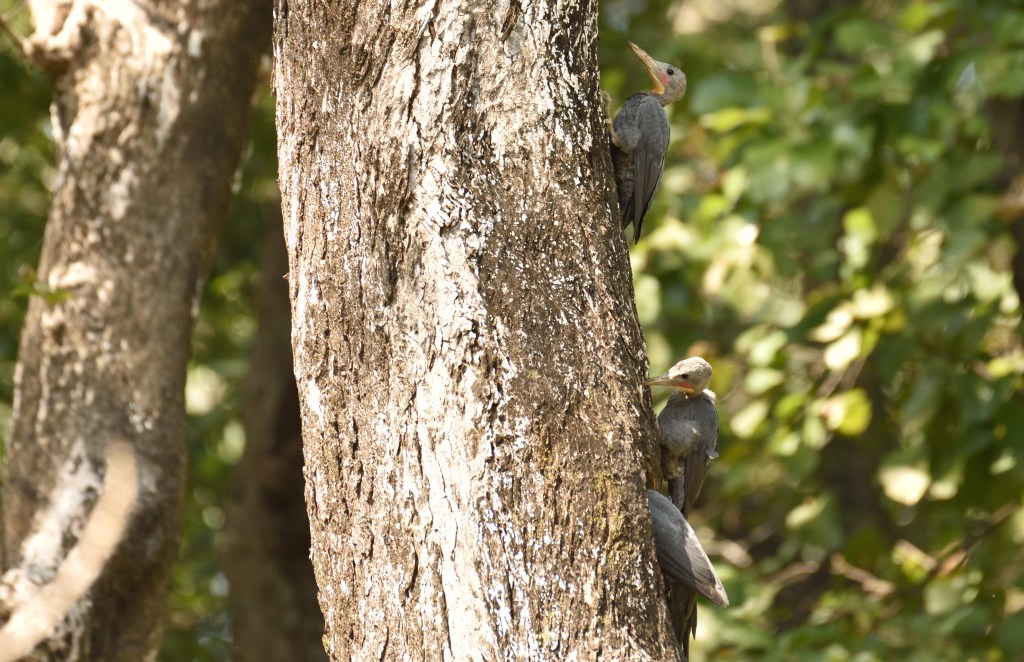
Great slaty woodpecker photo courtesy Sanjay Sondhi
Lalitha Krishnan: Sanjay, thank you so much for speaking with me on the Heart of Conservation podcast. As a naturalist, I’m sure you’ve gone to the Thano forest a zillion times. Could you tell us a little about its biodiversity, the species, or what it is you love about it?
Sanjay Sondhi: So, you know, we’ve been going to Thano on multiple occasions in the last decade and I think close to Dehradun, it’s one of the best bird-watching sites you can have. In fact, in recognition of this, its bird diversity, the 5th Uttarakhand Spring Bird Festival was held from 9th-11th March by the Uttarakhand Forest Dept. and during the festival, we released the Preliminary Checklist of Birds of Thano. At that point in time, the checklist was 175 birds. Of course, this is just a preliminary list because even during the festival, we added another 6 or 7 species. My estimate is that it would have more than 250 species if properly surveyed. It’s incredible.
Lalitha Krishnan: That’s incredible. And there’s so much there than just birds. The forest itself…the trees over there…what species of trees are more common.
Sanjay Sondhi: The forest itself, it’s a lot a broad-leaved forest. There’s a lot of sal over there. It’s a great spot for woodpeckers. I’m sure other people have also mentioned that it’s one of the few locations close to Dehradun where the Great Slaty woodpecker can be sighted.
Lalitha Krishnan: Which is (IUCN) vulnerable, right?
Sanjay Sondhi: Which is IUCN Vulnerable listed. Absolutely. You will not believe it that if you go to Thano, and you stand just in front of the forest rest house, just standing beside the road, you will spot between 30 – 35 species in the forest around. Just standing in one single location. That’s the kind of avian richness the forest has.
You’re right, it’s not just birds. There are butterflies, there’s a lot of other stuff which actually hasn’t been properly documented. The butterflies… has just been opportunistic. We’re out there for a bird walk and whatever butterflies we see we document. But the quality of forest in that area is such that it’s clearly a biodiversity hotspot. And, to be cutting that to build an airport which is not required is just a travesty of justice I think. Somebody said we need fresh air. We don’t need more planes and another airport.
Lalitha Krishnan: Yes, and nobody is talking about the noise pollution that airports create or an international airport would.
Sanjay Sondhi: Correct.
Lalitha Krishnan: But Thano is not a designated hotspot is it?
Sanjay Sondhi: No, I don’t think there’s a formal designation as a hot spot but…There are designated important bird areas…I don’t think it is even designated as an important bird area but solely by the number of species that we see…and not just birds but other things…it’s a very, very rich biodiversity hotspot which is so close to Dehradun and so easily accessible.
Lalitha Krishnan: Right. Sanjay we’ve covered the wildlife, but you also wanted to speak about the people in and around Thano.
Sanjay Sondhi: I said, Thano is such a biodiverse area and if we develop it properly, it has such a great potential for birdwatching, homestays with benefits going to the local community. In fact, Titli Trust-that’s our NGO and Cedar, jointly we are running a nature guide training programme for rural youth which extends from Thano to…………jheel and it’s a 2-year programme where we’re training local youth in that area to become bird guides and nature guides in the hope that it becomes a livelihood opportunity plus they are strongly focused on conservation because if the biodiversity is not there, they won’t earn anything from nature guiding. And the response has been great. There have been lots of people who have joined and the youth is very enthused because they see this as a win-win where they earn from the area’s biodiversity and they also help conserving.
Lalitha Krishnan: And they can stay at home rather than leave the state
Sanjay Sondhi: Absolutely. And the benefit goes to the local community who belong to that area. What could be better than that?
Lalitha Krishnan: Right. Absolute win-win.
Sanjay Sondhi: There’s no better incentive for conservation than livelihoods that they can earn living in or near their home.
Lalitha Krishnan: It’s a great initiative. Thank you for this Sanjay.
( I hope enjoyed episode 21 of the Heart of Conservation podcast. I’m Lalitha Krishnan. You can read the show notes on my blog: Earthy matters. If you want to know more about the Thano movement, or about the work my guests do there’s lots of information on the net. You can also hear my podcast on Spotify, Apple podcast, or other platforms of your choice. Till next time, stay safe and keep listening.)







 Earthy Matters