Apples, Bees and Sparrows in a High Altitude Desert


P1280546

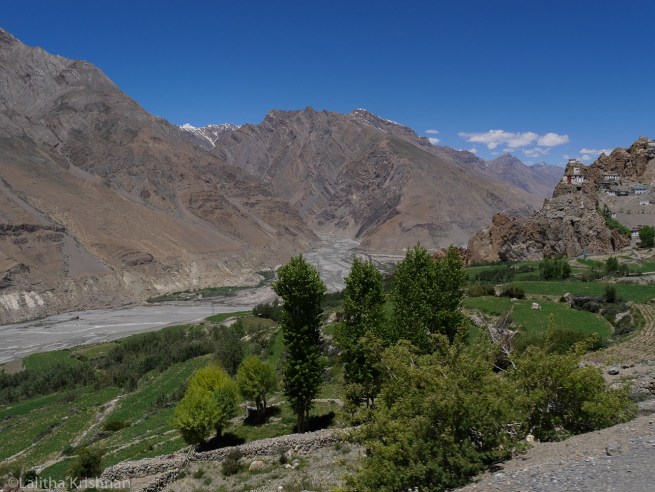
Spiti-the land that literally means the “The Middle Land”, – the land that divides Tibet and India, is part of the Lahaul-Spiti district in Himachal Pradesh, India. It’s one of my favourite places for various reasons. The culture is fascinating. The barren mountain-scapes are out of this world. Rivers and glacial melts feed the region; it’s snowbound for part of the year and hard to get to. Of course, that means it’s also barely populated.

P1280519

P1280424

The state of Himachal Pradesh is a prominent fruit producing state. Apples, cherries, plums, and peaches from here are found in corner stores all over India. The Spiti valley on the other hand technically falls in the rain shadow. The south-west monsoons that hit the rest of India for three full months scarcely reach the Spiti valley. And yet they’re growing apples. And they’re keeping bees to pollinate their orchards. Sparrows, that are have more or less disappeared from our cities seem to have settled in these orchards and are feasting on apples that are just beginning to appear on the trees. It’s amazing. Is this improved irrigation practices or climate change? I’ll have to go back to answer that.

P1280411

Not so Pleasant Pheasants in my Garden

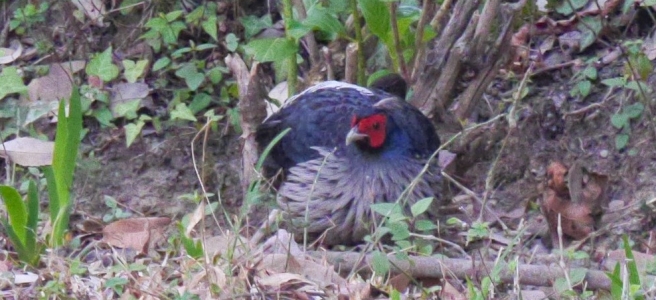
Khaleej Pheasant


I was lingering over my morning brew of South Indian coffee in Ranikhet [29.6434° N, 79.4322° E] when I spotted one of my favourite Himalayan pheasants pecking away below the dangling wisteria. The Khaleej is a common sight on the hillside,  it is categorized with a conservation status of ‘LC’ [Least Concern] by the International Union for Conservation of Nature (IUCN). That means there’s a healthy population of Khaleej pheasants around and you’re very likely to spot them if you’re in the Himalayan foothills.

Common not ordinary

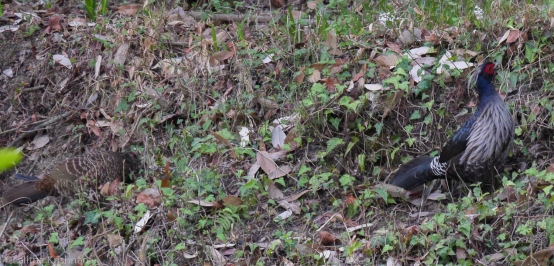
I find the Khaleej nothing less than dramatic. If you haven’t seen a Khaleej rooster up close, think of a dandy draped in iridescent blue-grey-black, donning a swanky brush-stroked neckpiece, delicate scalloped patterns on his coattail; hiding behind a bloodred masquerade mask. It’s quite the show stopper. The all brown hen with white-edged feather patterns doesn’t look so dull on her own. But put alongside her male counterpart and her chances are bleak. In the breeding season which is right about now, things get interesting.

The Khaleej [pheasant female]
You barely notice the female Khaleej
Plain Jane on the left


Coming back to my tale of two pheasants, our solo traveller cocked up his head; I too heard the clucking that got him into an instant splayed-crest mode. Then I heard an urgent onslaught of clucks and saw a rapid blur of pheasants clash behind the screen of yellow banksia. I missed all the action. The impact of the chest a/g chest or whatever that encounter was, made them recoil violently. They both kept at that raucous clucking but didn’t engage again. I noticed the hen leave the scene in a hurry. Romeo clucked himself downhill reluctantly. I spied on the pheasants for two more days to see if he would brave the competition again but he was a picture of foraging-innocence. The hen had chosen her rooster and stood her ground. The very red-wattled one who succeeded in thwarting her 2nd suitor was strutting around like a puff fish. How I just love watching wild performances over coffee.

You can watch it on my youtube channel:http://bit.ly/KhaleejFaceOff

Watch the split second faceoff:


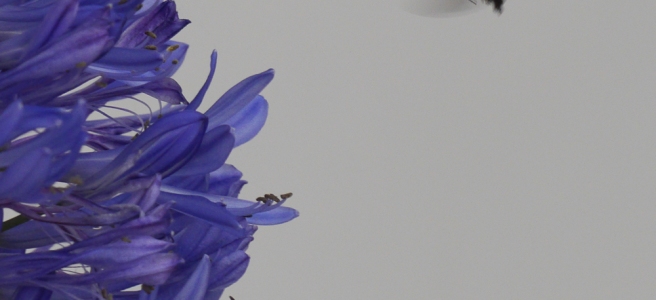
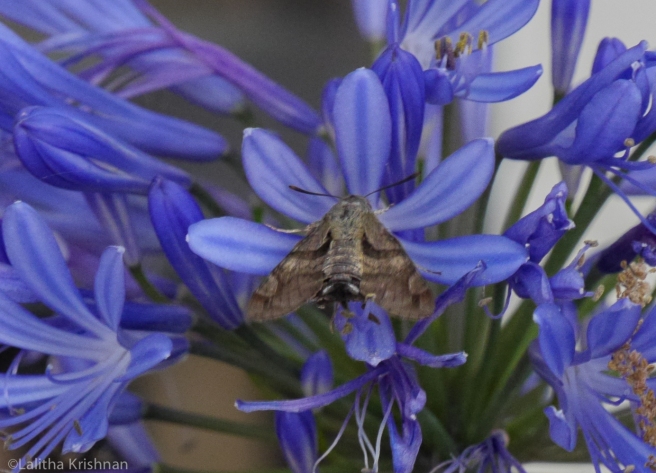
To be or not to bee. The bee-moth or hummingbird-hawk moth is back.

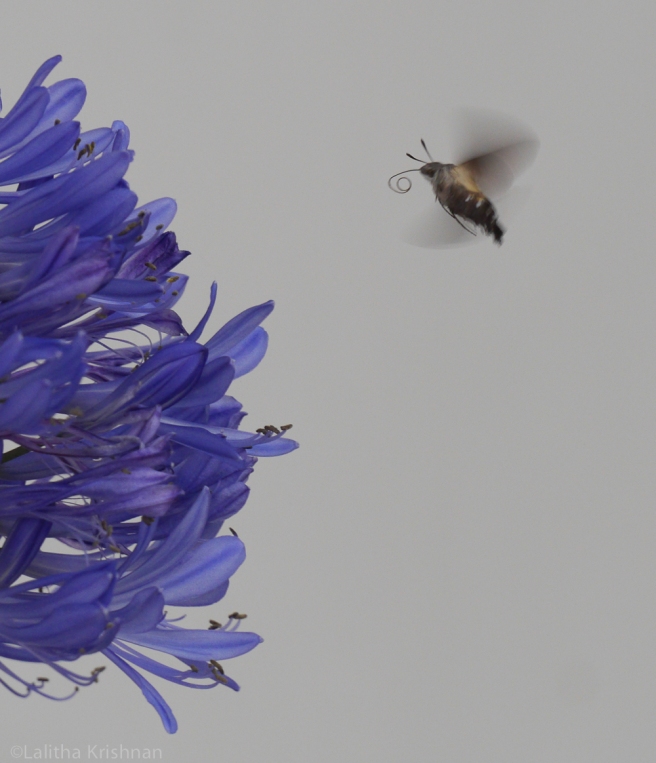
The proboscis of the hawk moth is curled under its chin in flight.

What’s growing in your garden?

The bee moth, also known as the hummingbird hawk moth is here again. I look forward to its annual dusk time visits. I have to be quick with my camera for this moth never lingers for too long.  It clearly favors the colour purple: African lilies [Agapanthus] and verbena [Verbena bonariensis] and larkspur [Delphinium]  -which is toxic to us. I have seen them sip up the nectar of pink zinnias and cosmos, so perhaps they are a bit partial to these flowers. To be honest, this hawkmoth does look hover like a hummingbird and hum like a bee.

Agapanthus, verbena and cosmos attract hawk moths.
Agapanthus, verbena, zinnias, larkspur, and cosmos attract hawk moths.
The hawk moth looks dull when sipping.
The hawk moth looks dull when sipping/at rest.
The proboscis of the hawk moth is curled under its chin in flight.
The long proboscis of the hawk moth is curled under its chin in flight.
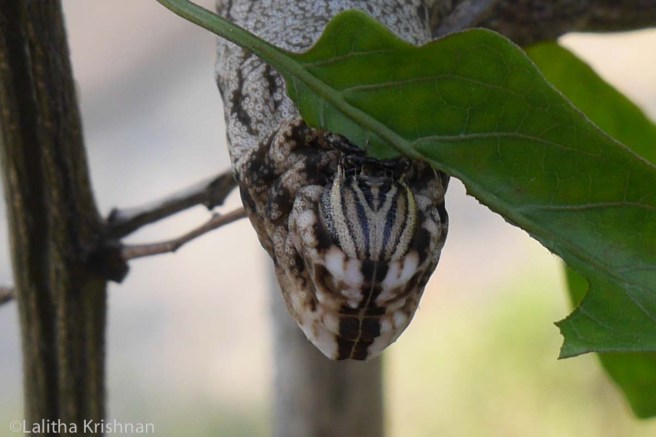
The mouth of an Himalayan caterpillar up close with cobra-like markings
The mouth of a caterpillar up close with cobra-like markings
Caterpillar hanging upside down whilst feeding on a leaf
Caterpillar hanging on un-delicately whilst feeding on a potato creeper.  Note the tail.

Watch the hawk moth:

Watch the hawk moth caterpillar on my YouTube channel. 

My friend and India’s leading lepidopterist, Peter Smetacek calls butterflies and moths bio-indicator species. Read about him: https://www.woodstockschool.in/hovers-like-a-hummingbird-looks-like-a-bee/


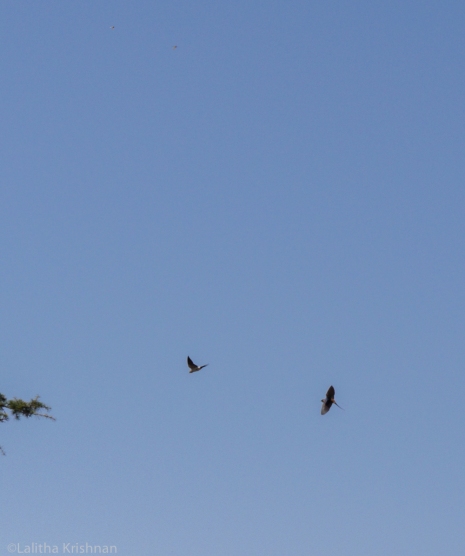
A Flight of Barn Swallows

Hirundo rustica revisits Landour at 7000 ft

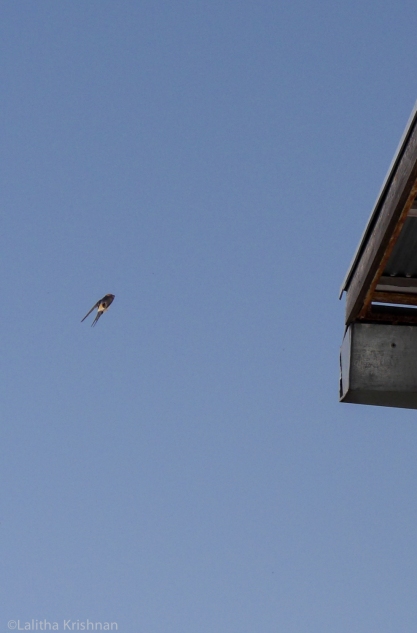
Migratory Barn swallows in Landour . Lalitha Krishnan Photos

Like summer visitors on the hillside, barn swallows descended on me in troves, unannounced, one fine morning. Then as swiftly (pardon the pun), they shot up, flew past a corner, looped around a tree or two, took a nose dive, twisted and turned and swung by again fleetingly. I stood rooted to my spot for a good few minutes, hypnotized by their acrobatics in the sky. What an air show…and a pain in the neck.

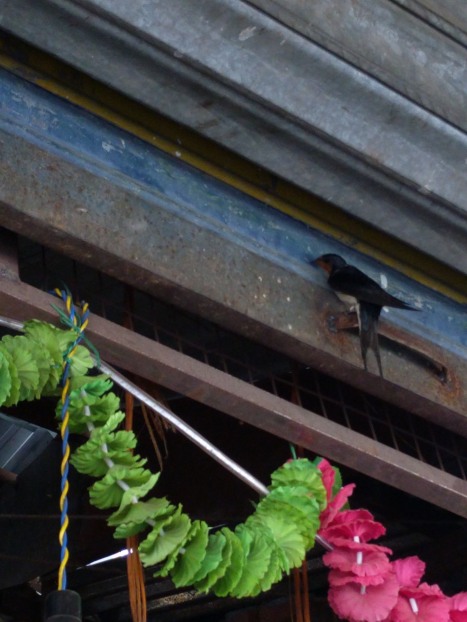
I noticed the swallows didn’t stay together like, say, white-throated laughing thrushes do, instead, they did their own thing, taking random flight paths “tweet-tweeting” without seeming to take a break.  Almost like they had left their kids at home alone and needed to get back soon. It is the breeding season. Landour town shops already have swallow-nesting inside.

P1260089-2

If there was a pattern to the swallows’ flight, I didn’t get it. It was impossible to stay focused on one bird continuously, let alone a flock. What I was watching was, in fact, nothing but a feeding frenzy. Summer bugs are out as well and the dives and swoops were directed by where the bugs were.  Swallows catch them in mid-flight making a competitive reality TV game show look like child play. Not to be left behind,  I zipped in and out with a camera and started randomly taking shots of swallows. 50+ blurs-in-the-sky has been promptly deposited in the trash. The rest I’m sharing with you.

P1260100-2

Migratory Barn swallows in Landour . Lalitha Krishnan Photos

P1260112-2

P1260124-2

P1260101-2


Spot the bug
Spot the bug

P1260116-2

P1260154-2

A summer visitor - swallows in Landour
A summer visitor – swallows in Landour

Read more about Swallows, Swifts via eden.uktv: https://eden.uktv.co.uk/animals/birds/article/swifts-and-swallows/

via BBC Nature: http://www.bbc.co.uk/nature/22527420

Of Dogs and Nests.

P1250687                 View from Jaberkeht Nature Reserve, Mussoorie, Uttarakhand, India

My mountain dog, Chingoo, sheds like there is no tomorrow. His fur coats everything I own, borrow or dream of. If I needed an autopsy, they’d probably find traces of it in my stomach lining as well. Not that I care.

On the other hand, fur on my jacket seems to get some folks into a tizzy. These ‘uncontrollables’ start brushing it off without so much as pausing to ask. Hello, take your hand off my… This is me, fur et al. Restrain yourself. Shed the thought or face the consequences, I think to myself. But of course, I say the very opposite looking as obliged as someone rescued from a terrible wardrobe malfunction just in the nick of time.

Guests are pre-warned of unique conditions in my home. It’s not about so much about being unafraid of dogs as of being prepared. My dog is allergic to some people I tell them. Honestly, he sneezes. (I don’t tell them we share the same allergies.) Don’t pack blacks I say. And don’t bother to remove your shoes. Oh definitely don’t walk in socks…you’re in the doghouse now. Every time I sweep the house (I don’t vacuum), Chingoo’s fur takes on a life of its own. It swirls into individual fur devils taking flight routes of their own making. Not even our large hills spiders are spared. I often see them donning a fur-cloak as they drag themselves to safety behind the flush tank.

Unlike anything I’ve seen, Chingoo’s fur seems to have a survival instinct. It has gone forth and seems to have multiplied over the years. You only have to step onto my porch. My entire ecosystem has paled out. The deodars, the oaks the little weeds that are surfacing the hard earth, the little bugs that are on these weeds and even dung left behind by roaming cows have been consecrated by the travelling Furburys.


This slideshow requires JavaScript.

Not all has gone to waste. Once in a while I see little creatures of the wood pick and collect Chingoo’s fur to line their nests. They go at it all day long collecting as much fluff as their beaks can hold before flying out to their new home-in-the-making. I love the idea of comfy fur-lined nests. It feels like giving back…through your dog. More so, if you own a down-jacket or two. I’m just saying.


Know your Bycatch before your Bitcoin. And take a good look at your toothpaste.

Lost at sea? Here are ready-mined terms and facts that are easier to comprehend. They might be hard to swallow but follow these leads in the right spirit and we could possibly see some tangible long-term yields across the globe.

cormorant

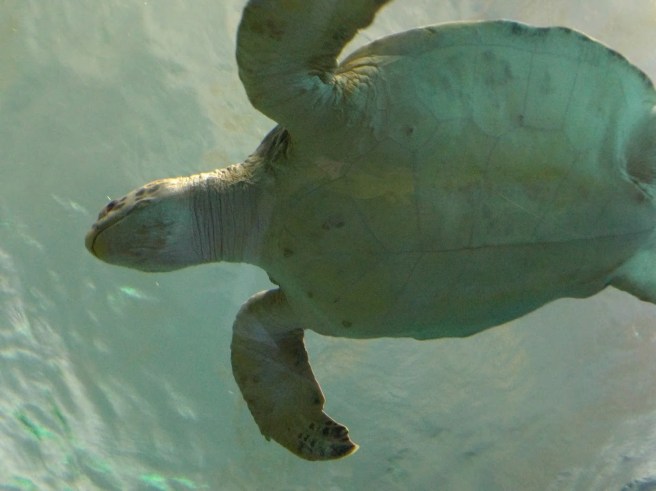
Did you know that for every kg of prawn you eat this holiday season approx 6-9 kilos, [sometimes more] other fish and marine species would die in trawler nets? The extra, unintentionally fished marine life called bycatch is discarded dead or dying. Often, these are juvenile species that don’t fetch a price but they definitely pay a huge sum themselves in terms of never reaching maturity or reproducing, thereby reducing their total species population.
turtle

Jan 2016-3

OK, so you’re a vegan. But you use plastic.

Get a taste of this. Scientists predict by 2025 the ocean will contain 1 ton of plastic for every 3 tons of fish. Plastics disintegrate very slowly into microplastics (sesame seed sized plastic bits) that move in the ocean, absorb DDT and collect in the currents. The fish, birds and turtles mistake these microplastics for food and bigger fish eat smaller ones. Their bodies can’t rid of the toxins fast enough and it ends quite tragically. This is called Bioaccumulation. It takes place within an organism when the rate of intake of a substance (in this case toxic chemicals) is greater than the rate of excretion or metabolic transformation of that substance.

IMG_20170109_150739

So what does your exfoliating face wash have anything to do with the price of fish?

Your favoured brand stands out in a shop shelf because it probably contains colourful microbeads (a type of microplastic) or tiny plastic pellets generously added to personal care, cosmetic and household cleaning products like your body scrubs, washing powders. And toothpaste. Teeth feel squeaky clean?birds on dead tree trunksYou’re a regular at the sea-front promenade. Ever wonder about the mangroves it replaced? Or why storms batter your city annually?

Mangroves reduce wind and high waves as they pass through mangroves, lessening damage during storms. Wide areas of mangroves have been known to reduce tsunami heights. Mangroves are carbon-rich habitats. Their dense roots build up soils, increasing soil thickness that may be crucial as sea levels rise. Mangroves and seagrasses capture carbon monoxide from the atmosphere a hundred times faster than terrestrial forests. Take a deep breath.IMG_20160715_171123
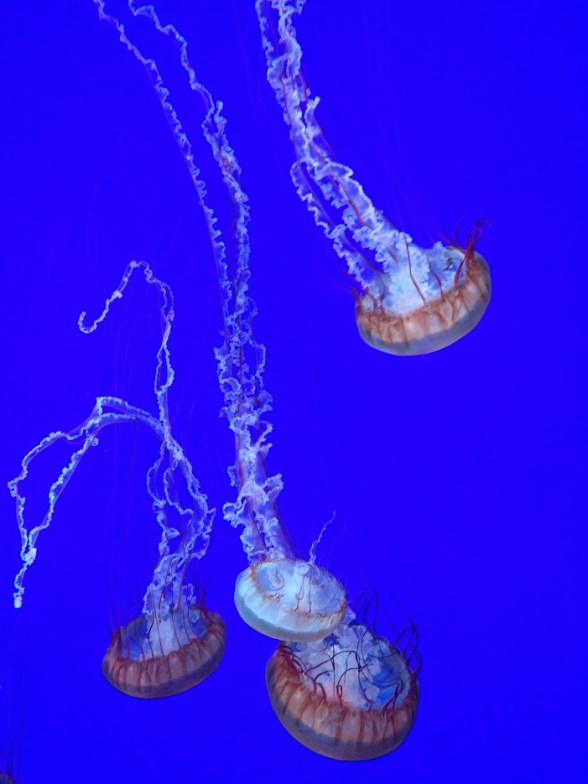
It seems appropriate to talk of human-induced Marine Death zones now. 

These are hypoxic (low-oxygen) areas in the world’s oceans and large lakes, caused by “excessive nutrient pollution from human activities”. Chemical runoff from our industrial waste, fertilizers and use of fossil fuel to our daily floor cleaners find their way into our rivers and oceans killing massive swathes of fish and marine species. There are 405 identified dead zones worldwide.

IMG_20170108_133459

Planning a long cruise?

I read that a one-week voyage on a cruise ship with 2, 200 passengers and 800 crewmembers generates 210,000 gallons of sewage and eight tons of garbage. Marine pollution analysts in Germany and Brussels say that such a large ship would probably burn at least 150 tones’ of fuel a day, and emit more sulphur than several million cars, more NO2 (nitrogen dioxide) gas than all the traffic passing through a medium-sized town.

Do take the kids [our future stakeholders] to see a coral reef a.s.a.p. #investintheenvironment

Be positive. Stay healthy. Be conscious. Happy holidays.

PS: And oh here’s some further reading for the beach.

Some sources and references via:
https://www.theguardian.com/environment/2016/may/21/the-worlds-largest-cruise-ship-and-its-supersized-pollution-problem

https://www.1millionwomen.com.au/blog/how-do-i-tell-if-product-contains-microbeads/

https://www.marineconservation.org.au/pages/microplastics.html

https://www.treehugger.com/green-food/6-shocking-facts-about-seafood-production.html

https://www.huffingtonpost.com/entry/oceans-plastic-fish-2050_us_569e9963e4b00f3e986327a0

https://en.wikipedia.org/wiki/Fishing_down_the_food_web

http://www.thehindu.com/todays-paper/tp-national/Huge-‘dead-zone’-discovered-in-Bay-of-Bengal/article16908928.ece

https://www.nature.org/media/oceansandcoasts/mangroves-for-coastal-defence.pdf

Photo credit: Lalitha Krishnan. All photos are copyrighted.


Jan 2016-22